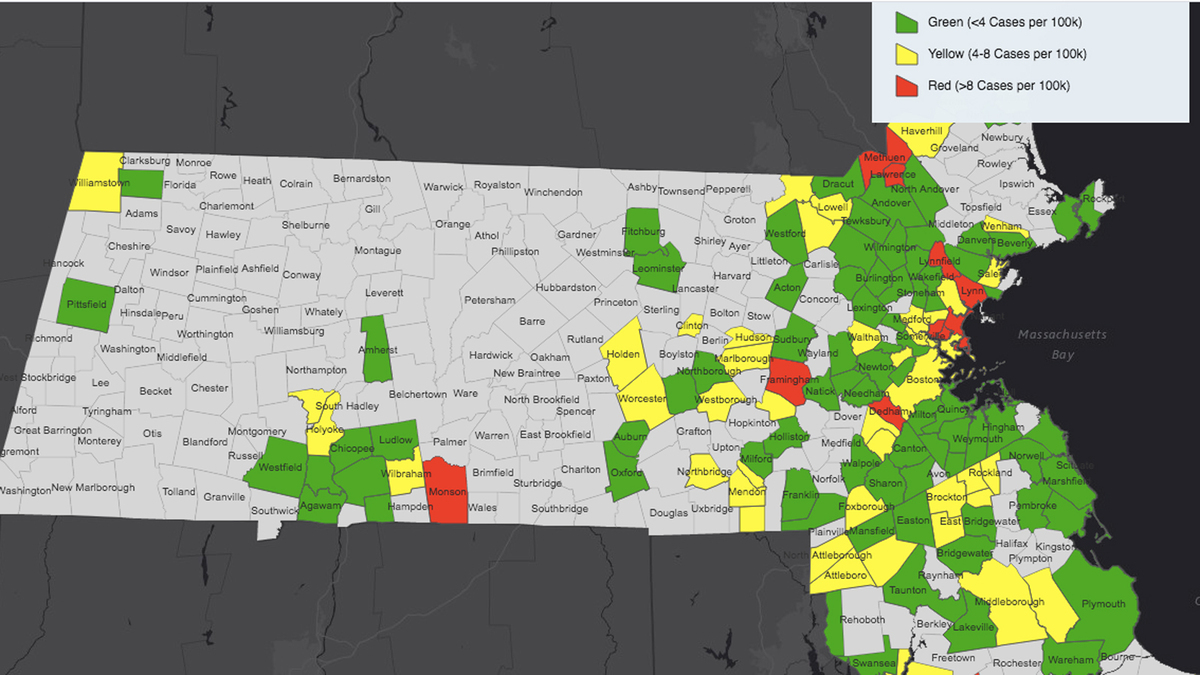
WILLIAMSTOWN, Mass. — The town's health inspector said Thursday he has no idea why the commonwealth's COVID-19 Community Level map is showing Williamstown as the lone "yellow" community in Berkshire County.
"I don't know where those numbers are coming from," Jeff Kennedy said. "I'm checking my computer. I'm checking the communicable disease database. I talked with my public health nurse.
"We only have, basically, one positive [COVID-19 test] in town right now, and that's the one you know about at Williams that's under isolation."
Late Wednesday, the state Department of Public Health posted its latest weekly map categorizing all 351 Massachusetts municipalities as "higher risk (red), moderate risk (yellow), or lower risk (green)" for the current rate of spread of the novel coronavirus.
According to the map, Williamstown has had five cases in the last two weeks and an average daily incidence rate per 100,000 people of 4.85.
It is one of four communities in Western Massachusetts designated as yellow, joining Easthampton, Holyoke and Wilbraham on that list. Monson is the lone town in the region listed in the red, with an incidence rate per 100,000 of 8.47, according to the commonwealth.
Williamstown's Kennedy was at a loss to explain how the town of 7,700 moved from grey (fewer than five reported cases) to yellow (4 to 8 cases per 100,000) in the period from Sept. 2 to Sept. 9.
"It's one of the glitches in the system," he said. "I wasn't aware of it until I got a couple of emails coming in, including one from Win Stuebner."
Stuebner, a member of the town's Board of Health, said Thursday morning he was not aware of the town's designation as yellow until after he received a phone call from iBerkshires.com seeking comment.
"Of course, we knew we had the two at the college," Stuebner said.
Williams College maintains a public "dashboard" of test results from the testing program it stood up on Aug. 17. It currently shows two positives since Aug. 17 out of 7,427 tests; one positive was in the last seven days.
"The first case at Williams, there were no exposures [in town]," Stuebner said. "He or she was dropped off by their parents and went right to the testing area. The second one at Williams came by bus. Ten other students are currently quarantined as well as the driver. But no cases I'm aware of have popped up from that."
Kennedy speculated it was possible that Williamstown is being "credited" with a diagnosis that happened outside of town of someone, like a student, who lists the North Berkshire community as their hometown.
He said he would ask the town's designated public health nurse to contact DPH to find out why the map designation does not match the numbers on the ground.
Kennedy said he has notified officials at the Mount Greylock Regional School District, which has triggers in its reopening plan based on the town's status under the green/yellow/red designations, that the designation as yellow appears to be without basis.
"I don't know how we got yellow," Kennedy said. "Maybe someone got overambitious with a highlighter."
If you would like to contribute information on this article, contact us at info@iberkshires.com.
Your Comments
iBerkshires.com welcomes critical, respectful dialogue. Name-calling, personal attacks, libel, slander or foul language is not allowed. All comments are reviewed before posting and will be deleted or edited as necessary.
this shows 4-8 per 100,000. Since Williamstown only has a population of 7,000. Even one case would exceed the standard, duh! In fact one case = 14 per 100,000 residents.
100,000 divided by 7,000 = 14.3
If population = 9,000, 100,000 divided by 9,000 equals 11.1 per one case.
In response to the above comment: I thought the same, until I read through the interactive map linked in the story. They are defining the x cases per 100,000 population *daily average* over a 14-day period (Aug. 23 - Sept. 5).
So the math would be: 5 cases (supposedly) in 14 days = 5/14 = .357 per 7700 population or 4.63 percent per 100,000 population.
It does seem like a very convoluted way of presenting the data.
And by the way the map is extremely inaccurate in showing actual rates of risk from town to town. The "less than 5 cases" cutoff is completely arbitrary. Consider if the town of Florida (pop. 752), 1/10th the population of Williamstown, had 4 cases in the past 14 days. They would be grey. Yet their per capita daily cases rate would be 4/14 = .286 / 752 = 38.0 cases per 100,000, nearly 9 times higher than Williamstown's.
The facts for Williamstown are that during that two-week period there has been probably the largest influx of people and the most robust testing per capita anywhere in the county, yet with an incredibly low infection rate. We should be thrilled with those numbers.
Why iBerkshires found it necessary to be all gotcha with town officials over a color on a map is maybe the real question in this nonstory.
Many of these events will continue to take place at local senior centers, making it convenient for older residents to access personalized assistance. Attendees at any location will have direct access to National Grid Customer Service Specialists, who can provide personalized guidance on payment options and energy solutions to meet each household's needs.
"As December begins, customers still have opportunities to find support and manage energy costs," said Bill Malee, chief customer officer, National Grid. "We're proud to host many of these events at local senior centers, ensuring customers have easy access to the support they need. Our in-person events are a great way for customers to connect with our team, learn about flexible payment options, and discover energy-saving programs that can help make a real difference this season."
Customers attending in-person events will have the opportunity to meet with representatives from National Grid, who will be on-site to assist with billing issues and provide information on:
Enrolling in National Grid's new Payment Assistance Bundle
Enrolling in Budget Billing
Enrolling in the Energy Discount Rate (for qualifying customers)
Scheduling home energy assessments and sharing information on other energy efficiency opportunities for homes or businesses
These events are part of National Grid's broader commitment to affordability and reliability. Customers can also access support by calling 1-800-233-5325.
National Grid customers can now sign up for a new Payment Assistance Bundle. The bundle combines three solutions to make it easier for managing energy costs and paying down past due amounts over a 12-month period.
Deferred Payment Agreement: Spread out past-due balance into future monthly payments.
Automatic Monthly Payments: Automatically deduct payments from your bank account each month and avoid missing due dates.
Budget Plan: Break down annual energy costs into balanced monthly payments, making it easier to budget and plan expenses.
Customers interested in enrolling in the Payment Assistance Bundle can do so online by visiting ngrid.com/hereforyou, at an in-person event, or by calling 1-800-233-5325.
From couture to canines and from crochet to carols, Williamstown Holiday Walk has you covered if you want to get into the spirit of the season this weekend. click for more
The Williamstown Chamber of Commerce reflected on this past year's success and the launch of a new coupon sales promotion at its annual meeting last week at Greylock Works.
click for more
Our Friday Front Porch is a weekly feature spotlighting attractive homes for sale in Berkshire County. This week, we are showcasing 1030 Simonds Road.
click for more