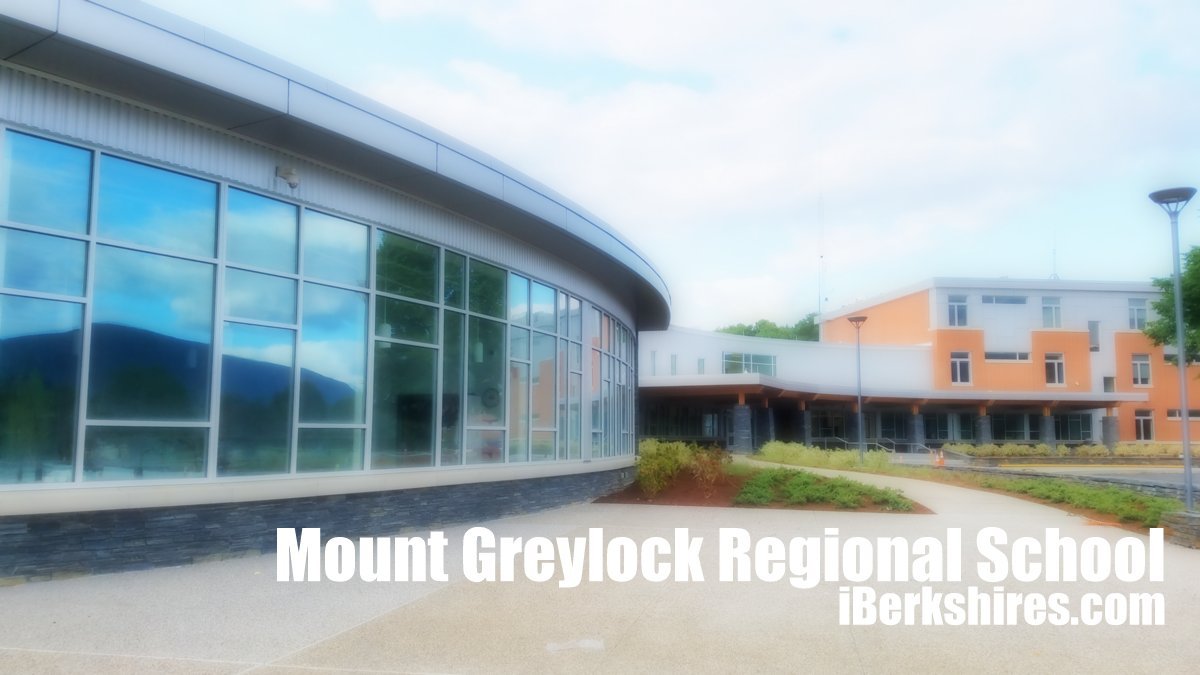
Mount Greylock School Committee Passes Modified Agreement with Union
WILLIAMSTOWN, Mass. — The Mount Greylock Regional School Committee on Tuesday night approved a number of modifications to the memorandum of agreement with the district's union about procedures related to the COVID-19 pandemic.
By a vote of 5-2, the committee OKed changes that include the structure an "remote academy" for elementary school pupils, the metrics that will be used for switches between remote and in-person instruction and safety precautions that will be in place during the school day when the district moves to a hybrid model of in-person and remote instruction on Oct. 5.
School officials had to rethink the remote academy idea for families choosing to keep their children at home throughout the pandemic after learning this month that fewer families were picking the remote model than previously anticipated.
Instead of having a single teacher for each grade in the remote academy, the district will assign one teacher to lead the remote cohort in Grades 1 and 2, one to teach Grades 3 and 4 and one to teach Grades 5 and 6. A single teacher also will teach the kindergarten remote cohort and have another assignment not specified in the three-page agreement approved on Tuesday.
To compensate the four teachers in the remote academy for their additional workload, each will receive a stipend of $5,000 over and above their contracted salary.
The updated MOA also clarifies that all teachers in the district's three schools — Lanesborough Elementary, Williamstown Elementary and Mount Greylock middle/high school — will be allowed to work from home on the "remote Wednesdays" that are part of the plan for hybrid instruction.
The MOA specifies that the district will move to fully remote instructions under the following scenarios: direction from the U.S. Centers for Disease Control and Prevention, direction from the Massachusetts Department of Public Health, direction from the member towns’ health agents, a 3 percent or greater COVID-19 positive test rate in the county, a 3 percent or greater test rate in "the combined member towns" of Lanesborough and Williamstown or a rating of either Lanesborough or Williamstown as "Yellow or Red" on the commonwealth's map for three consecutive weeks.
If the schools go remote because of a ranking of yellow or red for three consecutive weeks, they will return to hybrid or in-person instruction if both member towns are rated green or gray for three consecutive weeks, according to the MOA.
The last point, the use of the commonwealth's gray-green-yellow-red matrix, drew criticism from one member of the School Committee.
After the panel met in executive session for an hour and a half to review the MOA that was negotiated with the Mount Greylock Educators Association, the committee returned to open session to hold its vote.
Steven Miller attempted to modify the MOA, making a motion for an amendment that died for want of a second.
"As we've just seen, the state metrics do not always work well for small-sized populations," Miller said, perhaps referring to last week's apparent discrepancy between the state's and town's numbers in Williamstown. "This is why the state has already adjusted its metric once.
"I'm a little concerned about putting this in the agreement that we automatically go remote with three weeks of yellow. I think it would be better to say instead we go to remote if it's three weeks of red, and if it's yellow for three weeks, we do what the state says, which is take into account the local conditions and make a determination of whether we should be remote or hybrid."
Carolyn Greene said she understood Miller's point but noted that the agreement as drafted and presented to the committee was worked out over weeks of negotiation.
"While your point is well taken about this being an abundance of caution, there is a lot of nervousness and anxiety around getting back to school," Greene said. "It is in all of our best interests at this point to be overly cautious, given that we now know that we have COVID in our community. It was bound to happen, and it will continue happening. We need to be safe, and we need to be cautious, and we will continue to get kids into the schools as much as we can.
"This is really the best we're going to do. It's a good agreement, and we need to go with it. School starts tomorrow. Any amendments now that we know are not approved by MGEA will potentially delay the start of school."
Unlike most students around the county, students in the Mount Greylock district began classes on Wednesday, a result of pre-existing contractual agreements that did not allow the start of a 10-day professional development period to begin until Sept. 1.
Miller was joined by Regina DiLego in voting against the memorandum of agreement. The same two voted in the minority of a 4-2 vote to approve an initial MOA on Sept. 1.
Unlike Miller, DiLego on Tuesday did not express any of her objections to the agreement in open session.
The revised MOA specifies six safety precautions for the schools' day-to-day operations; three relate to the operation of the schools' HVAC systems.
Clause E(iii) of the agreement states that the district will work toward two air exchanges per hour and ultraviolet light treatment of air in all three of its buildings. Subsequent clauses say that teachers working in rooms with fewer than two air exchanges per hour will be issued five KN95 facemasks and that those rooms will have portable air purifier units.
Three of the safety precautions in the agreement relate to food.
Staff covering lunch duty — when students will not be wearing face coverings — will be issued KN95 masks. Pupils at the elementary schools will not have snack during the morning or afternoon sessions of in-person instruction, and students at the middle/high school will not have lunches in their classrooms as previously discussed.
Just before the School Committee adjourned, Miller said that despite the split decision from the panel on the MOA, the agreement has the full committee's support.
"As is the tradition of the School Committee, we can disagree, but we do so civilly, and once a decision is made, we all support the decision of the School Committee," Miller said. "I'm happy to write the state and talk to them about how to have the right metrics. I'll leave it at that."
Tags: COVID-19, MGRSD, school reopening,
More Coronavirus Updates