Williamstown Names Interim Police Chief; Process Sparks Committee Member's Resignation
WILLIAMSTOWN, Mass. — The interim town manager Monday announced that Lt. Mike Ziemba will serve as the town's interim police chief.
Ziemba, who has been serving as acting chief since the departure of Kyle Johnson in December, was vetted by a committee of concerned citizens created by the Select Board to advise the town manager, who has hiring authority under the town's charter.
That committee's role was called into question on Monday when one of the residents appointed to serve announced on Facebook that she was resigning over concerns with the process that led to Ziemba's appointment.
While making it clear that she had no objection to Ziemba's elevation to the position, Aruna D'Souza charged that Blanchard "overruled" the advisory committee by not appointing its preferred candidate.
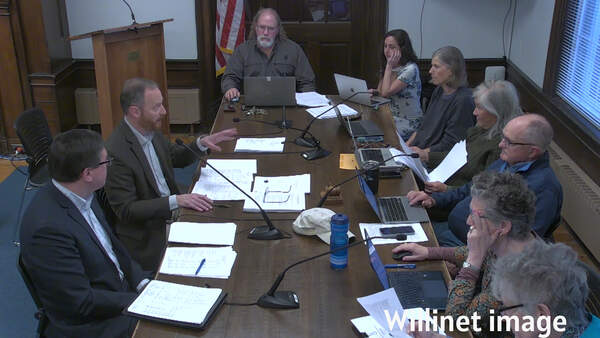
But Select Board member Anne O'Connor, who participated in the advisory committee discussions but was not a voting member, and another member of that committee had a different take on how the panel's final days have unfolded.
"The committee met on Friday, and as a result of that meeting, they had two candidates they brought forward for final selection," O'Connor said prior to Blanchard's announcement. "That was the purpose of the committee as defined in its charger, to recommend one to two candidates to the hiring authority."
But D'Souza, both in her social media post and again during the virtual Select Board meeting, maintained that the former town manager led the committee to believe he would abide by whatever decision the committee made. And she questioned the transparency of the process, characterizing it as a waste of the considerable time spent developing a job description, vetting candidates, interviewing finalists and deliberation.
"Today I resigned my role on the Interim Police Chief Search Committee, not because of my opposition to the candidate who was announced this evening but because of my deep disappointment in the way in which the former town manager, the interim town manager and the select board member who took on the role of facilitator of the committee bypassed the process laid down in writing by Jason Hoch without any attempt to realign the process to address changes to the process," D'Souza told the Select Board.
"What has happened is the interim town manager chose against the express written communication of the previous town manager and the procedure we all as members of the committee were told we were operating under. He chose to bypass the committee when there was no need to."
D'Souza said the advisory committee asked Blanchard to address the panel Friday and give his opinions on the finalists before the committee voted, but he chose not to do so. She indicated she believed if he had, enough committee members may have been swayed to pick his favored candidate.
"We had two excellent finalists," D'Souza said. "We had one appointee I'm sure will be excellent in his job. But what it does say is the facade of having community input into very important hiring decisions to our town ... are merely facades. If the town manager can unilaterally overrule the vote of these committees, I want to know what the point of the committees is."
Blanchard said he noted, when he was interviewing for the interim town manager position, that it would be at odds with the town charter to give hiring authority to such a committee. He said he was assured at the time that the advisory committee was just that, advisory.
He also pointed out that if the advisory committee did have the final say, its whole process — which included no open meetings or public release of minutes — would have run afoul of the commonwealth's Open Meeting Law.
"That committee was set up not as a public body," Blanchard said. "If that had been a search committee making recommendations to somebody who didn't have final authority, such as a town administrator that had to get approval from a Board of Selectmen, then all deliberations would have been in an open meeting … and finalists discussed in open session and recommendations made.
"In this case, the exception to the Open Meeting Law is simply to allow a committee like this, where their sole responsibility is to advise the sole appointing authority."
As the Attorney General puts it in her guide to the Open Meeting Law, "Bodies appointed by a public official solely for the purpose of advising the official on a decision that individual could make alone are not public bodies subject to the Open Meeting Law." In other words, the Interim Police Chief Search Committee was not a public body under the OML's definition because the town manager, under Williamstown's charter, makes the hiring decision.
D'Souza said she asked Hoch at the committee's first meeting what weight the committee's decision would be given.
"I said if it's just a recommendation, I won't want to be on this committee," she said. "I said this not to be churlish but because I have a limited amount of time and I have priorities on how I spend that time in service to my community. I already serve on a committee [the DIRE Committee] that is treated by the Select Board as if it is a body the Select Board doesn't have to listen to.
"At that meeting and in subsequent emails, Jason [Hoch] made it very clear the intention was the town manager would take the recommendation of the committee and execute it."
Later in Monday night's meeting, one of D'Souza's colleagues on the interim police chief panel said he felt the process went well.
"We talked and came to a consensus … that we emerged with a couple of leading candidates we'd be comfortable with," Jay Merselis told the Select Board. "At the end of the meeting today, it was clear [Blanchard] was going in a slightly different direction than we were. He clearly watched the recordings of our process. I think he gave the committee due voice."
"Speaking for myself, I'm not at all disappointed in the way things unfolded. For my part, I was clear who the ultimate hiring authority was."
Given the fact that the committee was not a public body, the public and press could not access its meetings. Unless and until it decides to release minutes of Friday's proceedings, the nature of the vote or votes taken is not clear. None of the participants who spoke on Monday night volunteered the language of motions that were voted in the closed-door session.
Tags: interim appointment, police chief,