image description
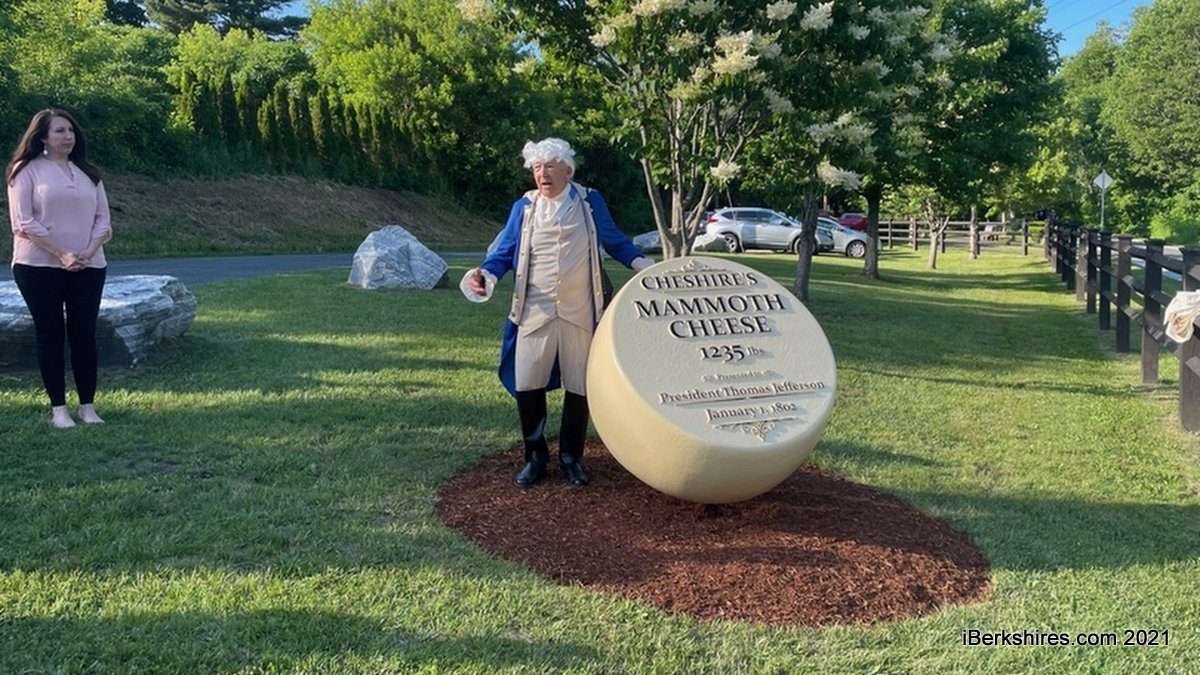
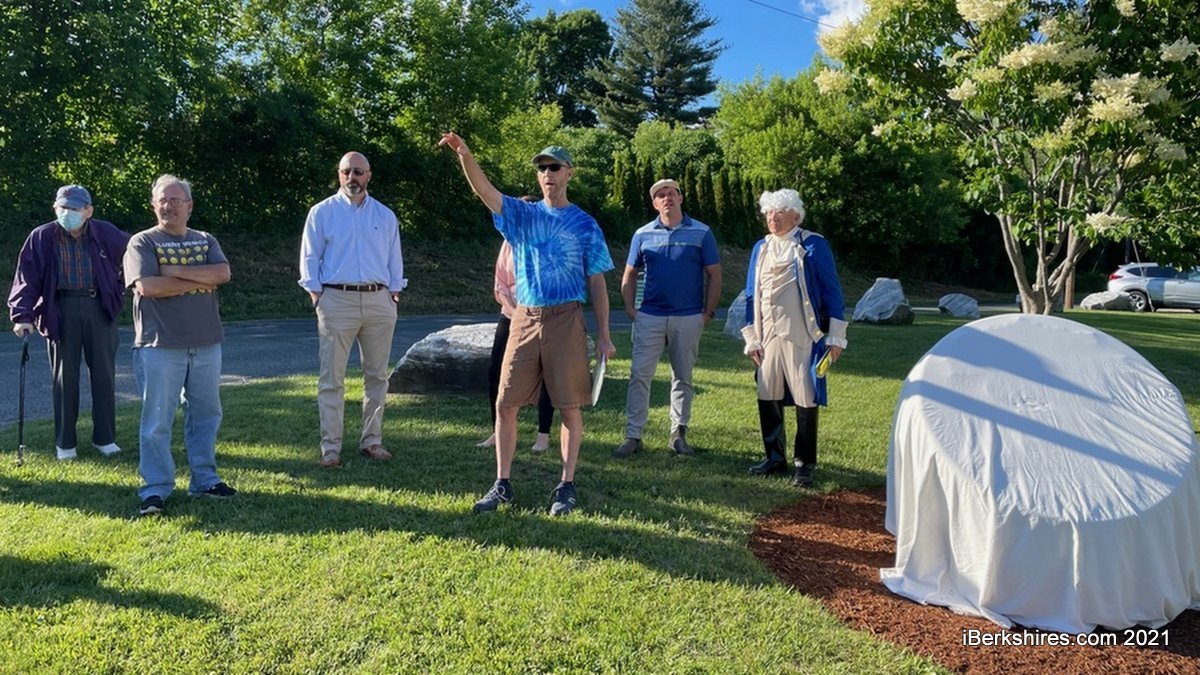
Local historian Barry Emery, dressed as Thomas Jefferson, holds forth about the history of the half-ton cheese that was presented to the president in 1802.
image description
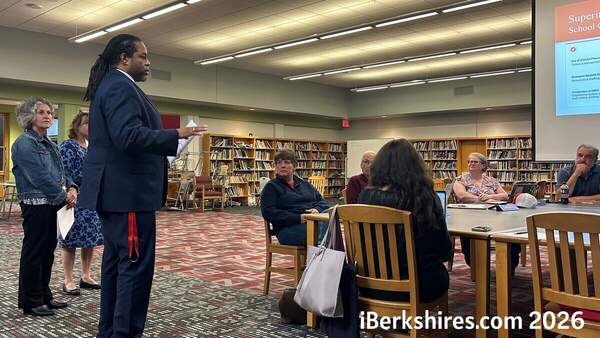
John Tremblay speaks about the cheese wheel project before it was unveiled.
image description
image description
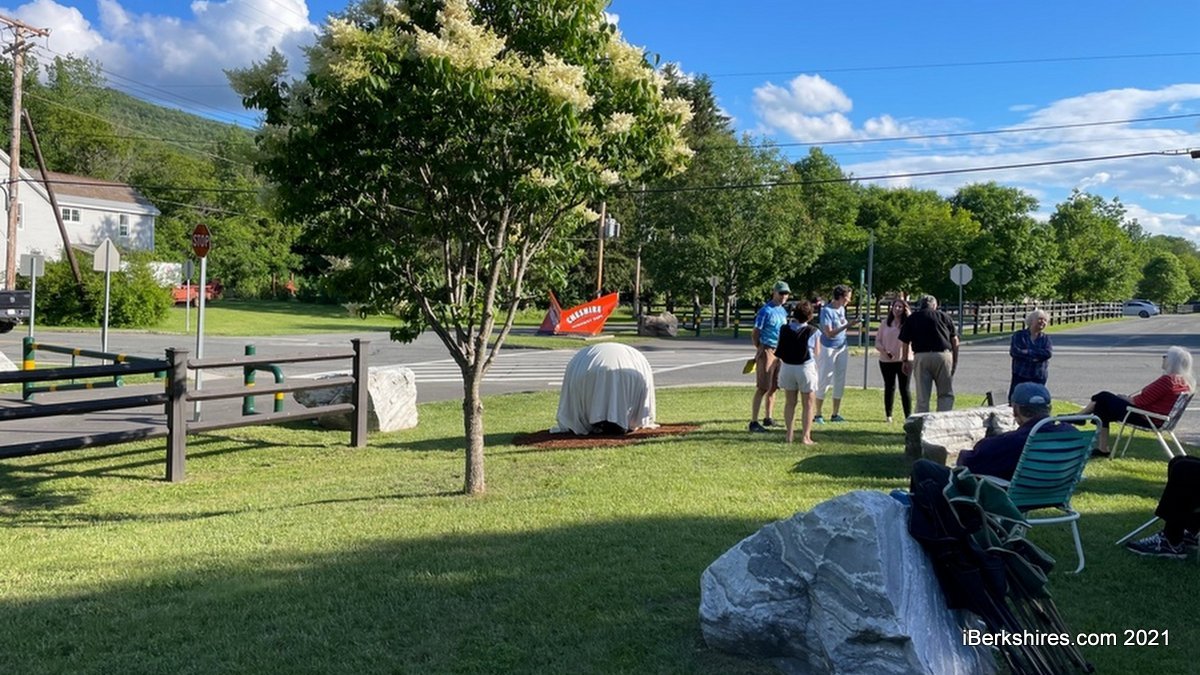
The cheese wheel sculpture sits at the intersection of the Ashuwillticook Rail Trail with Church Street.

Cheshire Unveils New Monument to the 'Big Cheese'
By Gregory FournieriBerkshires Correspondent
Print Story | Email Story

The cheese wheel was created by local artist Brent Whitney through a Mass Cultural Council grant. 

CHESHIRE, Mass. — There's no mistaking that Cheshire's the big cheese. 

A replica of the giant wheel of cheese made by Cheshire residents in the early 1800s was unveiled by the Cheshire Community Association on Tuesday beside the Ashuwilticook Rail Trail.

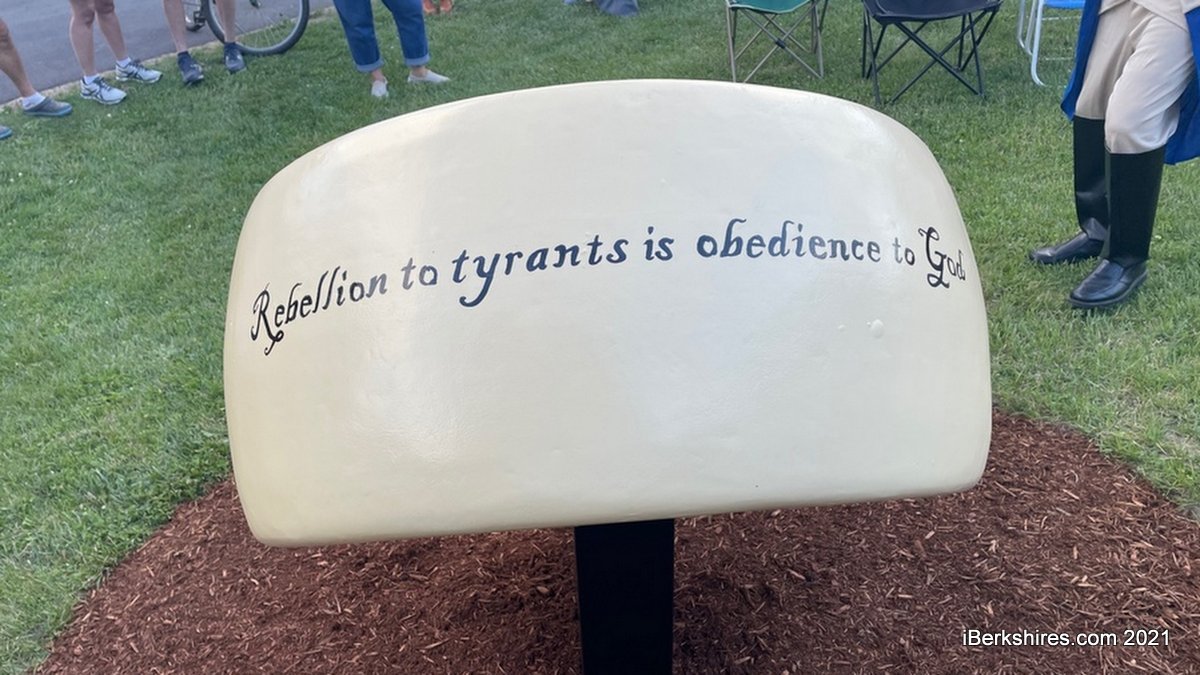
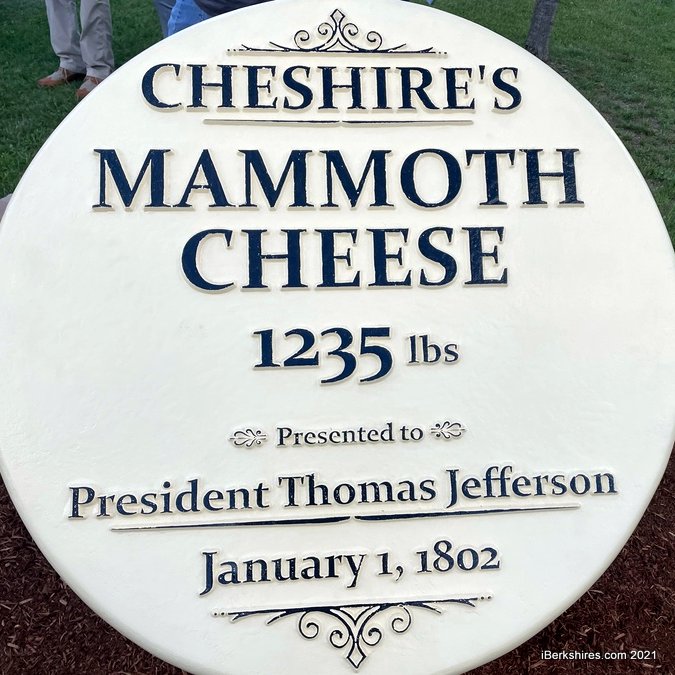
The front of the sculpture contains information on the original cheese wheel, including its weight and the date it was presented to President Thomas Jefferson (Jan. 1, 1802). On the back, the wheel reads, "Rebellion to tyrants is obedience to God."

According to town historian Barry Emery and Cheshire Community Association head John Tremblay, the 1,235-pound block of cheese was commissioned by Elder John Leland immediately after the election of 1800. According to Tremblay, Cheshire was the only town in Berkshire County to have voted for Jefferson; the rest went for Massachusetts' own John Adams.

In fact, Tremblay reported that Jefferson received every single vote but one in Cheshire. That vote, apparently, was seen as a mistake, and thus cast aside in the final tally.

The original block of cheese was so large that it took over a month to get to Washington, D.C. Emery said this event was the one for which Cheshire is most famous. Indeed, the subtitle of Emery's book on the subject is "When America Watched Cheshire." Jefferson reportedly paid $200 for the block of cheese, refusing to accept it as a gift. Emery reported that Jefferson recorded the transaction in his personal account book.

Tremblay said the project was "in honor of our forefathers," specifically Jefferson and Leland, who has a memorial next to a replica of the cheese press (with Leland's image) not far from the new cheese sculpture.

Local artist Brent Whitney created the sculpture. It took about eight months, on and off, to create. Tremblay applauded Whitney for his effort, saying he has a "similar passion that our forefathers had."

The cheese wheel is part of the Art on the Trail initiative, a set of sculptures set off the side of the rail trail on Church Street in Cheshire. It was funded by a Mass Cultural Council grant, part of an effort to increase art displays throughout the state. The other sculptures are silhouettes of a hiker, a biker, and a runner, which represents the convergence of the rail trail with the Appalachian Trail.

Tremblay talked up this latter point, saying this "convergence" of the Appalachian Trail and the rail trail could provide some "energy" for Cheshire. He said this display of art, along with the Appalachian Trail camp across the street, could serve as a "catalyst for economic development" for the downtown area.


Tags: Ashuwillticook Rail Trail,   cheshire cheese,   
If you would like to contribute information on this article, contact us at info@iberkshires.com.

Youth For The Future: Adwita Arunkumar

By Breanna SteeleiBerkshires Staff

PITTSFIELD, Mass. — Williams Elementary School fourth-grader Adwita Arunkumar has been selected as our April Youth for the Future for her mentoring of a younger child.

Youth for the Future is a 12-month series that honors young individuals that have made an impact on their community. This year's sponsor is Patriot Car Wash. Nominate a youth here

Adwita has cortical visual impairment; she has been working with her teacher, Lynn Shortis, and her, paraprofessional Nadine Henner.

"My journey with CVI means that I learned in a different way. I work hard every day with Miss Henner and Miss Lynn, to show how smart I am," she said.

"Adwita is a remarkable student. She's a remarkable child. She has, as she shared, cortical visual impairment, which is a brain-based visual processing disorder, which means the information coming in through the eyes is interfered with somewhere along the pathways, and we never quite know what's being interpreted and how and how it's being seen," said Shortis.

"So she has a lot of accommodations and specialized instruction to help her learn."

Recently Adwita has chosen to mentor 4-year-old Cayden Ziemba, who is also visually impaired.

"I decided to be a mentor to Cayden so that she can learn some new things. I teach her how to walk with the cane, with the diagonal and tap technique, I am teaching her Braille," she said. "I enjoy spending time with Cayden, playing games and being a good role model."

Shortis said the mentoring opportunity came up when Cayden was entering preschool at Williams, and they introduced her to Adwita. 

"Adwita works really, really hard academically. She's very smart, but there are a lot of challenges in that, because of the way that it's so visual and she's a natural. She's just, it's automatic," Shortis said. "It's kind of like a switch is turned on and she becomes this extremely confident and proud person in this teacher role."

Adwita also has been helping Cayden on how to use her cane on the bus and became a mentor in a unexpected ways.

"Immediately at the start of this year, she would meet Cayden at the bus. She has taught Cayden how to use her cane to go down the bus stairs. Again, Adwita learned that skill, so it wasn't something I had to say to her, this is what you need to have Cayden do. She just automatically picked that up and transferred that information," said Shortis. "Cayden is now going down the bus step steps independently with her cane. And then she really works hard with Adwita in traveling through the hallways, Adwita leads her to her class every morning, helps her put her things away and get ready for her morning."

Adwita said she hopes Cayden can feel excited about school and that other students can feel good about themselves as well.

"I want them to know that Braille is cool to learn. You can feel the bumpiness with your fingers. I want people to know how you can still learn if your brain works differently sometimes. I need to have a lot of patience working with a 3-year-old. I need to be creative and energized," she said.

She hopes to one day take her mentoring skills to the head of the class as a teacher.

"I want to become a teacher and teach other students when I grow up. I might want to teach math, because I am great at it," she said. "I also want to teach others about CVI. CVI doesn't stop me from being able to do anything I want to. I want students to not feel stressed out and know that they can do anything they want by working hard and persevering."

Her one-to-one paraprofessional said she likes seeing the bond that has grown between the two girls, and can picture Adwita being a teacher one day.

"I do see her in the future being a teacher because of her patience, understanding and just natural-born instinctive skills on how to work with young children," Henner said.

Shortis also said their bond is quite special and their relationship has helped to bring out the confidence in each other.

"The beauty of it, there's just something about it their bond is, I don't even really have a word to describe the bond that the two of them have. I think they share something in common, that they're both visually impaired, and regardless of the fact that their visual impairment differs and the you know the cause of it differs," she said.

"They can relate. And they both have the cane. They're both learning some Braille. But there's something else that's there that just the two of them connected immediately, and you see it. You just you see it in their overall relationship."

 
View Full Story

More Cheshire Stories