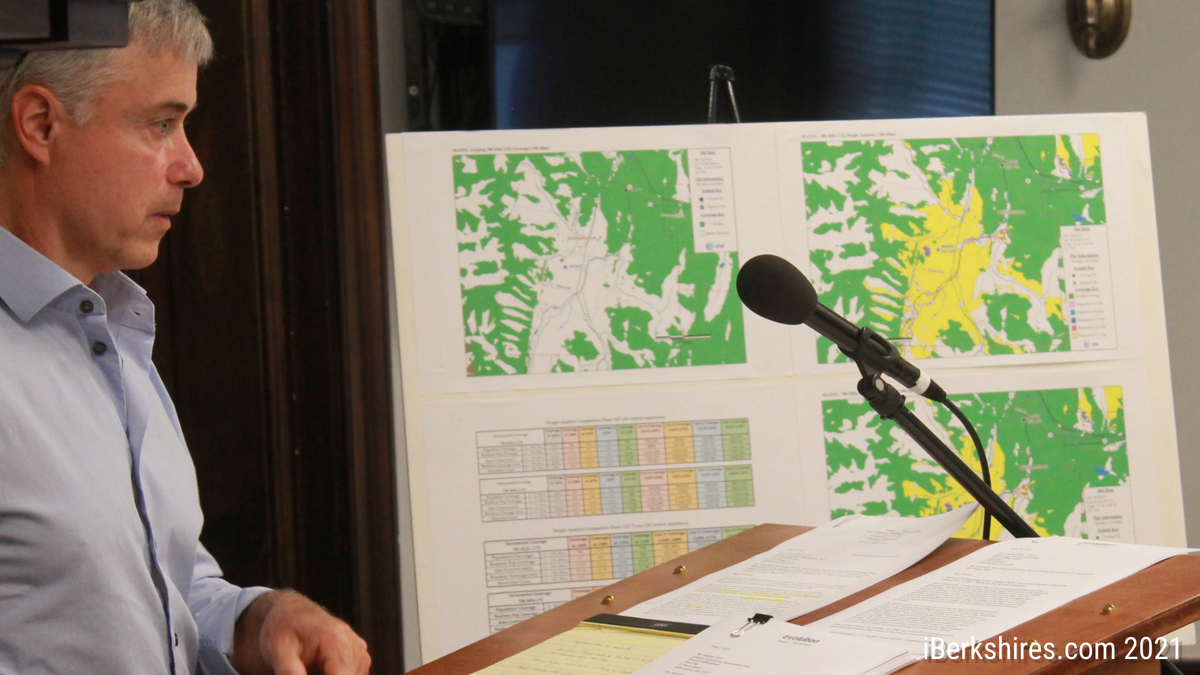
Williamstown Zoning Board OKs Cell Tower
WILLIAMSTOWN, Mass. — The fourth time was a charm for the developer seeking to build a wireless communications tower on Oblong Road.
By a vote of 5-0, the Zoning Board of Appeals on Thursday approved a special permit for Pittfield's Evolution Site Services to build a 153-foot cell tower on land leased from Phelps Farm.
Evolution originally came to the town with a proposal for a 165-foot tower that would have accommodated up to five cell service providers. The final project as approved shaved 12 feet from that plan and limits the developer to four spaces for cell companies, starting with AT&T, which was a co-applicant on the request.
The decision came at the third continuation of a public hearing that began at the ZBA's March meeting.
The hearing outlasted the COVID-19 pandemic -- starting with three virtual hearings over Zoom and ending on Thursday at Town Hall as the board held its first in-person meeting since February 2020.
Although the board heard from a number of residents opposing the proposal at the virtual meetings and through letters over the last four three months, the only resident to address the board in person on Thursday was an abutter who rose to support Evolution's application.
Elaine Neely of Woodcock Road told the board that improved cell service is needed in the South Williamstown neighborhood for the health and safety of residents.
"I had a severe accident in my barn, almost life-threatening," Neely said. "And when I was rescued, the man who rescued me had to go all the way back to the house to call the police. Farm work is dangerous … there's no way of getting help without having cell service.
"I don't think it's neighborly of people to put the health and welfare of their neighbors in jeopardy so they can have a view."
The impact of the scenic vistas in the rural residential zone was the principal concern of most of the objections heard by the board, and its members tried to minimize the tower's aesthetic impact throughout the process.
Christopher Ciolfi of Evolution stood firm on the notion that the project needed to at least have room for four antennae, which are 8 feet in height and need 3 feet of separation. The centerline of the lowest potential installation on the tower as approved will be 116 feet from the tower's base; any lower, and Ciolfi indicated that interference from nearby trees would hurt the performance of any antenna placed at the bottom position.
Ciolfi's original design called for 4-foot separation between antennae; cutting the separation by a foot made a marginal difference in the ultimate height -- though not as significant as the difference made by reducing the number of potential cell service providers.
ZBA member Keith Davis Thursday asked Ciolfi how likely it is there will be a fourth carrier, given the dominance of AT&T, Verizon and T-Mobile in the field.
Ciolfi said it is impossible to say who might enter the market in 10 years.
"Is Amazon going to do something we've never thought of before?" Ciolfi asked rhetorically. "That's why I think having a fourth spot in reserve is the right thing to do for me as a developer and for the community. What I'm trying to do is prevent more towers."
In a letter to the town dated Wednesday, Ciolfi emphasized the provisions of the town's bylaw that reads, "Tower[s] must be of a type which will maximize potential sharing" and "Towers and personal wireless service facilities shall be located so as to provide adequate coverage and adequate capacity with the least number of towers and antennas which are technically and economically feasible."
The economic argument also came into play. Walter Cooper, a consultant hired by the town (at Evolution's expense) to review the application, had advised the board that it could approve a tower high enough to accommodate three carriers but potentially expandable to add a fourth.
On Thursday, Ciolfi told the ZBA that adding to the height of an existing tower is a costly process that disrupts the coverage of existing providers, and a potential fourth carrier would be unlikely to go to that expense -- instead choosing to leave coverage gaps in the town.
"We're not in Springfield," Ciolfi said. "We don't have the attention of carriers that we might think we do. … By adding costs and delays, maybe they say, 'We'll see you next quarter or next year.' "
The Zoning Board granted Evolution the variances it needed from two sections of the bylaw, allowing it to build in an area near a protected species, Hitchcock's sedge, and nearer to an abutter than the bylaw requires.
The commonwealth's Natural Heritage and Endangered Species Program has reviewed Evolution's plan for protecting the sedge, a plan that includes having a botanist on site during construction.
As for the setback issue, the bylaw requires that towers be built at a distance of the tower's height plus 50 feet from neighbors. But the only workable site on the Phelps property -- in order to keep the tower away from the Hitchcock's sedge habitat -- is just 197 feet from the property line, or 6 feet closer than the 203 feet that would be required under the bylaw.
The Zoning Board included in the permit requirements that Evolution treat the tower material and all mounting infrastructure to dull its finish and that the antennae installed have a non-reflective, gray matte finish in order to reduce the the structure's visual impact.
In other business on Thursday, the ZBA approved a special permit to allow Overland Summers to use part of the Mount Greylock Regional School property for camping for its counselors during the summer. The local bicycle tour provider had used the school grounds in the past, but found a different location during Mount Greylock's construction project and suspended its tour program last year due to the pandemic.
The board also OK'd an expansion of the special permit it issued in 2018 to Silver Therapeutics to operate in the Colonial Plaza on Main Street. The cannabis retailer is expanding to incorporate a neighboring storefront currently occupied by Berkshire Palate.
Joshua Silver told the board on Thursday that his operation is "bursting at the seams." Silver's plan is to build a new retail space in the neighboring store and, eventually, convert Silver Therapeutics' current space to a "back of house" space that will allow a break room for its staff.
Tags: cell tower,