Social Workers Respond to Criticism of Williamstown Community Assessment
WILLIAMSTOWN, Mass. — The social workers directing a community needs assessment Monday sought to address some of the concerns raised last month about the research project.
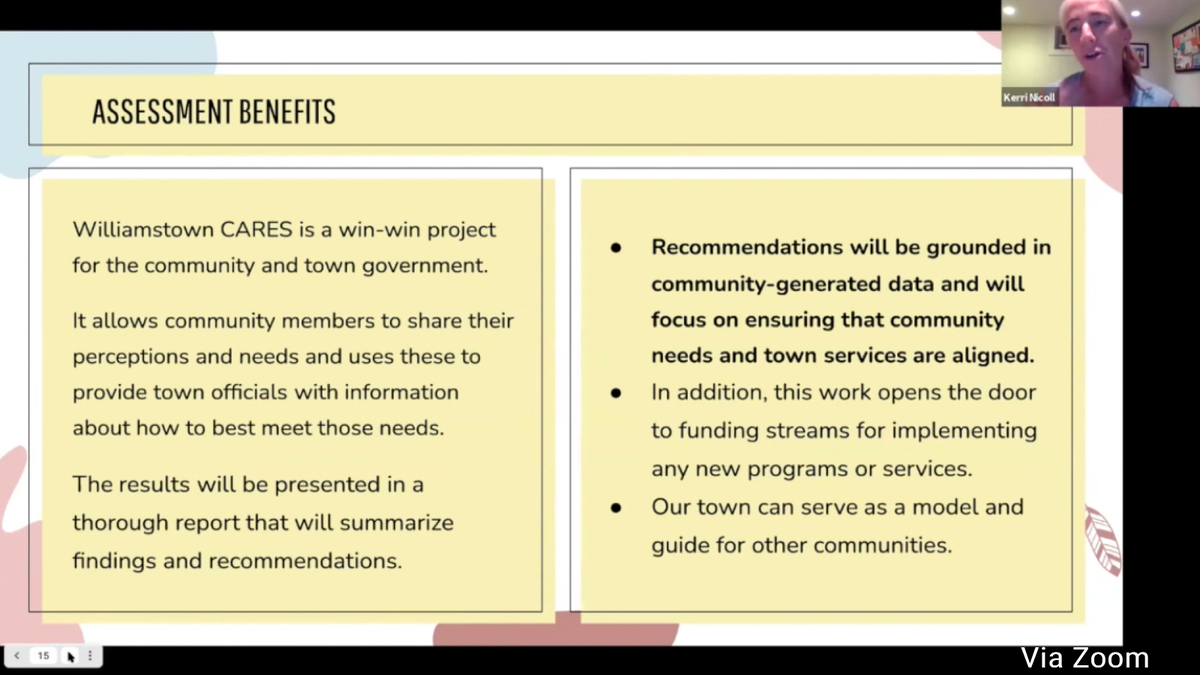
Two weeks after the Select Board heard comments favoring and challenging the Williamstown Community Assessment and Research (CARES) project, four of the social workers directing the town-funded study and the principal researcher addressed the board in a virtual meeting conducted over the Zoom platform.
The research team addressed head on questions that have been raised about the intent of their project and cost.
"We have no preconceived agenda about what we want to come of this project — what new programs we want, what new services we think are needed," Kerri Nicoll said. "The idea of doing participatory, community-based research is that community members have the opportunity to say, 'This is what I think safety means and what it would mean to feel safe and welcome in this community.'
"People may have a variety of ideas about what that is. Some people might feel like all of those needs are being met. And some people might feel like there are needs that are not being met. As we see where those gaps are, we can make recommendations, which is what will be in the report. And those recommendations will be things like, 'We see the police are providing this service, people say they have this need. It's not quite aligning. One possibility might be the police can provide this service differently.' Or it might be that this isn't something the town can provide for."
Nicoll and her colleagues reviewed the genesis of the CARES project, which grew out of discussions with the former town manager about how the town could devote resources to better serve the well being and safety of the community.
From those conversations, Jason Hoch created a line item in the budget for mental health services and funded it for $60,000 in fiscal year 2021 and $80,000 in the current fiscal year.
This spring, the researchers presented the interim town manager with a budget proposal that took into account "all of the possible expenses that might be involved in this project," Nicoll said.
The research team said it did not expect those additional potential costs to be discussed publicly, as they were in a July 12 Select Board meeting, until the conversations with interim Town Manager Charlie Blanchard were completed.
"We have indeed put in every possible expense, with the goal that we would sit down with the town manager and talk about, 'Here are the resources available. Where can we work to bring these things into alignment?' " Nicoll said. "We have already worked to cut that budget, basically, in half.
"Once we realized that there were not infinite resources, which is what the previous town manager had led us to believe, we … took out some of the things that had been contingent, we took out things where we had said, 'We can do the project faster if we do it this way, but it will work just as well to do it this [other] way.' We have done all those things, and we are back in conversation with the interim town manager about doing more of that kind of work."
The additional $87,000 figure that came to light on July 13 and drew criticism at the July 27 meeting was not intended to be a final budget number, Nicoll said.
"It was a budget proposal intended for discussion," she said. "Because it became public before we had a chance to have that discussion and we did not know that was going to happen, we were not present in the meeting to be able to explain the difference."
Nicoll also addressed the fiscal implications of the study by arguing a thorough needs assessment could pay dividends for the town if it decides to implement new programs to better serve residents.
"There is national, state and foundation funding out there right now around safety and well being that we will be able to access because we have a research base and an evidence base to be able to say, 'Our community has already invested in understanding our needs and has an evidence base to show that X program is what we need,' " Nicoll said. "If we come in applying for funding, it's going to be a much stronger application."
Among the criticisms that have been leveled at the CARES project is that it is focusing on gathering input from residents who don't feel safe and thereby generating a skewed impression of the general level of personal safety in the town.
The researchers Monday emphasized that they want to hear from as many Williamstown residents as possible (residents can register for an interview here). And the social workers will be monitoring demographic data about the CARES interview subjects in an effort to ensure no one group is overrepresented or under-represented.
"We're saying, 'If you have felt unsafe in this town and have never had a way to express that, we want to hear from you,' " NIcoll said. "Yes, we want to hear from groups that have been systematically marginalized in our society. But we don't only want to hear from them."
The social workers will continue to do outreach to find interview subjects, an effort that began with a mass mailing in the spring and continued through venues like Monday's Select Board meeting.
"Any resident of Williamstown can sign up to be interviewed," Elizabeth Whitney said. "This project is genuinely strengthened by the inclusion of all voices. And all members of the Williamstown Police Department are being invited to be interviewed."
The researchers stressed that they see the perspective of the WPD as an essential part of the needs assessment. Abby Reifsnyder told the Select Board that the former police chief was aware of and supportive of the project as far back as last August, and Nicoll said lead researcher Jennifer James has had multiple conversations with interim Chief Mike Ziemba, who also is on board.
"As far as the police, so far, so good," James said. "I'm really taking it slowly. I know they've been through a lot in the situation in town. I'm just going to shift changes until I meet them all and just talking about [the research project]. We just sat and I answered questions and showed them literature where they wanted details.
"I recognize the situation has been fraught for police officers and many people in town. Respecting that, I'm giving them all the time they need. They don't have to decide [about a formal interview with a social worker] immediately."
Tags: needs assessment,