Health Officials Ask Employers to Urge Workers to Get Vaccinated
PITTSFIELD, Mass. — Berkshire Health Systems officials Tuesday urged area employers to motivate their workforce to get vaccinated against COVID-19, which the medical professionals called the "best we can do to push back" the pandemic.
"Our push and our plea and our reason for participating with you today is to say encourage, enforce, encourage, support, encourage, encourage, encourage, encourage vaccination among those people you have influence with, those people you care about, those people that you think might benefit," Dr. James Lederer said. "All of us need to do what we can to encourage vaccination as the No. 1 way to manage the delta variant.
"But masking, social distancing and good hand hygiene are those things that we always have to do in the background."
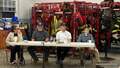
Lederer joined BHS President and CEO David Phelps and BHS Executive Vice President Darlene Rodowicz in an hourlong webinar hosted by 1Berkshire to update the business community about the current state of the pandemic in Berkshire County and, mostly, to talk about the importance of getting as many residents as possible vaccinated against the novel coronavirus.
To that end, the hospital officials said they are ready to help in any way businesses think Berkshire Health Systems can be a partner in educating their employees.
"If it's useful for them to hear from someone other than their employer, we'd be happy to create any efficient mechanism to do that," Phelps said. "We have a track record of working together on all issues important to our community.
"We're willing to use our knowledge, our time, our energy to engage with as many of the employee groups as can be organized over the next month or two. The best thing we can do to push back this pandemic and provide some relief to this community is to increase vaccination rates. It's clear that is our path out."
And it is a path that most Berkshire County residents have shown they are willing to travel.
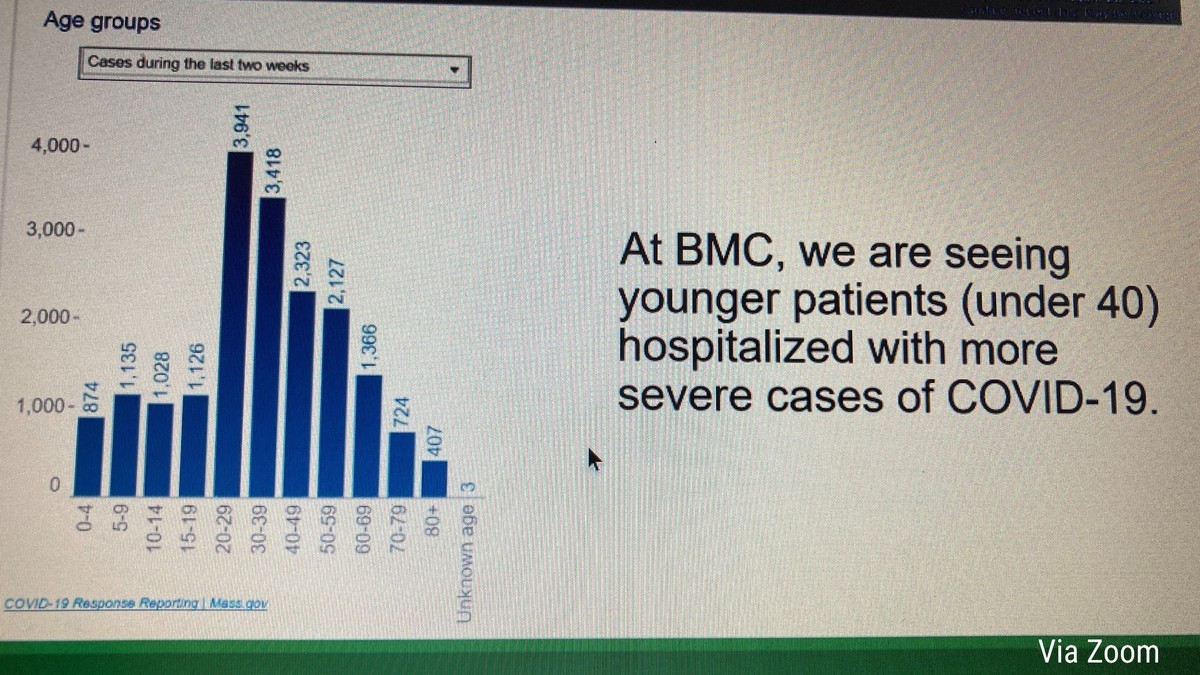
But as Rodowicz explained on Tuesday, too many area residents, particularly in younger age groups, are not heeding the call to get vaccinated.
"In Massachusetts, the vaccination rate for 20-29 year-olds is 70 percent," she said. "In the U.S., it's only 58 percent. Unfortunately, in Berkshire County, our vaccination rate is only 60 percent for that age cohort. It is the one age cohort in our county where we are not following closely the Mass population trends. We've been thinking all summer long about how to find these 20-29 year-olds and what we need to do to engage them.
"I think it's important for you to know, as we think about your workforce, that that is an area of vulnerability for us."
Young adults are, among other things, putting at greater risk their own children who, before they turn 12, are not eligible to receive the COVID-19 vaccine themselves, Lederer pointed out.
Rodowicz supplied numbers that demonstrated that low vaccination rates in younger populations is translating to higher rates of hospitalization in that age group.
"Today, we have 11 patients in house," Rodowicz said. "That's been a fairly consistent number over the last month or so. Of that 11, only two were vaccinated. … The average age of the vaccinated patients [hospitalized with COVID-19] is 86 years old, compared to the nine unvaccinated, who range in age from 23 to 79 with an average age of 52."
The county's positivity rate and hospitalization rates are not yet approaching the pandemic-high levels Berkshire Health System saw in January. But they have risen since the late spring, Rodowicz said.
The seven-day rolling average for positive tests is 5.3 percent, which is lower than the county-record 8.1 percent on Dec. 31, in the wake of the holiday season.
"Even with the vaccination, we're seeing a relatively high rate of positivity," Rodowicz said. "Part of that is because the community is open, we're able to go out and partake in social activities."
Lederer said he was as guilty as anyone of letting his guard down in the spring as thousands of Massachusetts residents were becoming fully vaccinated each day and hospitalizations plummeted.
But as vaccination rates leveled off and the more virulent COVID-19 strain known as the Delta variant emerged, the situation has changed, the BHS officials said.
Lederer, who came to BHS before the pandemic with credentials as a board-certified adult infectious disease specialist, spent much of Tuesday's webinar dispelling some of the misinformation that people may have heard about the COVID-19 vaccines: It was developed with untried technology, it has not been adequately tested and "breakthrough infections" mean it is not effective.
Lederer said the messenger RNA vaccines are different from traditional vaccines that most people use on a regular basis — to fight measles, mumps or the annual flu. But mRNA technology has been around for 30 years, he said.
As for testing, the COVID-19 vaccines already have a strong track record to show that they are safe.
"In retrospect, I can tell you it's been tested 200 million times," Lederer said. "That's how many doses have been given in the U.S. But the original clinical trials used anywhere between 23,000 and 40,000 in their initial studies."
He said that all three of the vaccines in use in the United States are highly effective, even against the Delta variant.
"It's true that back in May and June, we relaxed a lot of our Massachusetts guidelines," Lederer said. "We turned off some of our social distancing, turned up our participation in events, we allowed more capacity in restaurants and shopping areas. We were doing it because we were protected. Unfortunately, the Delta variant in Provincetown taught us otherwise.
"What [the Delta variant] didn't do in Provincetown was cause death and significant hospitalization. In all the Provincetown outbreak, I think there was one death associated."
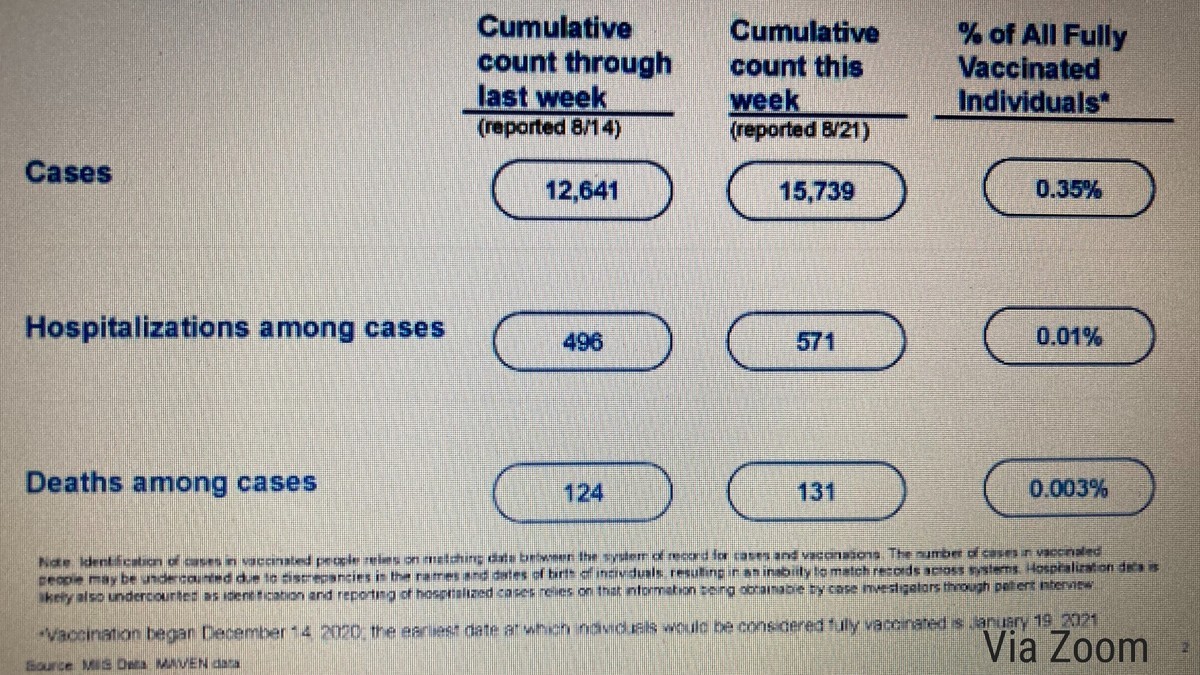
Lederer said that of the 4.49 million Bay Staters who are fully vaccinated, there have been 15,000 breakthrough infections — a 0.35 percent positivity rate. "We're seeing almost 20 times that rate in our unvaccinated population."
Among the 15,000 breakthrough infections, there have been 131 deaths attributed to COVID-19 in Massachusetts, a death rate of 0.003 percent, Lederer reported.
Public health officials are hoping numbers like that will help persuade those holding out on the idea of getting a vaccine. Another thing that might help: this month's full approval of the Pfizer vaccine from the U.S. Food and Drug Administration, which last year granted emergency use authorization to get the vaccines into circulation but still required further tests for full approval.
Rodowicz said Berkshire Health Systems has seen a "slight uptick" in the 40 to 50 vaccines distributed each day at three clinics in the county.
On Tuesday, the BHS officials made a plug for those pharmacies, where residents can receive free COVID-19 tests and vaccines. Details about the three clinics follow:
• Pittsfield Testing Center/Urgent Care, 505 East St.; open daily from 8:30 a.m. to 7:30 p.m.; Pfizer vaccine available daily and Moderna vaccine available Tuesdays and Thursdays.
• Fairview Hospital, 29 Lewis Ave., Great Barrington; open Monday-Friday from 9 a.m. to 2 p.m.; Pfizer and Johnson and Johnson vaccines available daily and Moderna vaccine available on Fridays.
• North Adams Testing Center, 98 Church St.; open daily from 8:30 a.m. to 4 p.m.; Pfizer vaccine available daily and Moderna vaccine available on Tuesdays and Thursdays.
Tags: BHS, COVID-19,
More Coronavirus Updates