Adams Board of Health Receives Pushback on COVID-19 Directive
ADAMS, Mass. — The Board of Health has issued a COVID-19 Public Health Directive that strongly suggests and reinforces the wearing of masks, social distancing, and other safety standards.
The directive was rolled out at an emergency meeting early Thursday afternoon held in person and over Zoom. It asks — but does not mandate — residents to wear masks indoors in public, and to continue COVID-19 safety protocols as the Delta variant becomes more prevalent in Berkshire County
"This is a call to action. We are asking people to use their sense of community and willingness to basically pick up those protocols that stopped the virus last winter," Chairman David Rhoads said. "We live in a community and that means all of us together so we are appealing to community spirit here."
The directive is directed toward restaurants, businesses, and schools, including private schools.
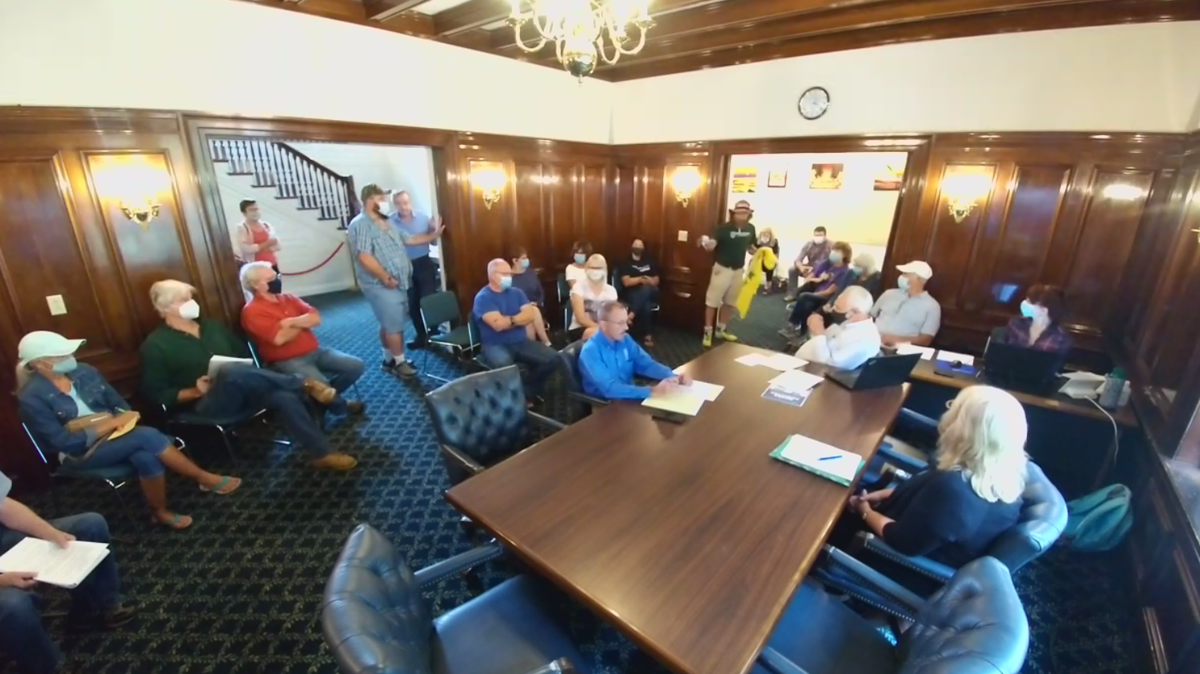
Dozens attended the meeting in person and attempted to social distance around the small Mahogany Room at Town Hall. Another dozen or so watched the meeting over Zoom.
The conversation was at times confused and attendees were unsure if the Board of Health was considering an enforceable mandate or a suggestion. The order itself had a start date of midnight of Friday, Sept 10.
Resident and School Committee member Mike Mucci had questions about the genesis of the directive and was unsure exactly what it meant to the community and the schools.
"It sounds very grand and encompassing. I heard schools, outside of schools, business, public spaces, sports, venues. I heard everything," he said. "I am trying to understand if this was approved by other communities and why you decided to trump what DESE is going with."
The state Department of Elementary and Secondary Education promulgated its own guidelines for public schools, including universal masking, in August.
Town Counsel Edmund St. John III, who was at the meeting via Zoom, said he had yet to review the directive and that it is not legally enforceable.
Rhoads agreed and said the directive is a strong recommendation just shy of a mandate. He said non-compliance would further discussion and force the board to consider implementing more strict regulations.
The conversation was sporadic and touched arguments over the effectiveness of masks, freedom, and the virus itself. Most attendees who spoke were in opposition.
Resident John Cowie questioned the legality of the decision. He also felt that masks were ineffective, citing a Chinese study he found.
"If you are really concerned about the Delta variant ... if you are really concerned about the kids why don't you close the schools," he said, and then claimed without prove that "masks generate germs and we are going to cause more problems with the kids."
(See Johns Hopkins All Children's Hospital for information on pediatric masking.)
Rhoads disputed Cowie's sources and reiterated that when people wear masks the chance of transmission drops dramatically. He added, for instance, because of mask-wearing and hygienic practices common flu cases have been very low.
Cowie did not agree and said the flu cases were only down because "COVID wiped it out, the COVID pushed it aside."
One unmasked resident stormed into the meeting alleging that Rhoads' statements in regard to COVID-19 were unscientific and that the directive was unconstitutional. He waved a crumpled mask in one hand and a "Don't Tread On Me Flag" in the other and asked for a motion for Adams to become a "constitutional community" that went unanswered.
There were a few who spoke in support of the directive and Hauflinger Haus owner Don Sommer said restaurant staff have been wearing masks throughout the pandemic, and he encouraged others to do the same.
"I don't know why we are even having this discussion. What the board is offering is something that will help people in Adams and protect the kids," he said. "Most of the medical people and scientists say masks work, and they don't hurt people. People, let's put them on."
Jim Daunis agreed with Sommer and said mask-wearing was for the good of the community.
"Who is going to be the last person standing to say 'gee everyone else died maybe I should have worn a mask,'" he said. "This is for the general welfare and good of the population."
Council on Aging Director Erica Girgenti said COA members are encouraged to wear masks. She wasn't sure if a mandate was needed on their end and said the schools seemed to be doing a good job as well.
She did encourage the board to continue educating residents and felt they may have heard from more voices in support of the directive if they held the meeting in the evening instead of 1 p.m.
The meeting was always on the edge of total chaos as more people edged closer to the perimeter of the Mahogany Room.
Questions were shouted out and board members were often interrupted as they tried to answer them.
Attendees asked a few times for specific numbers in regard to cases in Adams and wanted more historic data in terms of viral outbreaks in town.
Rhoads did not have these specifics which irritated some attendees.
"You came to this meeting with nothing ... you dont know and you want us to get behind you but we can't," Wayne Piaggi said. "You have not done your homework."
The town had 38 new cases in the past two weeks ending Sept. 4, the second highest number in the county, and a 14-day daily incidence rate of 33 cases per 100,000, according to state data posted Thursday evening.
Rhoads conferred with Code Enforcement Officer Mark Blaisdell who said his department is in constant contact with Berkshire Medical Center and the state Department of Public Health. Rhoads added that increased cases in step with relaxed regulations did spur this emergency meeting
"This was a little rushed. I feel it was but because I feel an urgency," he said. "So take that into a consideration. We all feel some level of urgency here."
He said the board will take up the conversation again at its next meeting at which the town's public health agent will be available to provide more data.
Questions continued to ping pong across the room and attendee John Duquette inquired why Blaisdell did not have a mask on.
Blaisdell responded that per town regulations, town employees did not have to mask in Town Hall. He also said he has a condition that exempted him.
Duquette did not like that answer.
"Where is your mask? COVID can't get you because you are a town employee?" he said as he ripped off his own mask. "It is fair when you want it ... does it matter if you are a visitor? Can you not still spread it?"
Rhoads called for a point of order to regain control of the room. The conversation continued another few minutes but he eventually motioned to continue the discussion to the next meeting.
He thanked those who attended.
"This is good. This is what we are here for to hear everyone," he said. "Thank you for coming and thank you for your opinion."
Tags: COVID-19,
More Coronavirus Updates