Display Will Obscure Williamstown's 1753 House to Make a Point
WILLIAMSTOWN, Mass. — The Sign Commission on Tuesday OK'd an art installation on Field Park that will draw attention to the region's heritage as the homeland of the Stockbridge-Munsee Band of Mohican Indians.
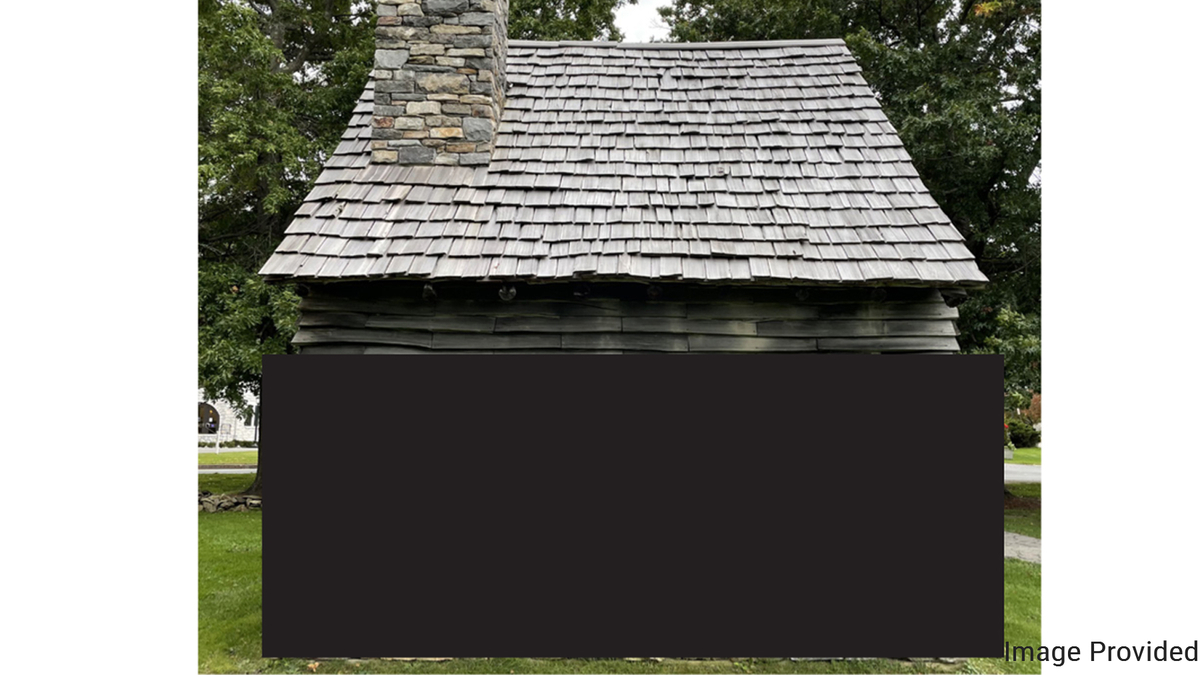
A group of Williams College employees and members of the community have asked the town's permission to install a four-sided black fence around the 1753 House, a 20th-century replica built using 18th-century tools and techniques.
If all goes according to plan, the fence will be installed on Monday in time for Indigenous Peoples Day and stay up for the two-week period approved by the Sign Commission by a unanimous vote on Tuesday afternoon.
"The idea of the project is to imagine what the green would look like symbolically if the 1753 House wasn't there," Randal Fippinger told the commission in introducing the proposal. "The 1753 House is obviously a representation of colonial Williamstown.
"The idea is to surround the 1753 House with a fence, a freestanding fence from Berkshire Fencing. … GVH Printing in Bennington will create a black mesh that goes around each side of it. On each side of the mesh are symbols from the Stockbridge-Munsee Community. Each image represents cardinal points on the compass."
Fippinger, who serves on the town's Diversity, Inclusion and Racial Equity Advisory Committee, said the concept was created by a local artist who wishes to remain anonymous. The concept grew out of conversations between himself, former DIRE Committee member Bilal Ansari and Williams College Museum of Art Deputy Director for Engagement Christina Yang.
In addition to the fencing designed to obscure the view of the replica structure, the petitioner plans to display a reimagined version of the town flag, adopted in 2015, that erases the structure.
"We had a conversation with Bonnie Hartley from the Stockbridge-Munsee Community," Fippinger said. "They like the idea."
So did the chair of the 1753 House Committee when Fippinger pitched the idea to the group responsible for maintaining the historic replica, Fippinger said.
The Sign Commission, which is responsible, among other things, for making sure that public displays do not create unreasonable distractions to motorists, considered whether the thought-provoking temporary display would pose a hazard on the rotary at the junction of Routes 2 and 7.
Community Development Director Andrew Groff, who staffs the commission, said neither he nor interim Town Manager Charlie Blanchard have an exception to the installation.
"If you look at the broader issue of signage as it relates to vehicular safety, generally what your commission is concerned with is readability in an area where the speed limit is 20 mph," Groff said. "This [fence] is set back from the road, there's vegetation there. … I have not raised this to [interim Police Chief Mike] Ziemba, but I don't think they'd have a problem with that."
Sign Commission member Kathy Thompson, who identified herself as a past chair of the board of the Williamstown Historical Museum, pointed out that the museum directs its visitors to the 1753 House and that visitors to the replica spike during fall foliage season. Thompson asked whether it would be possible to create a break in the planned 20-by-20 fence that would allow visitors to the house while the installation is in place.
"I'm really interested that the 1753 House Committee isn't more concerned," Thompson said. "I totally like the concept. I'm not against that at all. I'm pro indigenous people. I just think cutting it off from people who might want to visit in fall foliage time … ."
Sign Commission Chair Anne Singleton pointed out that the question of whether the house could be accessed for two weeks is not part of the commission's purview.
And a resident who spoke from the "floor" of the virtual meeting pointed out that the installation's timing is both intentional and appropriate.
"This town should be so proud of our Mohican-Stockbridge-Munsee heritage, and any way we can amplify it is wonderful," Arlene Kirsch told the commission. "What better time than Indigenous Peoples Day? It's a great project to educate people, a visual statement that educates people and amplifies our history."
Tags: historical building, signage,