Pittsfield Parks Commission Sees Design for Springside Bike Park
PITTSFIELD, Mass. — One year into discussion about the proposed Springside Park pump track, the Parks Commission has received a final design for the facility.
At Tuesday's meeting, the commission said it is in favor of the project but is not ready for a vote because there are still aspects that need to be fleshed out.
In November 2020, the panel approved a concept for the bike skills park and has since received pushback from opposers who say it will have negative environmental impacts and is not consistent with the park's intended use.
Those concerns have not been mirrored by city entities. In August, the Conservation Commission ruled that the proposal's location is not within a wetland resource or buffer zone.
Similarly, City Solicitor Stephen Pagnotta in September confirmed that if approved, this proposal is consistent with the deed to Springside Park and does not trigger Article 97, which grants people a right to a clean environment and authorizes the commonwealth to acquire conservation easements.
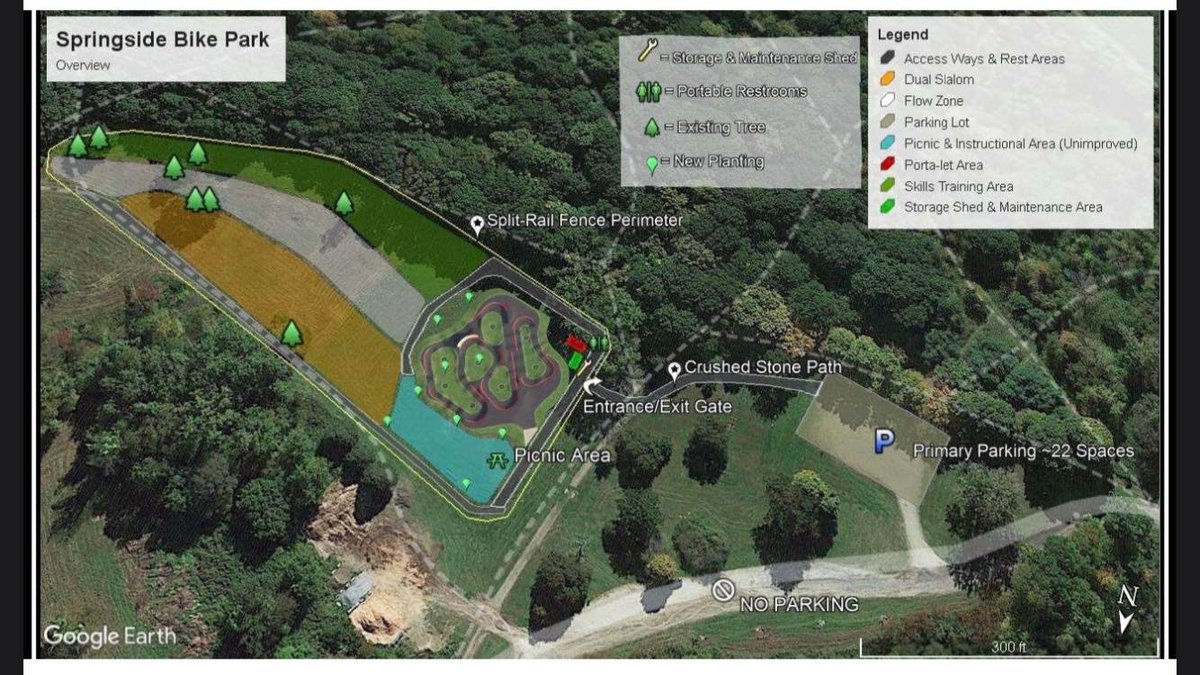
The bike park would cover 2.3 acres on the former baseball field behind the North playground. An abutting location was originally proposed and approved but the commission later requested that it be moved South.
Its design consists of an asphalt pump track, a skills development area, a flow zone, and a dual slalom course for head-to-head racing. In addition, there is also a picnic area and Americans with Disabilities Act (ADA) compliance features throughout.
The proposal has been referred to as the "pump track" but in fact, that is only one of the four features in the design.
There will be about 9,000 square feet of asphalt coverage but the majority of the components will be constructed with dirt.
All of the elements are meant to work together for an integrated experience. The park can be used by beginner bikers, advanced bikers, and everyone in between.
For maintenance responsibilities, a memorandum of understanding would be created between the city and the Berkshire Chapter of the New England Mountain Biking Association (NEMBA.) The organization would pay for the project with fundraising and have hired Powder Horn Trail Co. for its design and construction.
"I don't think we're in a position to vote on this right now," Chairman Anthony DeMartino said to McGee.
"I think you would hopefully hear from us that we are very much in favor of this but we kind of hear concerns in regards to perimeter security, whatever those options are, our city end of it, looking at road/parking, your end of it looking at sort of staged construction pieces along the way and with timelines, and then we can, in the process, work on the memorandum because that is obviously a big piece of it as well."
Members of the commission made two suggestions on the final design: that a split rail barrier fence be replaced with a guard rail for increased durability and that the pump track is opened first so its popularity can be surveyed before the rest of the park is finished.
The suggestions were taken into consideration by McGee and Conroy.
Concerns on overcrowding and limited parking were also voiced, as people would likely travel to Pittsfield for the unique facility. Chairman Anthony DeMartino specifically sees the possible issues in the dual slalom course attracting too many people or the want for large events.
The project is just too big for Clifford Nilan, who advocated for a phased opening approach.
Paula Albro stood as the outlier of the group, supporting it wholly and having no concerns.
"We're only talking 2.3 acres total," she said, adding that there was a big turnout of young pump track supporters at the public hearing that was held over the summer.
Earlier in the meeting, resident Daniel Miraglia submitted a petition that addressed his concern with improper parking in the area of the bike park proposal and parking within the wetland buffer zone.
Miraglia has also spoken against the project in the past.
Parks, Open Space, and Natural Resource Program Manager James McGrath said he had exaggerated the situation.
McGrath explained that the access road to the north playground has been maintained for 40 years and though its upkeep could be improved, the situation is not hazardous to the surrounding environment.
"Mr. Miraglia, I will go on a limb and say this, I think he's overblown the situation relative to parking up here, I think his statements are misleading around the impacts of parking but we're willing to look at this," he said.
"Because let's not forget this area is not only going to be needed for parking for pump track patrons, but also for the rest of the community that uses Springside Park so we can figure that out, but really, I don't want anyone to think that cars parking on the side of the road adjacent to a wetland is an environmental abomination because it isn't."
DeMartino said this project would be a "very positive addition" to the park and it has to be done the right way. The commission will take it up again at its next meeting on Dec. 21.
Tags: biking, Springside Park,