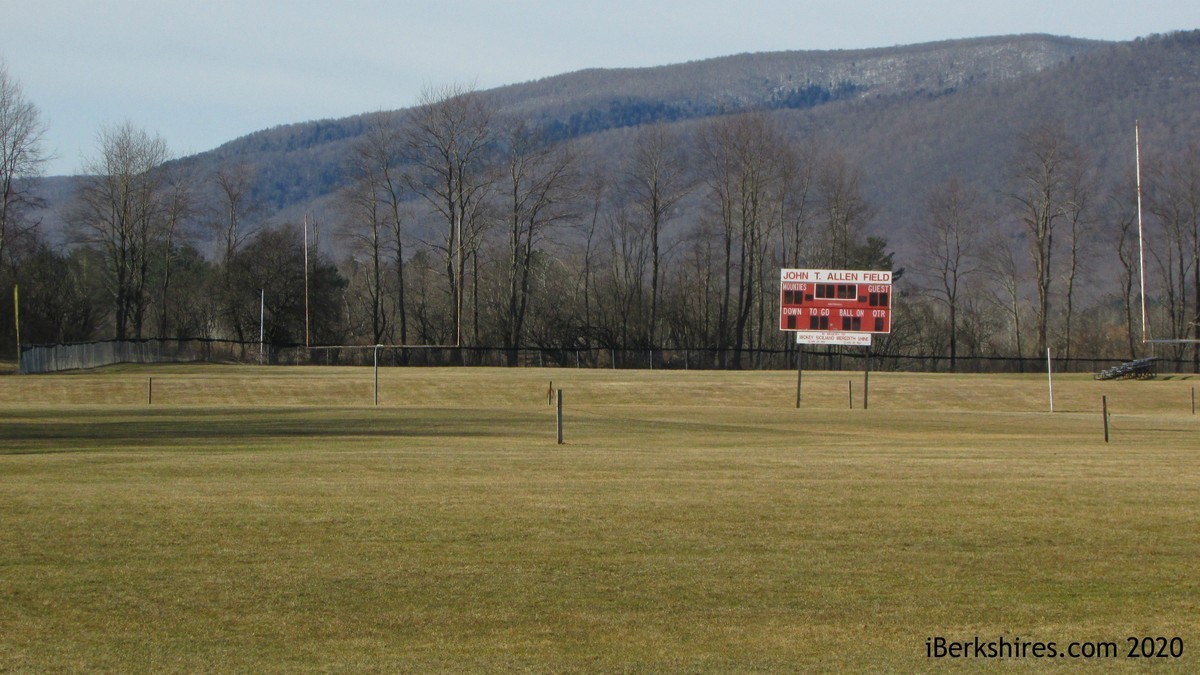
Mount Greylock School Committee Advances Natural Grass Playing Field Plan
WILLIAMSTOWN, Mass. — The Mount Greylock Regional School Committee voted Thursday to order design work for a new natural grass multi-sport athletic field at the middle/high school.
For the first time in the long and complicated history of the natural vs. synthetic turf field debate in the district, the committee voted to move forward with a field plan that does not include an artificial turf surface.
Carolyn Greene, the chair of the School Committee's Finance Subcommittee, reported that the latter panel decided at its late December meeting to recommend a field project that puts a natural grass playing field at the center of a new, six-lane artificial track.
Greene said the district has gained more knowledge and expertise in the last couple of years about how to maintain its existing playing fields to maximize playability, and a move to create a new natural grass field might progress without the level of opposition from community members that has met previous plans for an artificial turf field.
"This is not just about the risks of synthetic turf or the political expediency of getting this done," Greene said, reading from a proposal advanced by the Finance Subcommittee by a vote of 2-0-1. "It is also about the benefits of creating a first-class, fully organic campus with a staff that can both model and share best practices with the rest of our district.
"A properly constructed and maintained grass field should be able to meet the playability needs of the district. It will also enable us to take other fields offline for reconstruction with a goal of having all seven fields (as well as baseball/softball fields) achieving maximum playability of modern grass fields."
Greene and Ursula Maloy voted in the subcommittee to advance the grass playing field proposal to the full committee. Steven Miller, a consistent proponent for an artificial turf field, abstained from the vote at the subcommittee level and again on Thursday in the full committee vote.
"I'm abstaining because I cannot vote before I know what the playable hours will be for everything," Miller said.
Julia Bowen, Christina Conry, Jose Constantine, Greene and Maloy each voted in favor of the natural grass field proposal on Thursday. Curtis Elfenbein did not attend Thursday's meeting.
The School Committee long has planned to finance a new multi-sport field at Mount Greylock with proceeds from a $5 million capital gift the middle/high school received from Williams College at the start of an addition/renovation project at the school.
Previous efforts to address a need for a more reliable playing field at the school have come up against higher than anticipated price tags and pushback from community members concerned about the environmental impact of a synthetic turf field, potential health risks to children using the field and the long-term cost of upkeep and, down the road, replacement of the carpet.
The Finance Subcommittee's report indicated that the cost savings from a less expensive grass field could have ripple effects in the now PreK-12 district (Williams College's gift predates a decision by Lanesborough and Williamstown to fully regionalize their public schools).
"Savings realized between synthetic and modern natural grass fields along with the expertise developed by our staff could potentially be invested in other district, school and community fields," Greene said. "So, we talked about that as well, that we're building a resource here that will benefit the entire school, the entire campus, potentially our other schools and potentially our towns."
In answer to a question Thursday from School Committee member Jose Constantine, district Business Manager Joe Bergeron said any design for a new natural grass field would include a plan for irrigating that field.
The district also may need to dig a new well and would look at ways to bring water to its existing playing fields, Bergeron said. That would be outside the scope of a plan to create a new playing field, but it could make sense to do the work concurrently.
"The process of drilling a new well, that's probably best parsed out for a local engineering firm that could go through the necessary surveys, test wells and, actually guiding the construction of those wells and the pipes necessary to run water to other parts of the campus," Bergeron said.
As for playing time on the fields, which has been the main argument raised by advocates for a synthetic turf field, the district reached out to two consultants, PJC Organic of Rowley and Huntress Associates of Andover. Bergeron reported their feedback to the Finance Subcommittee at its Thursday meeting that preceded the full committee's session.
According to the minutes of the Finance Subcommittee meeting, both experts gave largely the same advice. Specifically, Huntress advised that a natural grass field, allowed to rest during the summer, could be usable in the fall until frost sets in and in the spring from the third week in March, providing about 600 playable hours per year.
Bergeron on Thursday could not provide the subcommittee with a specific number of hours required.
But assuming the field is home for boys and girls soccer (up to 24 varsity home games per year), boys and girls lacrosse (again, up to 24 home dates for the varsity teams) and football (up to six home games per year), that equates to 54 contests, or 216 hours (assuming four hours per contest) before adding junior varsity games and practices, which hypothetically could be scheduled on other fields on the campus.
Tags: playing fields,