U.S. Interior Survey of 'Derogatory' Site Names Lists One in Berkshires

Staff ReportsPrint Story | Email Story
GREAT BARRINGTON, Mass. — The U.S. Board of Geographic Names released alternative names on Tuesday for more than 660 natural landmarks that still use the term "squaw," considered an ethnic and misogynistic slur. 
 
Of those, only six are in Massachusetts and one in Berkshire County. 
 
But the name of Squaw Peak in the Monument Mountain Reservation, listed by Interior, was already changed last year by the Trustees of Reservations.
 
The Trustees worked with the Stockbridge-Munsee Community Band of Mohicans to rename the summit "Peeskawso Peak," which they say means "virtuous woman" in the Mohican language, and the trail leading up to it Mohican Monument Trail, rather than Indian Monument Trail.
 
The name changes were announced in April 2021, along with changes to the narrative of the mountain that had focused on the famous picnic of authors Nathaniel Hawthorne and Herman Melville in 1850. The signage now includes more on the history of the indigenous people who had lived there first. 
 
This altered framing was repeated throughout the Trustees' 120 conservation and historic sites as part of an internal review process. 
 
BGN offers four possible alternatives of naming for each site and the ones for Peeskawso Peak are bit — head scratching. Three are for bodies of water — Agawam Lake, Agawam Brook, and Konkapot Brook — and one for the mountain gap,  Brookside Col. All four of the names already exist as geographic sites in Berkshire County, with the exception of Agawam Lake in New York State.
 
The reasoning, according to the declaration of U.S. Secretary of the Interior Deb Haaland, was to offer "candidate replacement names drawn from a list of nearby associative topographic features, the names of which are already accepted and in local use."  
 
The suggestions are moot at this point since the peak's name has been changed but there's six more sites in Barnstable, Bristol, Franklin, Norfolk and Plymouth counties. 
 
There are no sites in Vermont, three in Connecticut and 11 in New York State, including Squaw Swamp in Rensselaer County. 
 
Haaland declared the term "squaw" derogatory last November and charged the U.S. Geological Survey with developing the list of locations and suggested replacement names through a task force made up of representatives of Interior and related agencies.
 
"Words matter, particularly in our work to make our nation's public lands and waters accessible and welcoming to people of all backgrounds. Consideration of these replacements is a big step forward in our efforts to remove derogatory terms whose expiration dates are long overdue," Haaland said in Tuesday's press release on the results of the survey. "Throughout this process, broad engagement with Tribes, stakeholders and the general public will help us advance our goals of equity and inclusion."
 
Some more famous areas have already made the change, with pricey ski resort Squaw Valley becoming Palisades Tahoe. While in Great Barrington, there's still a bit of a tussle over Squaw Peak Road. 
If you would like to contribute information on this article, contact us at info@iberkshires.com.

Berkshire County Getting $4M Toward Housing Improvements

By Brittany PolitoiBerkshires Staff

Housing Secretary Ed Augustus has been a frequent visitor to the Berkshires and says a new rural designation for the Housing Choice Initiative grew out of conversations with small towns.  

GREAT BARRINGTON, Mass. — Millions of federal Community Development Block Grant funds are coming to Berkshire County for housing and economic development. 

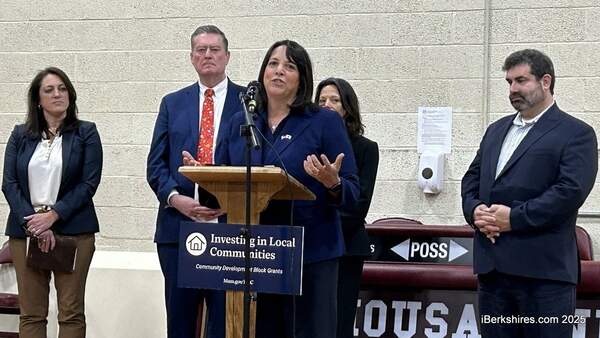
On Thursday, Lt. Gov. Kim Driscoll said announced $33.5 million in federal CDBG funds, of which $5.45 million will be coming to the county. 

Great Barrington, in conjunction with Egremont and Stockbridge, has been allocated $1.25 million to rehabilitate approximately 14 housing units. 

"We really recognize the importance of having strong local partners who are doing that hard work every day, educating our kids, keeping our neighborhoods safe, investing in the best of what makes our community special, places we make memories, places that drive the economy," said Driscoll at the Housatonic Community Center.

"These dollars in particular can help do all of that, along with helping cure older housing stock and meet the needs of community members who might find a desire to have a new roof or make a housing unit more accessible, but don't always have the resources to do it. These dollars are really special, and we're really grateful." 

The federal fiscal 2025 CDBG awards, funded by the U.S. Department of Housing and Urban Development and administered by the state Executive Office of Housing and Livable Communities, help small cities and towns undertake projects that benefit low and moderate-income residents.

The more than $33 million will be dispersed to 52 communities across the commonwealth. Hinsdale and Florida will share a total of $950,000 to rehabilitate 11 housing units; Lenox and Sandisfield will share a total of $1,050,000 to rehabilitate 12 housing units, and New Marlborough, Mount Washington, and Otis will see a total of $1,250,000 to rehabilitate 15 housing units. North Adams is getting $950,000 for the second phase of senior center improvements and road repairs.

The funds can be used for projects involving housing rehabilitation, sidewalk and road improvements, planning studies, public facility upgrades, and social services such as food pantries, youth programming, and homelessness prevention. 

Town Manager Liz Hartsgrove said this reflects what is possible when federal, state, and local governments work together, and that the public investment shares significance beyond dollars alone. 

"These programs and projects become instruments of stability, equity, and trust. It allows the government to meet real needs, strengthen neighborhoods, and ensure residents can remain safely and securely in their homes. Places where lives are built, memories are formed, and community identity is shaped for generations to come," she said. 

"Investments like CDBG reduce uncertainties for families, provide reassurance for seniors, and create pathways for households to remain rooted in the communities they contribute to every day. When individuals and families are supported in this way, they are better positioned to thrive, and when people thrive, communities grow stronger, more resilient, and more connected." 

View Full Story

More South Berkshire Stories