Mount Greylock School Committee Advances Budget with Diversity Director
WILLIAMSTOWN, Mass. — The Mount Greylock Regional School Committee on Thursday voted 5-0-1 to advance a fiscal 2023 spending plan that includes assessment increases north of 4 percent for each of its member towns and a new administrative position to address equity issues.
The total operating budget of $25.1 million would be up by just more than a million from the FY22 spending plan if ultimately approved this spring by annual town meetings in Lanesborough and Williamstown.
The final product of the district's budget deliberations has a price tag lower than the projection the district was sharing with the community earlier this week.
But it still includes the expenditure that generated the most discussion at Thursday's public hearing: a roughly $100,000 allowance for a newly created director of diversity, equity, inclusion and belonging. For perspective, $100,000 represents less than 0.4 percent of the district's budget and less than a 10th of the increase in the operating budget from FY22 to FY23.
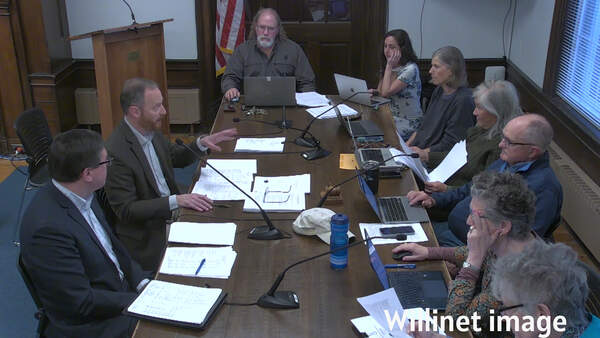
Committee members Julia Bowen, Jose Constantine, Curtis Elfenbein, Carrie Greene and Ursula Maloy voted to send the budget to the member towns of Lanesborough and WIlliamstown. Steven Miller abstained from the final budget vote after expressing misgivings about the DEI director post during the committee's deliberations. Chair Christina Conry did not attend Thursday's meeting.
Twenty-three residents of the district, most of whom identified as residents of Williamstown, addressed the School Committee during a public comment period that consumed nearly an hour of a four-hour meeting.
The comments ran more than two-to-one in favor of the new position, which Superintendent Jason McCandless explained during an hour-long budget presentation to kick off the meeting.
McCandless said the need for a DEIB officer was made clear during his first 18 months in the district, which included a six-month listening project to determine the extent to which all students and families feel they belong in the PreK-12 district.
"We understand that we serve students best when we infuse the budget with opportunities to become more culturally competent and build a better sense of belonging for all students, and make sure all students are represented in our curriculum, our materials and our approach to teaching and learning," McCandless said.
He showed the committee and the public at the hearing data that supports the perception that the district's student population is growing in diversity.
As recently as the 2016-17 academic year, 17.8 percent of the district's students were identified by the commonwealth as low-income students; this year, that percentage is 26.3 percent. Just two years ago, 90 percent of the district's students and families reporting a racial identification identified as white; this year, that number is 80 percent.
McCandless emphasized during his formal presentation and later in a back-and-forth with School Committee members why he feels creating a DEIB position in the district is a moral and ethical duty. But he also offered a different justification.
"I also see this, to some degree, being an economic development issue," McCandless said. "Working to be more culturally competent, working to be more aware of our implicit biases … is vital in many ways, including economic development and sustainability of the towns of Williamstown and Lanesborough.
"I think presenting the Mount Greylock Regional School District as a district that is ahead of the curve instead of behind the curve … for those employers who recruit increasingly not only from around the country but around the world, I think this is an important message to send about who we are and how we operate."
Seven residents spoke during the public hearing to encourage the district to at least delay plans for a DEIB position. Several argued that the position — which would not come online until July 1 if the budgets pass — does not have a formal job description yet.
"Is it premature to fund a position when you don't know what it entails?" Anne Skinner of Williamstown asked.
Williamstown's Ralph Hammann said he helped author a petition against moving forward with the position that received the support of 80 residents but stressed that more than a dozen people supported the petition but declined to sign their names.
"It is a shameful and ironic truth in this town: People are afraid to speak or even ask for further discussions for fear of reprisals," Hammann said.
Most of the speakers during the public hearing — and the 200 residents who signed a different petition — applauded McCandless and his administrative team for addressing the need for a position to support the district's ongoing DEIB efforts.
The youngest speaker to address the School Committee was Mount Greylock senior Henry Art.
"I felt it was important to have my voice heard as a member of the school community and a leader in the school community," Art said. "I've been the class of '22 president for three years and a member of the Mount Greylock Peer Team, which is currently involved in facilitating some of the DEIB discussions in the school.
"As a member of both those groups, I can confidently say that … having someone in that position as a DEIB director, that sort of leadership is paramount in actively increasing the efficacy and impact of those discussions and, in the future, making the school and the school district a more inclusive place."
Most of the School Committee members expressed strong agreement.
"Although there are a wide variety of opinions … this needs to happen and needs to happen now," Elfenbein said.
Bowen addressed a notion expressed by opponents of the DEIB position that its work is best left to the district's teachers without an added administrator.
"Knowing what teachers and the adults in our buildings have gone through trying to serve the students and what they have gone through, I absolutely believe we need additional support in this particular area," Bowen said. "I don't think the reading interventionist and the math interventionist [being added to the FY23 budget] will be as successful if we don't have classrooms where the students feel they belong."
Lanesborough's Maloy echoed the sentiments of Williamstown resident Jeanette Smith, who told the School Committee that DEIB work "is not just about race."
"When I think about this position and why it's important, it's not only race, it's all types of diversity, including sexual identity, household type, division among the towns," Maloy said. "I think about all the ways people need to feel included."
Constantine directly addressed the charge from critics that the district is "rushing" to create a DEIB position.
"Folks have tried to contrast this process with the process our communities participated in with regard to the playing fields on the Mount Greylock campus," Constantine said. "What I'd like to hear in those concerns is a concern to do this right, which I fully back.
"But I'd like to point out that none of this work is new. We're not establishing a precedent. The support for diversity, equity and inclusion in educational settings has been going on successfully across the country for decades. In some respects, we're behind the times.
"We have excellent examples for how to do this well and a demonstrated need to do it right."
Miller said he did not feel the DEIB position was "fleshed out enough" to include in the FY23 spending plan.
"I want to make sure if we have a position like this that we get it right," Mller said.
McCandless told attendees at the hearing that he has a well crafted job description and talked about how he sees the DEIB director serving the district on a day-to-day basis.
"I see this person interacting on a daily basis, a weekly basis, as part of the administrative team to help us as learners and help us guide our decisions," McCandless said. "I see them working with staff in real time around real issues. One of the key items would be to help us take advantage of teachable moments in real time … and to get our teachers, many of whom are highly skilled with this and almost all of whom are highly willing but almost all, including the superintendent, feel nervous going into realms that are challenging and hard to discuss.
"I would see this person providing leadership and expertise. I see this person being a resource for the towns of Lanesborough and Williamstown as they work to do the same work. We would see this person working to develop educational workshops not only for staff and students and administration but for our parents and community."
The budget presented at Thursday's hearing showed a lower fiscal 2023 operating budget than the version posted on the district's website on Tuesday.
Forty-eight hours before the public hearing, the district was projecting a total budget of $25.3 million. By Thursday night, that number had dropped to just less than $25.1 million.
Likewise, the projected assessments to member towns Lanesborough and Williamstown were lower on Thursday than listed in the publicly-available document on Tuesday.
In the case of Lanesborough, a projected $5.7 million assessment for the operational budget was down to $5.6 million, and what was a 5.5 percent increase from the current fiscal year was down to 4.7 percent.
For Williamstown, the earlier forecast of an $11.9 million assessment for operations (taking out capital costs) had dropped to $11.8 million, and the increase from FY22 went from 5.5 percent to 4.4 percent.
The total assessment to each town, including capital costs, is up by 4.29 percent in Lanesborough ($5.9 million to $6.1 million) and 4.10 percent in Williamstown ($12.3 million to $12.9 million).
Tags: diversity, fiscal 2023, MGRSD_budget,