Baker: State Support There as Schools Address Learning Loss
By Stephen DravisiBerkshires Staff
Print Story | Email Story
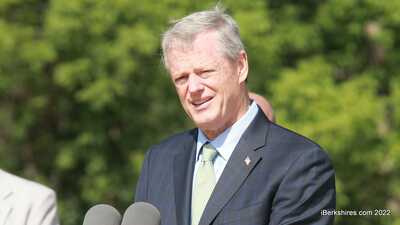
Gov. Charlie Baker speaking in Adams on Tuesday.
ADAMS, Mass. — As children throughout the county return to school this week, Gov. Charlie Baker said Tuesday that he was confident public schools have supports they need to address learning gaps coming out of the COVID-19 pandemic.
 
While face coverings, social distancing, remote learning and "hybrid" schedules largely are a thing of the past, the education deficits created by the pandemic have been front of mind for school officials for more than two years.
 
During a stop in Adams on Tuesday, Baker said he believed the commonwealth has adequately supported school districts to deal with that issue.
 
"We certainly believe the resources the state put out through the Student Opportunity Act and some of the elements that were in the budget that we signed recently should mean the locals have what I would describe as the tools and the resources to deliver on a decent year for kids," Baker said. "I think the last couple of years for kids — and adults who teach and work in the school system — have been very challenging."
 
Baker was in the Mother Town to herald the groundbreaking for the Greylock Glen Outdoor Center.
 
As the calendar turns from August to September, the two-term Republican governor has been focusing a lot on what educators hope will be the first full "normal" year of public school education since the 2018-19 academic year.
 
Last week in Boston, the Baker-Polito administration announced it would seek nearly $40 million in supplemental budget requests in the coming weeks to support safety-related infrastructure spending for schools.
 
Included on the administration's wishlist were matching grants for security and communication upgrades in K-12 schools and colleges, grant funding for an anonymous "tip line" to report potential threats, ongoing emergency response training for school officials and funding for a statewide "Say Something" public awareness campaign.
 
"These safety proposals would support a huge range of children and students, from those in child care to those at public colleges and universities," Education Secretary James Peyser said in a statement last week. "The key to these proposals is collaboration among different state agencies and different local entities. When we invest in strengthening partnerships between school districts and first responders, we help ensure that schools are safe environments focused on learning and growing."
 
Lt. Gov. Karyn Polito agreed.
 
"Children, teachers and staff deserve to feel safe in the classroom, and our administration’s funding proposal will invest in the resources and programming required to equip school communities and emergency personnel with the tools they need to keep schools safe," she said. "We look forward to working with our colleagues in the Legislature to provide critical funding for districts across the commonwealth."
 
On Tuesday, Baker pointed to past investments in programs to help keep K-12 students from falling behind during the pandemic.
 
Some of that federal money passed through the state to local school districts will continue to benefit children going forward, he said.
 
"Last year and this year, we ran pretty extensive summer school programming, which is more enrichment programming than anything else," he said. "Many hundreds of communities in Massachusetts participated in it. Some of them did their own with the federal money they have. There's still about a billion dollars in federal [Elementary and Secondary School Emergency Relief Fund] money available to school districts to spend on — whether it's after-school programs or enrichment programs or programs associated with learning loss.
 
"They can also use it for testing. There's a wide variety of things they can use that money for."

Tags: COVID-19,   schools,   


More Coronavirus Updates
Keep up to date on the latest COVID-19 news:


If you would like to contribute information on this article, contact us at info@iberkshires.com.

Adams Fire Deliberates Next Steps on Retirement Mandate

By Breanna SteeleiBerkshires Staff

ADAMS, Mass. — The Fire Department is seeking clarifications on how the state's mandatory retirement age for firefighters will affect its older members who aren't involved in firefighting. 

Earlier this month, the Fire District questioned the impact of the retirement mandate after four Dalton firefighters, including the interim chief, had to retire.

During a workshop on Monday, board members said they will seek a legal opinion regarding the district's available options. With Chief John Pansecchi set to retire, First Assistant Engineer David Lennon intends to run for the chief position, while Edward Capeless plans to run for Lennon's current role.

Pansecchi went over some of the department's policies, stating that members 65 and older are just support members and are exterior only (as opposed to entering a building).

The board is looking to also clarify its insurance related to what ages it covered. 

"We have documentation that in 2021 our insurance company said that we were covered for everything, but after 70 we weren't covered for heart circulation. We're trying to verify the current age," Pansecchi said, stating the company may have changed its policies.

He also would like to know if the district creates a separate support person, what would be needed to make sure they cover their insurance bases.

Lennon brought examples from other communities which have had to deal with the mandatory retirements and how they used home rule petitions through the Legislature to keep older firefighters on. Some had done it by department and some by individuals, and got district meeting votes before applying. 

They plan to ask state Rep. John Barrett III to guide them on a home-rule petition as well as look at sample language from others who have applied.

Lennon suggested having fire company members who are 65 and older not wear fire gear at a scene,  but rather a coat or vest that will show they are affiliated with the department.

"What we would like to do, to keep the Prudential Committee comfortable with what's going on, because we do want to have safety for all of our firefighters," he said. "The safety of my guys that are inside are directly affected by the person I have outside. So he's making judgement calls, and he's getting resources that we need, and there needs to be somebody to do that.

"And when take some of those people away that can do that, but can't be interior, we remove more interior people, which is not advantageous."

He said Capeless is a valuable asset as he usually is outside of the fire.

"We just had a structure fire, and the way that worked was, we got to work. We took over command, stayed outside. He did the radio work. He got resources while the people were inside. Now, if we take that out of that picture, that means one of the people working [inside] has to now go outside, and so that's where we come down to," Lennon said.

The team is also working with legal counsel to find out if support members should be driving the vehicles and what other liability exposures there might be.

Pansecchi said the department is comprised of a core of 15 members and will lose one once he leaves next month, and the loss of another five affected by the mandate will have a deleterious impact.

"Thirty-three on the roster. If you remove these five individuals, bring us down to 28 out of those, one's on regular military leave, two apprentices have not been showing up and may be removed in their future, one of the engineers has not responded to a call in months," he said. "That brings us down to 23 then we have about eight members, not including the above members, that have made less than 10 percent of the calls." 

Board members agreed to start the uniform differential with the older members and said  they will consider next once they have more information.

View Full Story

More Adams Stories