image description
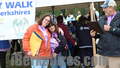
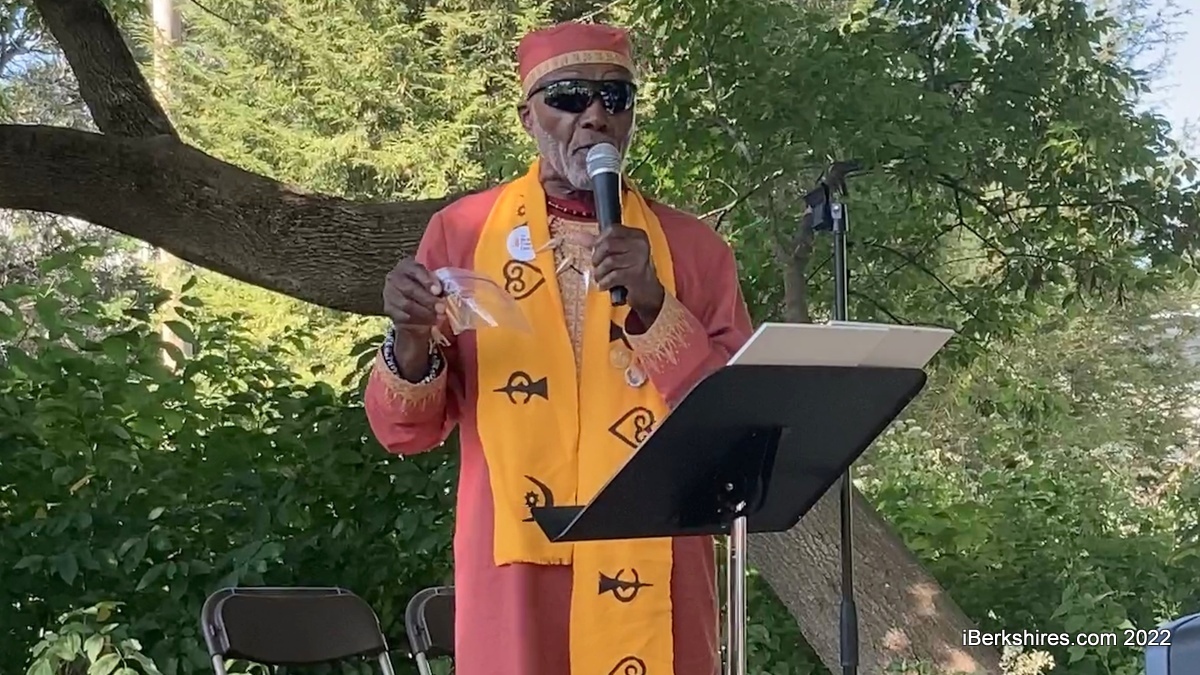
Berkshire NAACP President Dennis Powell holds the vial of water from Accra, Ghana, that will be poured into the water of the Housatonic in honor of W.E.B. Du Bois.
image description
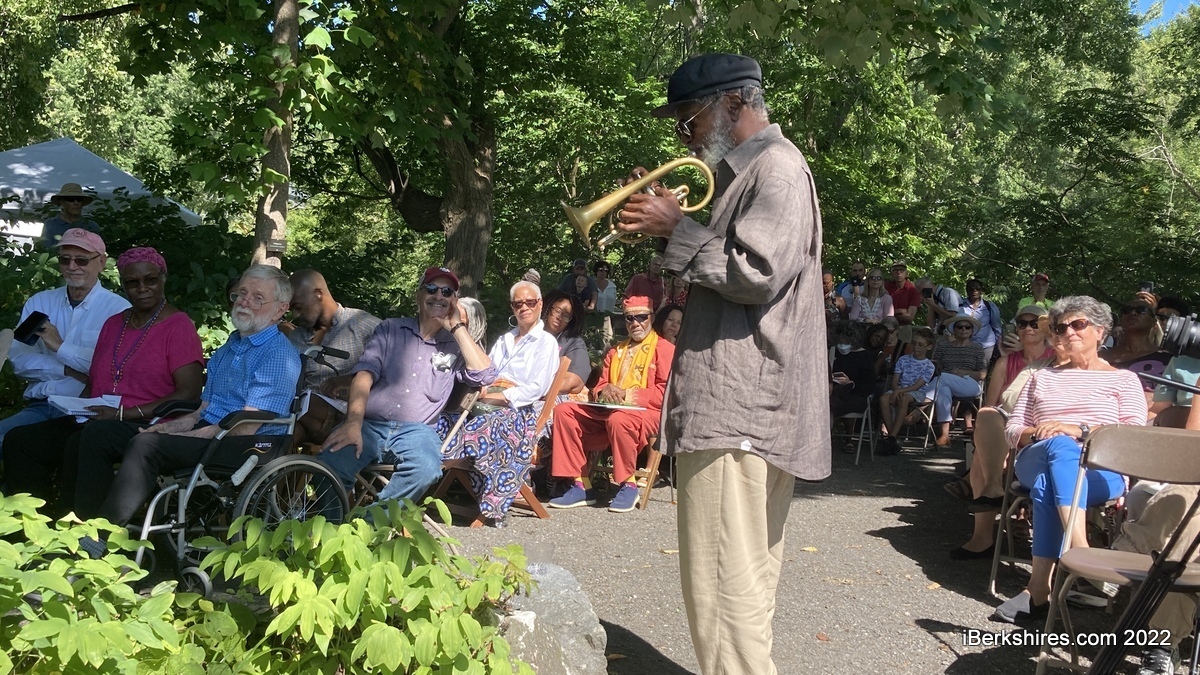
Cornetist/trumpeter Graham Haynes performs at last Saturday's ceremony.
image description
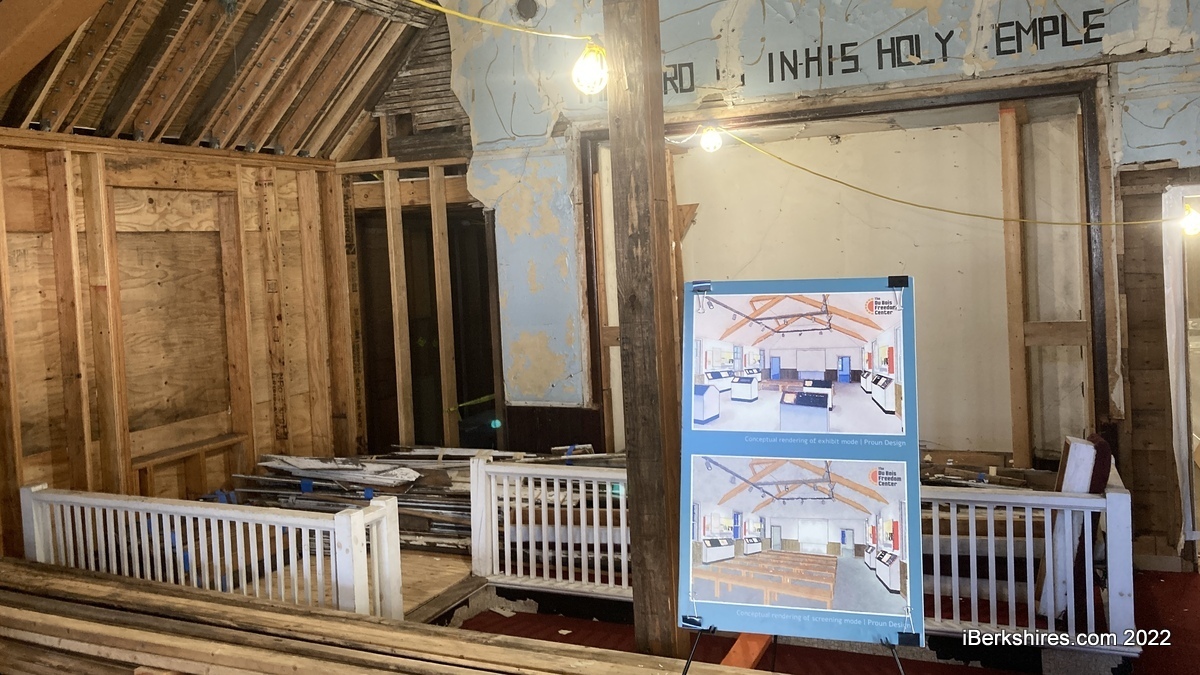
Designs shown for the future rehabilitation of Clinton Church.

W.E.B. Du Bois Honored on 59th Anniversary of His Death

By Brittany PolitoiBerkshires Staff
Print Story | Email Story

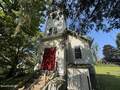
Clinton AME Zion Church, which is on the National Register of Historic Places, is being renovated to become a cultural hub on the Upper Housatonic Valley African American Heritage Trail.

GREAT BARRINGTON, Mass. — Community members last week celebrated W.E.B. Du Bois' legacy on the 59-year anniversary of his passing.

The Saturday, Aug. 27, event, "W.E.B Du Bois: I've Known Rivers," included readings, music, and history at the River Park named after the late sociologist, historian, and civil rights activist.

William Edward Burghardt Du Bois was born in Great Barrington in 1868. He would go on to attend the University of Berlin, become the first African American to earn a doctorate from Harvard, helped found the NAACP and become a leading proponent of the Pan-African movement. Among  his many works, his best known may be "The Souls of Black Folk," a collection of essays, and "Black Reconstruction in America."

"Today is really a remarkable collaboration of so many groups and individuals that really care about W.E.B DuBois and the principles that he fought for," the Housatonic River Walk's founding Director Rachel Fletcher said.

Fletcher pointed to Du Bois' writings about being "born by a golden river" and said the event could not have been held closer to the spot he referenced.  

The park was dedicated in 2002 to honor Du Bois' love of the Housatonic and his environmental activism, which were only two of the many things he championed.  It is on the Upper Housatonic Valley African American Heritage Trail.

"Today is Aug. 27. In 1963, that was the eve of the great March on Washington for jobs and freedom. It was also the day of Du Bois' passing in Accra, Ghana," Fletcher said.

A hallmark of the event was the release of waters from Accra that Berkshire NAACP President Dennis Powell collected during his 2019 trip for the "Year of Return," which marked 400 years of the arrival of the first documented enslaved Africans in Jamestown, Va., and 400 years of African resilience.

Powell brought water from the Housatonic to Accra — where Dubois was buried — three years ago and brought water back to release in the river near his birth site, completing the circle of life.


He explained that he has been safeguarding the vials of water from the Pra River, also known as the "Slave River" or the "Last Bath River."

"It is a beautiful spot and it is the confluence that is complicit with crimes against humanity," Powell said.

"The location is known as the Slave River, the Last Bath River, the last path enslaved Africans took on the continent before being sold to the Caribbean, the Americas, and a life of chattel slavery."

He described the treacherous journey that enslaved people endured or succumbed to. Survivors had a brief respite from their inhumane journey and a chance to be in their land of birth one last time, Powell said.

"As I hold the vials I still think about standing down and those cold running waters as it ran through my (feet) and the energy that came from that river wasn't just water in that river," he added. "That river was full of life. Full of spirit."

As he stood there in the water and visited the caves where people were held, he said, "what this tells me is that my ancestors made this journey and now I am back home."

The event included a collaborative reading of Du Bois' speech "The Housatonic River" delivered more than 90 years ago in Stockbridge and which was the blueprint for much of the River Walk.

The event ended with a ceremony at the historic Clinton African Methodist Episcopal Zion Church, which is the site of a revitalization effort that aims to bring light to Great Barrington's African American history and highlight Du Bois' place of birth and boyhood.


Tags: du bois,   W.E.B Du Bois Center,   
If you would like to contribute information on this article, contact us at info@iberkshires.com.

Sheffield Craftsman Offering Workshops on Windsor Chairs

By Breanna SteeleiBerkshires Staff

Andrew Jack uses hand tools in his wood working shop. 

SHEFFIELD, Mass. — A new workshop is bringing woodworking classes and handmade items.

Andrew Jack specializes in Windsor chairs and has been making them for almost 20 years.

He recently opened a workshop at 292 South Main St. as a space for people to see his work and learn how to do it.

"This is sort of the next, or latest iteration of a business that I've kind of been limping along for a little while," he said. "I make Windsor chairs from scratch, and this is an effort to have a little bit more of a public-facing space, where people can see the chairs, talk about options, talking about commissions.

"I also am using it as a space to teach workshops, which for the last 10 years or so I've been trying to do out of my own personal workshop at home."

Jack graduated in 2008 from State University of New York at Purchase, and later met woodworker Curtis Buchanan, who inspired him.

"Right after I finished there, I was feeling a little lost. I wasn't sure how to make the next steps and afford a workspace. And the machine tooling that I was used to using in school." he said, "Right after I graduated, I crossed paths with a guy named Curtis Buchanan, and he was demonstrating making really refined Windsor chairs with not much more than some some flea market tools, and I saw that as a great, low overhead way to keep working with wood."

Jack moved into his workshop last month with help from his wife. He is renting the space from the owners of Magic Flute, who he says have been wonderful to work with.

"My wife actually noticed the 'for rent' sign out by the road, and she made the initial call to just see if we get some more information," he said. "It wasn't on my radar, because it felt like kind of a big leap, and sometimes that's how it's been in my life, where I just need other people to believe in me more than I do to, you know, really pull the trigger."

Jack does commissions and while most of his work is Windsor chairs, he also builds desks and tables, and does spoon carving. 

Windsor chairs are different because of the way their backs are attached into the seat instead of being a continuous leg and back frame.

"A lot of the designs that I make are on the traditional side, but I do some contemporary stuff as well. And so usually the legs are turned on a lathe and they have sort of a fancy baluster look to them, or they could be much more simple," he said. "But the solid seat that separates the undercarriage from the backrest and the arms and stuff is sort of one of the defining characteristics of a Windsor."

He hopes to help people learn the craft and says it's rewarding to see the finished product. In the future, he also hopes to host other instructors and add more designs for the workshop.

"The prime impact for the workshops is to give close instruction to people that are interested in working wood with hand tools or developing a new skill. Or seeing what's possible with proper guidance," Jack said. "Chairs are often considered some of the more difficult or complex woodworking endeavors, and maybe less so Windsor chairs, but there is a lot that goes into them, and being able to kind of demystify that, or guide people through the process is quite rewarding."

People can sign up for classes on his website; some classes are over a couple and others a couple of weekends.

"I offer a three-day class for, a much, much more simple, like perch, kind of stool, where most of the parts are kind of pre-made, and students can focus on the joinery that goes into it and the carving of the seat, again, all with hand tools. And then students will leave with their own chair," he said.

"The longer classes run similarly, although there's quite a bit more labor that goes into those. So I provide all the turned parts, legs and stretchers and posts and things, but students will do all the joinery and all the seat carving the assembly. And they'll split and shave and shape their own spindles, and any of the bent parts that go into the chair."

His gallery is open Wednesday through Sunday 10 a.m to 2 p.m., and Monday and Tuesday by appointment.

View Full Story

More South Berkshire Stories