Pittsfield Tax Rate Drops, Tax Bills Rise for Fiscal 2023
 |
PITTSFIELD, Mass. — It took the City Council less than an hour on Tuesday to approve a split tax rate that will see the average homeowner's property tax bill increase 8 percent.
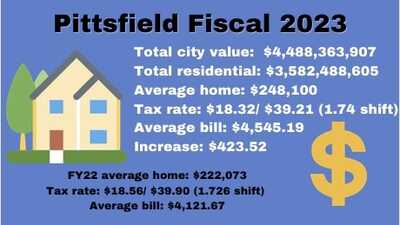
The residential rate for fiscal 2023 is $18.32 per $1,000 of valuation and the commercial, industrial, and personal property rate of $39.21.
This is a 24 cent decrease from last year's residential rate of $18.56 and a 69 cent decrease from the commercial tax rate of $39.90.
Despite the lower rate, average tax bill for a single-family home will increase by about $420. The rise if value is primarily due to housing sales in 2021. The average single-family home was valued at more than $248,000 at the time of the assessment in January, up $26,000 from the previous year.
The FY23 tax rates represent a commercial shift factor of 1.74. The city will levy of $101,150,561.84 to cover this year's budget; the levy limit is $104,649,832.
There was a $393,212,727 increase in real and personal property values over fiscal 2022, bringing the city's valuation to $4,488,363,907. The residential valuation is $3,582,488,605.
The tax classification passed with Ward 2 Councilor Charles Kronick, Councilor at Large Karen Kalinowsky, and Ward 1 Councilor Kenneth Warren voting in opposition. Ward 7 Councilor Anthony Maffuccio was absent.
Kronick unsuccessfully motioned to use $3 million in free cash to reduce the burden on homeowners, a move that was described as a "short-term, short-gain strategy" by the city's finance director, Matthew Kerwood.
"What I want is to keep the people in their homes because they can't afford to spend more money on their property taxes than they are spending on interest and principle combined," the councilor said.
Kalinowsky said the city is over-taxing residents and that residents are paying more for basic needs such as oil, gas, and food.
"I think we can do something for our residents," she said. "I don't think our residents can, some of them, afford the tax increase due to what their houses were valued at in January."
Kronick, Kalinowksy, and Warren were the only votes in favor of using free cash while the rest of the council argued against depleting the city's reserves for what they felt was a negligible impact. Some quick math showed that this would save residents about $75.
"We believe that saving those reserves is essential for the fiscal stability of our city," Mayor Linda Tyer said. "So I do not think this is a wise decision."
Tyer said the administration feels strongly about having reserves in the savings account to address emergencies, citing a "significant fiscal crisis" when she took office that prompted recovery goals.
She explained that the city's free cash has not yet been certified by the Department of Revenue and cannot be committed but when it is, the council will see a proposal to spend a "significant amount" on body cameras for police. This has been widely requested by councilors and the community after the police killing of Miguel Estrella in March.
During budget season, the council voted to appropriate $1 million of free cash to reduce to tax rate.
"The impact to the reserves of a $3 million appropriation is significant. The impact of the tax rate for the taxpayer is not going to be hundreds of dollars, it's going to be something less than a dollar," Tyer later added.
"The other thing that I would say is that we're here this evening to fund a budget that was approved in June. That's the process and the budget that we proposed was lower than the budget that the City Council approved because you asked us to put additional services into the budget and we agreed to do it. ...
"So I think that we've done our part to be as fiscally responsible as possible, and I think this evening is an opportunity for us to balance what's needed in order to fund operations for the city of Pittsfield and protect our reserves."
Councilor at Large Earl Persip III said the city needs to think long-term and appropriating more free cash is not a way to solve the high tax rate. Residents don't want their houses to decrease in value, he pointed out, as it is part of a person's wealth as they get older.
"I won't support $3 million," Persip said. "I think using our reserves for 30 cents, $75 for an average taxpayer just isn't using our money in a smart way."
Kronick highlighted the importance of encouraging new business growth in the city and said American Rescue Plan Act funds should be used to "backfill budget accounts that have been depleted by loss of revenue."
Tyer stressed that the regulations written by the U.S. Treasury specifically prohibit the use of ARPA funds to lower the tax rate.
Warren argued that the city can "get creative" by using it to pay for projects that are in the budget so that the money doesn't have to be raised by property taxes.
"It can be done whether you guys want to do it or not. I understand there's a difference of a view and I agree with the administration for the most part," he said.
"Most of the time you need to plan for the future and there are some good things they have done, I have no problem with that, but I also feel that there is a short-term, short gain situation where we could help our residents because of the pandemic [with] the monies that the federal government gave to allow us to do that."
Tags: fiscal 2023, tax classification,