Pittsfield Council to Tackle Snow Removal Designation
PITTSFIELD, Mass. — To plow or not to plow?
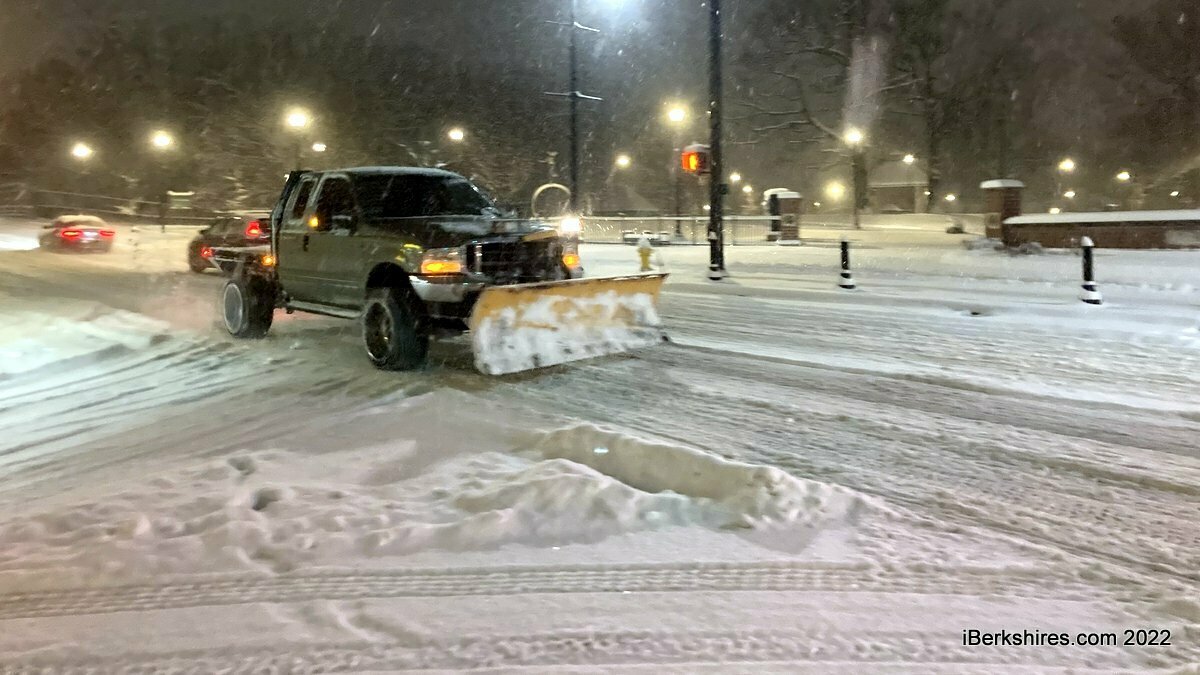
That is what the City Council will determine after Commissioner of Public Services and Utilities Ricardo Morales recommended an ordinance to designate streets for snow removal.
The Public Works subcommittee last week referred the request to the Ordinances and Rules subcommittee to start the process.
Pittsfield adopted a statute in 1945 that allows the council to designate private ways for snow and ice removal if it is within city limits and open to public use, though Morales says this definition is ambiguous.
"In our city code it is silent as to how we do the adding of a private way to be plowed," he said.
He recommends that a number of factors are taken into consideration when approving a private way for services.
These include:
- Road design relative to safe plowing
- Degree to which the road handles public traffic, relative to other roads
- Timing of request by petitioners, relative to the winter season
- Relative number of residents using the road
- Length of road per resident or relative to its importance for maintaining traffic
- Circulation or alternate routing
At a recent seminar, unaccepted streets were also discussed as being under the umbrella of private ways. This needs to be addressed as well.
"I believe at the end of the day the important thing to note is that no matter what that legal ambiguity is, the City Council can take the rein and decide and codify what the process can be to essentially eliminate that ambiguity and I think that's the prudent thing to do," Morales said.
Before the snow season last year, the council voted to include streets on four private developments per the request of residents: Walden Lane, Alpine Trail, Woodmonte Estates, and Churchill Crest.
Of the approved developments, the city has only started plowing in one. Another decided that it was more beneficial to stay with a private contractor.
Ward 1 Councilor Kenneth Warren made it clear that he wants dead-end ways to be considered for plowing like every other street.
"Just because it's a dead end does not mean that it's not open to the public and the public can't get use and it's only for those people on the road," he said.
Morales agreed in terms of roads that are accepted.
He pointed to the Supreme Judicial Court's opinion that states "'open to public use' as applied to a private way naturally means that such way is actually susceptible of use by the public other than for the purposes that are merely incidental to the use of the way by the owner thereof, and also that the way is open to the public at large for purposes of travel, not merely incidental to its use by the owner thereof, in a manner similar to the ordinary use for purposes of travel of a public way of the same general nature."
"And I leave it there because I believe the municipality, any municipally still has the option to weigh one way or another and I recognize that," Morales said.
Ward 3 Councilor Kevin Sherman said it sounds like the two agree that it is not so much the application as it is the implementation.
He recognized that there are a lot of nuances that need to be taken into consideration.
"What this isn't doing, I don't think, is just saying that we are going to take every single street and plow it now," he said.
‘We're going to give consideration for qualifications for certain streets as brought up to the city council but we want to have it in a code so that we get rid of the ambiguity."
Sherman also recognized that there are unaccepted streets that are clearly residential and would not support taking all paper streets off the plowing list.
"We're going to do the right thing and get the right streets done is the point," he said.
The panel also spoke about a potential window of time for residents to request plowing services on their street so that the Department of Public Works has time to prepare to add them to the roster. Councilors supported having a schedule but taking considerations out of that time period if needed.
A petition from Ward 2 Councilor Charles Kronick requesting a review of free plowing services offered to private ways in 2022 was filed because the panel felt that it was a part of the larger conversation they had just referred off.
Tags: plowing,