Pittsfield Homeless Committee Gets Look at Hub Program
PITTSFIELD, Mass. — The Pittsfield Hub is said to be effective for both the people it treats and service providers.
Established last year, it is a pooling of social services and police that meet virtually every other week to review cases of mental illness, substance abuse, poverty, and other issues that plague the area.
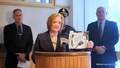
Sgt. Lindsey Maynard of the Berkshire County Sheriff's Office has been running the program for about a year and said that when used correctly it is an effective tool. She gave a presentation of the program to the Homelessness Advisory Committee at its Wednesday morning meeting.
"The individuals that we discuss at the Hub table are people who we consider an acute elevated risk," she told the committee. "Typically that means individuals or families who if we do not intervene, the harm will continue, that worse things will happen, that it's a danger to the community or a danger to that individual and family."
The Chelsea Police Department created the model, as the community's crime rates per capita were some of the highest in the entire country.
Human service agencies work with law enforcement to better serve the homeless population and those struggling with mental health and addiction issues. This includes the Berkshire County District Attorney's Office, the Berkshire County Sheriff's Department, Berkshire Health Systems, the Brien Center, ServiceNet, the state Department of Children and Families, 18 Degrees, and the Berkshire County Regional Housing Authority.
Maynard reported that the Pittsfield Hub meets weekly, beginning with discussing situations from previous meetings and then any new ones.
If there is a provider who wants to present a situation, they will be asked to disclose non-identifiable information such as gender, age range, language, and then a list of risk factors.
The sergeant would then ask if there is verbal or written consent and would then ask the group to decide if there is a high predictability of harm in need of intervention.
"The table would make a decision based on the information," Maynard said. "Again, it's not identifying an individual person yet."
If they are determined to be an acute risk, a name, date of birth, and last known address are given and often will be recognized by one of the providers. When the individual is not recognized, a team is built to address the person's needs.
That would then become a "filter four" discussion and the individuals assigned to the situation would brainstorm a door knock to get the person out of elevated risk in the next couple of days.
Maynard said sometimes the person cannot be located after or they become reluctant to get help.
"I think the premise behind this is that we're trying to catch people ultimately at times, upstream versus downstream," she explained.
"So we are trying to help people not reach that level of crisis where it's hard to come back up or something worse happens or they're debilitated or a community is being harmed because of it."
Right after the committee's meeting, she would be working with a female in her 20s who was connected with housing, is working on an emergency voucher for an apartment, and has been connected with a mentor at the Brien Center.
"And then I'm going to ask the table 'Are we going to close out this situation? Has this person been connected to services?'" Maynard explained.
"The table at that point is going to probably say, 'Yes, this person is connected to services.' That doesn't mean the people that were assigned to help that individual don't keep working with her. They continue doing case management to continue helping her guiding her along that process but it's no longer an open situation at the Hub team. We've helped her get her needs met or connected to the appropriate resources to get her needs met. We close her out at the table but that doesn't mean in two weeks if she's an acute elevated risk again, something goes awry and she needs the additional help again, that we can't open her back up. So that's kind of the process in a nutshell."
Erin Forbush, director of shelter and housing at ServiceNet, pointed out that the Hub helps all of the people at the table create good connections and work well together. She said the team is always looking for more members in the provider community.
"I think one of the important pieces of it is that we're not only helping our community members, we're helping each other," Maynard said.
Chair Kim Borden, who is the director of the tenancy preservation program and related services at the Berkshire County Regional Housing Authority, said she was excited to see this model come to the area.
Tags: Hub, social services,