Jacob's Pillow Welcomes Associate Artistic Director
Print Story | Email Story
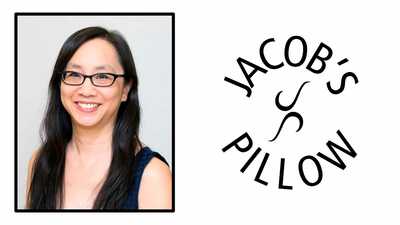
BECKET, Mass. — Jacob's Pillow announced that Kim Chan will join the organization's curatorial and leadership team as Associate Artistic Director, an enhanced full-time staff position that begins January 22. 
 
In this role, Chan will oversee several administrative departments at the organization, with a program portfolio encompassing archives and preservation, audience engagement, community engagement, in-person performances, artist residencies, and The School at Jacob's Pillow.
 
Chan will also serve on the curatorial team at Jacob's Pillow, identifying artists to perform at the Jacob's Pillow Dance Festival (which will celebrate its 92nd season in summer 2024) and to participate in the Pillow Lab year-round residency program. With Chan, the curatorial team is composed of Jacob's Pillow Executive and Artistic Director Pamela Tatge (since 2016), Associate Curator Melanie George (since 2020), and International Advisor Cathy Levy (since 2022), and is supported by Producing Director Holly Jones.
 
Additionally, the Associate Artistic Director position will be responsible for integrating Jacob's Pillow's programming areas operationally and strategically with an eye to achieving the organization's Inclusion, Diversity, Equity, and Access (IDEA) goals. Over the next five years, Chan and Tatge will also collaborate on facilitating a deeper digital integration of Jacob's Pillow's programming areas.
 
"We are greatly looking forward to welcoming Kim into our growing year-round staff, and I am excited to work closely together as we set the strategic direction of programming at the Pillow," said Tatge. "The Pillow's Associate Artistic Director will be a strong partner to colleagues in the field, bringing progressive ideas back to the team, and challenging the organization to innovate and remain relevant in a changing world. Kim's strengths, wide-ranging expertise, and her overall compassion and intelligence make her an excellent fit for this role."
 
Chan said she is "thrilled and honored" to contribute to Jacob's Pillow's legacy in partnership with the Pillow staff and curatorial team. "Dance is a lifelong passion," she said, "and Jacob's Pillow has fed that passion throughout my career. I am also excited to participate in the leadership that the dance field brings to today's cultural sector, and how the Pillow can further its mission by establishing and nurturing coalitions with artists and peers to shape our collective futures with equity, strength, and creativity."

Tags: jacobs pillow,   
If you would like to contribute information on this article, contact us at info@iberkshires.com.

Pryor & Peacock's Whimsical Furniture Environmentally Friendly

By Breanna SteeleiBerkshires Staff
 

The company uses digital printing to create the upholstery fabric, saving water and saving vintage furniture from ending up in landfills.

STOCKBRIDGE, Mass. — A unique furniture store has popped up on Elm Street this month.

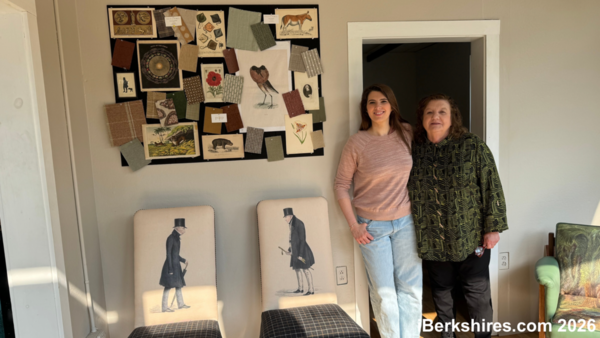
Mom-and-daughter store Pryor & Peacock is hosting the pop-up storefront from Aug. 13 to Aug. 25 at 6 Elm. The New Marlborough business is co-founded by Rosalina Wright and Luca Shapiro, who is also the creative director. 

Their online shop was created in 2024 but they wanted people to see the pieces in person, so they're renting the space for a limited time before a long-term tenant moves in.

The store sources prints to create unique fabrics and reimagines vintage and antique furniture acquired at auctions, local shops, and online.

"We source prints from all over the world that date from the late 1600s up through mid-20th century, and Luca turns those prints into fabric by manipulating them, scanning them, oftentimes has to add or subtract things, and then we manufacture the fabric using only digital printing, which is very environmentally friendly, unlike traditional textile printing," Wright said.

Upholstering the furniture can take weeks of work. Shapiro looks for the perfect design for each piece and, if need be, uses Adobe Photoshop to extend the art work to fit or enhance the print.

"One of the most difficult parts comes in marrying the fabric to a piece of furniture because we only use antique and vintage frames also to be earth friendly, and they're also more beautiful and durable than new furniture," Wright said. "So the image has to go with the furniture, so that takes a lot of work."

One of Pryor & Peacock's missions is to be environmentally friendly. Digital printing doesn't use the same amount of water as traditional textile productions do nor does it contaminate water with ink according to their website.

Not only are they saving water, but they are saving furniture from going into the landfill while also using more durable furniture that doesn't break as easily as current pieces. They started their business to create something unique and to help the environment together.

"It's creating something nobody else is doing. People can't continue to buy throwaway furniture. Six percent of American landfills is furniture, and digital printing not only opens up the possibility of being able to put unique images on a piece of furniture, but it also is, as I said, environmentally friendly. So, for us, the excitement is to take an old East Lake settee that somebody's going to store in their barn and forget about, and make it something completely new and surprising," Wright said.

They hope their furniture helps bring a pop of fun to someone's home.

"We think our furniture is very whimsical and surprising, and most furniture today is oatmeal colored couches and gray neutral chairs, and it's boring," she said.

The two named their business after their mothers' maiden names to honor them and believe the name reflects their pieces.

Shapiro works in interior design outside of the business and the two liked working together and thought it would be great to start a business together. Shapiro says they can work well together and that her and her mother, Wright, has flipped houses before and have the same eye for design.

"So it's very easy for us to work together. When we see something, generally we agree on whether it works or doesn't work on a piece. We agree on the color schemes and that sort of thing. So it's very fun and fulfilling to work together," Shapiro said. 

View Full Story

More South Berkshire Stories