HooRWA: What Happens on Land Doesn’t Stay on Land
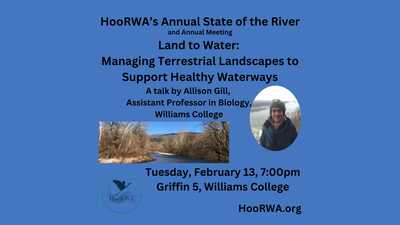 |
WILLIAMSTOWN, Mass. — Ecosystem ecologist Allison Gill will talk on "Land to Water: Managing Terrestrial Landscapes to Support Healthy Waterways" at the Hoosic River Watershed (HooRWA)'s State of the River and Annual Meeting, Tuesday, Feb. 13 at 7:00 p.m. in Williams College's Griffin 5.
She will discuss how the way people treat land impacts waterways, like the Hoosic River.
All are welcome. No registration needed for this free program co-hosted by Williams College Center for Environmental Studies.
A brief Annual Meeting of the Hoosic River Watershed Association (HooRWA) will proceed the presentation, with a review on some of HooRWA's major activities, the presenting of the Tanzman Friend of the River Award, and an election of board and officers.
Upland forests, meadows, residential streets, and agricultural fields can be critical nutrient sources to local waterways. Their land use and management are a key to protecting water and aquatic habitat quality. Allison Gill will discuss land-based strategies to support healthy waterways at local to regional scales.
Issues include protecting and building organic matter in the soil to reduce nitrate leaching; supporting biodiverse communities that maximize nutrient uptake on land; and planning municipal leaf removal programs to minimize phosphorus getting to waterways through storm drains and sewers. Together, she believes, such management strategies can support efficient nutrient cycling on land ecosystems and limit the problems of nutrient loading in our rivers.
An assistant professor of biology at Williams, Gill received a BA from Mount Holyoke College, a PhD from Boston University, and was a Grand Challenges in Biology Postdoctoral Fellow at the University of Minnesota. Her research is published in journals including Ecology Letters, Global Change Biology, Biogeochemistry, Soil Biology & Biochemistry, Plant & Soil, and Ecosystems. Her research focuses on how interactions between plants and microorganisms influence carbon and nutrient cycling in forest, grassland, and wetland soils, and considers how these processes respond to global change.
Griffin Hall is the building to the east of the college chapel on Main Street, Williamstown. Parking is behind the chapel. Room 5 is upstairs. Light refreshments provided.