Seiji Ozawa, Longtime BSO Conductor, Dies at 88
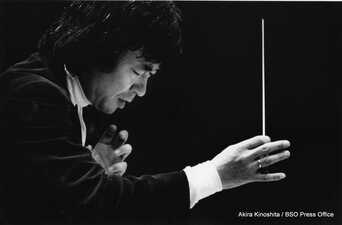 |
| Seiji Ozawa conducting in 1983. The maestro died on Feb. 6 at age 88. |
LENOX, Mass. — Longtime Boston Symphony Orchestra conductor Seiji Ozawa died Feb. 6 in Tokyo at the age of 88.
Ozawa was the orchestra's longest serving conductor and held the title of music director for 29 years until stepping down in 2002. Seiji Ozawa Hall on the grounds of BSO's summer home Tanglewood was opened in his honor in 1994.
One of his generation's most sought-after and celebrated conductors, Ozawa was born in Shenyang, China, in 1935 and from a young age studied piano and then conducting (under Hideo Saito) in Japan.
He burst upon the musical scene in 1959, winning First Prize at the International Competition of Orchestra Conductors held in Besançon, France, and was invited the next summer to Tanglewood by then BSO Music Director Charles Munch, who was a judge at the competition. Later mentorships with Leonard Bernstein and Herbert von Karajan quickly propelled his career to directorships of the Toronto Symphony, San Francisco Symphony, Chicago Symphony's Ravinia summer festival, and finally the Boston Symphony where, in 1973, he became the orchestra's 13th music director, succeeding William Steinberg.
Under Ozawa, the Boston Symphony entered a global era, through a renewed commitment to commissions and contemporary music, a prolific number of recordings, radio, and television appearances, and history-making tours. He championed many of the most important composers of the late 20th century, including Henri Dutillleux, Peter Lieberson, Olivier Messiaen, and Toru Takemitsu; a total of 44 compositions were commissioned under his tenure, three of which went on to win Pulitzer Prizes in Music.
Award-winning recordings of more than 140 works were also among his output, featuring distinguished artists such as Yo-Yo Ma, Jessye Norman, Itzhak Perlman, and Peter Serkin. He won two Emmy Awards: in 1976, for PBS' "Evening at Symphony" and in 1994, for Individual Achievement in Cultural Programming for "Dvo?ák in Prague: A Celebration."
_001.jpg)
Ozawa with Leonard Bernstein in 1980.
After leaving the BSO, Ozawa was music director of the Vienna State Opera but maintained his connection to Tanglewood and its music center as a mentor for young musicians. He also was a founder of the Saito Kinen Orchestra in 1984 and several international projects and academies to train and cultivate young musicians.
"I am greatly saddened to hear the news of Seiji's passing. Without question, Seiji Ozawa was one of the world's greatest conductors, and the Boston Symphony Orchestra was privileged to have had such a long and productive relationship with him as music director," said Andris Nelson, music director and head of conducting at Tanglewood. "I will always be grateful to Seiji for the kindness and warmth he showed me. I also recall so well and appreciate his enthusiasm for the city and people of Boston, Tanglewood — and the Boston Red Sox! He was a musician with a big heart, and I will greatly miss his humanity and serene grace. My thoughts are with Seiji's family at this challenging time."
Content provided by Berkshire Symphony Orchestra.
Tags: BSO,