image description
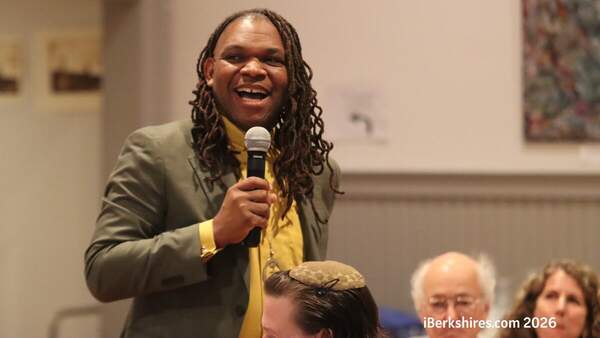
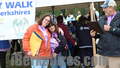
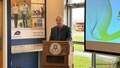
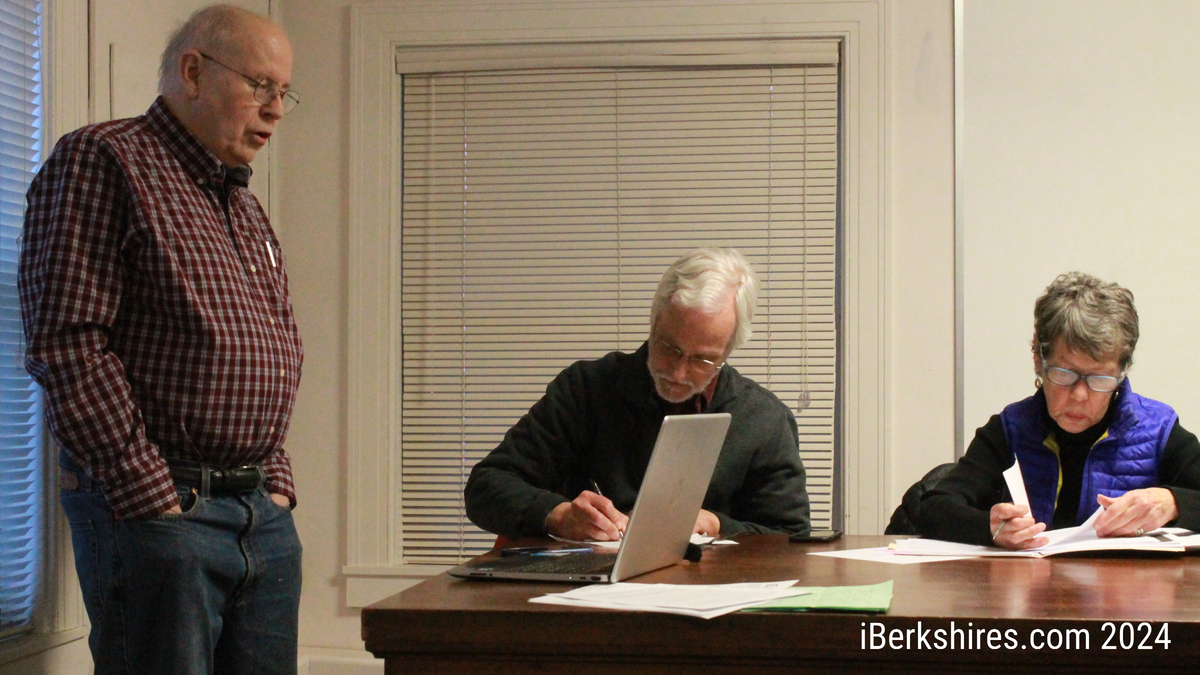
Keith Davis of Northern Berkshire Habitat for Humanity, left, addresses the Affordable Housing Trust last week. Andrew Hogeland, center, and Ruth Harrison attended the meeting in person. Three other members participated remotely.

Habitat for Humanity Plans Wednesday Info Sessions on Williamstown Development

By Stephen DravisiBerkshires Staff
Print Story | Email Story
WILLIAMSTOWN, Mass. — Northern Berkshire Habitat for Humanity will hold two information sessions this spring for residents interested in a planned five-home development off Summer Street.
 
The non-profit will explain more about the project on Wednesday, March 27, and Wednesday, April 3, at 7 p.m. at the Harper Center on Church Street.
 
The 1.75-acre lot currently is owned by the town's Affordable Housing Trust, which acquired it and a parcel at the corner of Cole Avenue and Maple Street for the purpose of developing income-restricted housing.
 
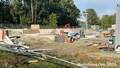
Northern Berkshire Habitat built two homes on the Cole-Maple site and has turned its attention to Summer Street, where it hopes to build a small road onto the property and divide it into five quarter-acre building lots.
 
"At these information meetings we plan to share a site plan and a floor plan and exterior building view of the proposed houses," according to a post on the Northern Berkshire Habitat for Humanity's Facebook page. "All houses will be a single floor ranch style house with a low angle roof to fit into the character of the neighborhood."
 
Last week, the president and project manager for the non-profit was in front of the board of the Affordable Housing Trust to talk about how the trust will distribute $120,000 to support the Summer Street project.
 
Originally, the board had talked about releasing the money to developer Northern Berkshire Habitat for Humanity in three installments: $60,000 to build the road, $30,000 for the first house and $30,000 for the second house.
 
Affordable Housing Trust Chair Andrew Hogeland told his colleagues he suggested a time frame that would have the last disbursement by the end of calendar year 2026 as a way to finish spending the American Rescue Plan Act funds in the AHT's coffers before the ARPA deadline.
 
NBHFH's Keith Davis came to the board at its March 20 meeting with a counter proposal: $60,000 for the road and $60,000 for the first house to be built on the site.
 
"We don't have a permitted project," Davis explained. "We don't know if the Planning Board will approve it. We have a site plan. We have a floor plan worked out. I'm not sure we'll be able to go to the Planning Board in May. It may be June.
 
"Until we have an approved plan, it's hard to ask contractors to build [a road]. So you can't go out to bid. I'm concerned we may not get the road done this year. … Putting the road in and trying to build two houses in two years will be difficult for us."
 
The board took no formal action, but the members present agreed in principle that a two-installment distribution would work.
 
Since the Summer Street land is still owned by the trust, the trustees on Wednesday took the formal step of approving Northern Berkshire Habitat's subdivision plan for the lot. That allows the non-profit to bring the proposal to the Planning Board for approval.
 
Hogeland said NBHFH could pursue the development through the commonwealth's Chapter 40B process, which provides relief from local zoning regulations for the purpose of building affordable housing, but getting town approval of the subdivision would be, "a faster way to go."
 
After the development is permitted, the trust will be able to transfer the property to Northern Berkshire Habitat for Humanity, as it did with the Cole/Maple property, Hogeland said.
 
The trustees on Wednesday did agree to allow Northern Berkshire Habitat for Humanity to put a shed on the Summer Street lot before it takes possession of the land.
 
In other business on Wednesday night, the Affordable Housing Trust board approved the latest grant under its DeMayo Mortgage Assistance Program. According to the representative from lender Greylock Federal Credit Union, the recipient is a Berkshire County native currently living and working in the town.
 
Under the DeMayo MAP, first-time homebuyers who meet income eligibility requirements and qualify for a loan with a lender that has a physical presence in town can receive up to $15,000 toward the purchase. The homeowner repays the trust a prorated amount of the grant if they sell the home within five years of purchase.

Tags: affordable housing trust,   habitat for humanity,   
If you would like to contribute information on this article, contact us at info@iberkshires.com.

Students Show Effects of Climate Change in Art Show

By Breanna SteeleiBerkshires Staff

Students from 10 area high schools are showing works that reflect on climate change at the Clark Art this week. The exhibit will move to Pittsfield and Sheffield later. 

WILLIAMSTOWN, Mass. — Students got to showcase their art at the Clark Art Institute depicting their relationship with the Earth in the time of climate change.

"How Shall We Live," a juried art exhibit, was on display Saturday in the Clark's Hunter Studio at Stone Hill. Students from 10 high schools participated.

Climate educational organization Cooler Communities has hosted this show for the past couple of years at different venues across the Berkshires. This year, it was approached by the Clark to host the show and is co-organizing with Living the Change Berkshires.

This was the first year Cooler Communities, a program of the Harold Grinspoon Charitable Foundation, changed its prompt to make it more personal for the students in hopes to start a conversation in the classrooms on climate change.

"In our work with Cooler Communities, we want to really make conversations about climate change normal, so it doesn't just happen in high school science or in activist circles, but for everyone to feel like they have a role to play, and for everyone to explore what it means for them," said Executive Director Uli Nagel.

"And so that's why the work of classrooms rather than after-school programs, but actually have it in the classroom and then bring it to the community and connect it to solutions. That's why the community is here, and so we always try to actually make it real, but also give kids the opportunity to explore their own emotions and interior experiences through art."

The Clark wanted to expand on its Sensing Nature Program and give students a higher impact experience instead of just the program tour that could help fit the criteria for the students’ portrait of a graduate.

The show had 74 displays as well as an iPad that showed other students’ art that was not showcased in the show, which was around 180 submissions.

Students were asked to respond to one or more elements in the following prompt:

  • What does nature provide?
  • What are the Earth's needs?
  • What matters most?
  • What is resilience?
  • Where do you find guidance and inspiration?

Pittsfield High student Stella Carnevale, 16, made her artwork out of newspaper, Mod Podge, chalk, and watercolors. She drew three sardines showing the effect polluted water had on them and wrote in her artist's note that she wants people to pause and feel empathy while also recognizing their role in protecting the natural world.

"Fish are vital to our world. They balance ecosystems, feed communities, and remind us how deeply connected life on Earth is. When our waters are polluted, fish are often the first to suffer, and their disappearance signals a greater loss that affects us all," she wrote. "Pollution doesn't just damage rivers and oceans; it threatens food sources, cultures, and the health of the planet itself. I make art to bring attention to what is quietly being taken away."

She said it was really cool to see her art hanging in the Clark and never thought it would happen.

Wahconah Regional High student, Alexandra Rougeau, 18, painted a jellyfish in acrylics.

"I started off making a different painting that was very depressing, obviously, because it's climate change, and I got really annoyed because everything was so negative," she said. "And although climate change is a really negative part of the world right now, I want to try to show that there is some hope in it. And that we do have some hope in saving our environment. So the jellyfish is meant to depict fire, global warming, but it's in the ocean and it's rising up, and there is some hope, hopefully at the top, in the surface."

Rougeau said it is an honor to be chosen to have her art here and to see all the other depictions from other students.

Monument Mountain High sophomore Siddy Culbreth painted a landscape in oil pastels and said he was inspired by his grandfather who is a landscaper and wanted to depict "what we should save."

"I was picturing this as a quintessential, it's kind of like epitome of what a nice landscape should be like," he said. "And so in terms of climate change, like how that is kind of shifting, or what our idea of like the world is shifting. And I feel like it's really important to preserve what, like, almost not a perfect world, but, what the world should be like."

Some students from Pittsfield High in Colleen Quinn's ceramics class created a microscopic look of what they thought PCBs looked like and wanted to depict how the polychlorinated biphenyls might have affected them at Allendale Elementary, near disposal site Hill 37. 

Quinn said she is very proud of all her students. 

The show is at the Clark until April 26 and is free and open to the public. It will be moved to Pittsfield City Hall to run from May 1 through June 8, and then to Sheffield's Dewey Hall from June 12 through 21.

It is made possible with support from the Feigenbaum Foundation, Lee Bank, and Greylock Federal Credit Union.
View Full Story

More Williamstown Stories