North Street Parking Study Favors Parallel Parking
PITTSFIELD, Mass. — A parking study of North Street will be presented at Tuesday's City Council meeting. The design maintains parallel parking while expanding pedestrian zones and adding protected bike lanes.
The city, by request, has studied parking and bike lane opportunities for North Street and come up with the proposal staged for implementation next year.
While the request was to evaluate angle parking configurations, it was determined that it would present too many trade-offs such as impacts on emergency services, bike lanes, and pedestrian spaces.
"The commissioner has been working with Downtown Pittsfield Inc. and my office to come up with this plan," Mayor Peter Marchetti said during his biweekly television show "One Pittsfield."
"We will probably take this plan on the road to have many public input sessions and hopefully break ground sometime in the summer of 2025."
Working with Kittleson & Associates, the city evaluated existing typical sections, potential parking
configurations, and a review of parking standards. It compared front-in and back-in angle parking and explored parking-space count alterations, emergency routing, and alternate routes for passing through traffic within the framework of current infrastructure constraints.
The chosen option is said to align with the commitment to safety, inclusivity, and aesthetic appeal and offer a solution that enhances the streetscape for pedestrians, businesses, cyclists, and drivers without compromising the functionality of the corridor.
"The potential for increasing parking space is considerable; however, the implications on safety and the overall streetscape call for a balanced approach," Commissioner of Public Services and Utilities Ricardo Morales wrote.
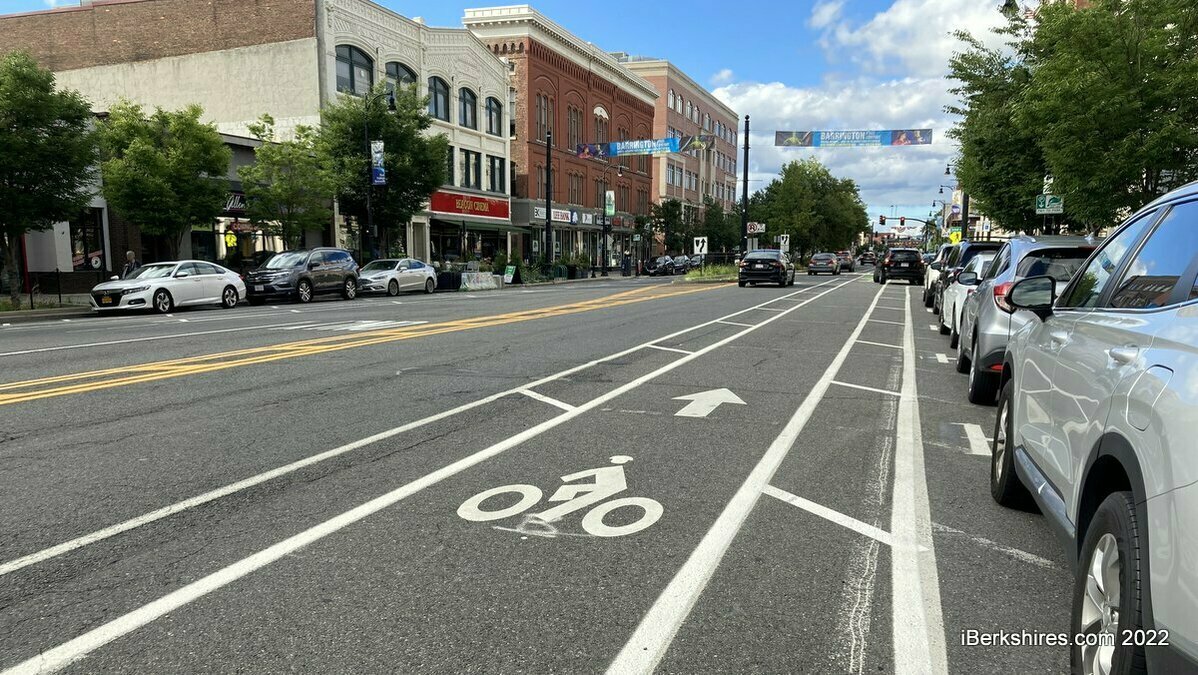
Bike lanes and parking have been a hot topic over the last few years since North Street was redesigned.
In September 2020, the city received around $239,000 in a state Shared Streets and Spaces grant to support new bike lanes, curb extensions, vehicle lane reductions, and outdoor seating areas, and enhanced intersections for better pedestrian safety and comfort.
The first pilot program was implemented the following November and in February 2021 the Public Works Committee voted to keep the bike lanes and changes made to North Street.
Another grant of around $163,000 was received in April 2021 to create two parklets and double-buffered bike lanes on both sides of the street and in the following June, the current iteration of the pilot project was done.
Last year, former Councilor at Large Karen Kalinowsky unsuccessfully attempted to enact a ballot question that asks voters if North Street should return to a four-lane way. She cited safety concerns with the configuration though a 2022 report showed a 77 percent crash decrease after the lanes were implemented.
Currently, the street has 12-foot travel lanes, 10-foot turn lanes, 6-foot bike lanes, and 8-foot of on-street parking with 3-foot buffers. Curb to curb, this adds up to 74 feet of road space with a 5-foot landscape buffer and 10-foot sidewalks.
The city requires about 20 feet of clearance for emergency vehicles in the corridor in line with national recommendations.
Both front-in and back-in angled parking with painted bike lanes were evaluated. Front-in parking posed risks to vehicles and pedestrians because of decreased visibility and obstruction to travel lanes.
Several other alternatives were considered such as front-in parking at a 30-degree angle with bike lanes, back-in angled parking at a 30-degree angle with bike lanes, and front-in angle parking at a 45-degree angle with raised sidewalk level separated bike lanes.
The chosen option includes protected bike lanes at sidewalk or street level, which can be built while maintaining existing curbs. These include a 5- or 6-foot separated bike lane between a landscaped
buffer and sidewalk and an 11-foot travel lane, leaving 19 feet unobstructed from curb to curb.
There are currently 136 eight-foot parallel parking spaces. With 45-degree angled parking, there could be 231 spaces and with 30-degree angled parking, there could be 163.
The study also outlined existing and alternative routes for emergency vehicles, with First Street and Seymour Street to Center Street shaving off one minute between Berkshire Medical Center and Park Square for less than a half mile of additional travel.
It concluded that angled parking requires more width than parallel parking and will reduce the bike lane width, 30-degree front-in or back-in angle parking will result in a striped bike lane without a buffer that is sandwiched between angle parking and travel lane, and 45-degree angle parking requires more width than 30-degree angle parking and will leave no space for bike lanes.
While angled parking could add more spaces, it may reduce space for sidewalk cafes, outdoor dining, and street landscaping and additional space can be added for these features if parallel parking is maintained.
Tags: diagonal parking, North Street, parking,