Williamstown Select Board Discusses Language in 'Guidebook'
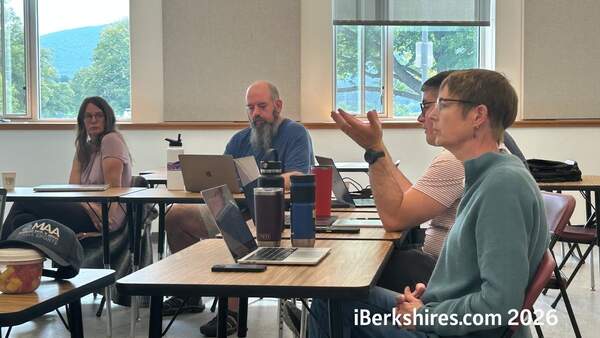
WILLIAMSTOWN, Mass. — During a discussion about goal setting and priorities for the 2024-25 term, Select Board member Randal Fippinger on Monday pointed out that the body has limited bandwidth.
"There's so much that we have to do," Fippinger said. "There is so little discretionary time in our calendar for stuff to do."
Moments later, the board spent more than 40 minutes discussing modifications to a 3-year-old document that the town does not need, largely focusing on a passage that has no basis in state law or town code.
At issue was the "Select Board Guidebook," which the body created in 2021 and published on the town website.
The 29-page document covers a lot of ground, pulling together information from the town charter and town bylaws as well as information from Massachusetts General Law and the Massachusetts Municipal Association's Select Board Handbook — all readily available online in other places.
One passage in the Williamstown document appears to be unique to the 2021 publication, drafted by Select Board members serving at the time, "with input from prior Select Board and community members," according to its title page.
Right near the front of the Williamstown guidebook, in the first paragraph of a section titled "Representation," is a sentiment that has drawn the concern of Stephanie Boyd, who was elected to the board in 2023.
"Select Board members should work to advance the interests of the community as a whole. Each member should consider all issues with a broad view, avoiding personal bias or undue influence by strident community members," the Williamstown document reads. "Board members do not run or serve as part of a political party and the Board generally does not discuss state or national politics, except for the degree to which such matters might affect Williamstown locally. We note that some Select Board candidates run for office by focusing on a particular issue. However once elected, that candidate must adopt a holistic approach which may or may not include action on policies they advocated during their campaign."
Leaving aside the fact that the guidebook makes no attempt to define terms like "strident," "undue influence" or "holistic approach," it offers no authority that mandates elected officials "must" be held to such standards.
There are, of course, legal limits on the actions of Select Board members and all public officials in Massachusetts. These include the Open Meeting Law and Conflict of Interest laws, both of which are referenced elsewhere in the guidebook.
But the "holistic approach" paragraph appears to be an original concept created by the 2021 board.
Ultimately, it is the voters who decide whether the board members, who serve three-year terms on a staggered basis, serve the interests of those voters.
But the inclusion of the language on Page 3 of the official looking document is problematic, Boyd said.
She referenced Page 26 of the pdf, which spells out the board's standard operating procedure for considering requests that the board sign petitions, which she missed the first time she reviewed the guidebook herself.
"I had so many conversations with people in the community who said, 'Oh, it's in your law that you have to do this or that,' " Boyd said. "I replied, 'What law are you talking about?'
"People really interpreted what was written in this document as statute. So, I think, along with our thinking that we want to improve communication with the community, this is a key way that we communicate with our community, when we talk about how we're going to work and what we're going to do. We have to make sure that this is right."
That means, Boyd argued, not passing off the opinions of a group of Select Board members at one moment in time as a requirement — a "must" — for all Select Board members.
"There are points in the handbook/guidebook where it's clearly opinion, and I think we need to make sure we indicate that as opinion and not as: This is the way things have to work," Boyd said. "Or remove that section because not all board members may agree with that."
Chair Jane Patton agreed that the "holistic approach" paragraph could be flagged in the guidebook as opinion.
"I guess one way to go about this — piggybacking on what you said — is maybe take the subjective pieces out, although it is a guidebook," Patton said. "There's nothing in here that says, 'You'll be drawn and quartered if you don't do this or do do this.' I think it was some of the more subjective things that were an issue, and I happen to agree with a majority of those things.
"But to maybe move this forward, if we distill it down to, 'This is how you do citizens petitions,' or, whatever. Maybe that gets it started, and it can always be revised, should we feel like we need to do that."
Patton, the longest tenured member of the current board who was in office when the guidebook was produced, said at one point Monday that, "one person's 'strident' is another person's 'overzealous.' " But Patton did offer a window into what a Select Board member might see as "undue influence."
"The things that make subjective items such a challenge is they're so subjective," Patton said. "We could sit here and parse all the adjectives and all the 'stridents' … But if you're sitting in this room, which I have been in this room, with people [screaming] their point of view when they didn't get what they wanted, as much as it impacted me, how they felt, I could not allow myself to be influenced by their insistence that the only way to vote on this was their way.
"You can be strident all you want. This book is designed to make recommendations to this body [emphasizing the word 'this']. Even if you're getting a crazy amount of pressure that makes you uncomfortable in some form or fashion or it's your best friend who is demanding XY or Z, we were elected to represent everybody in town, not just the loudest voices."
The May 2021 document was published after a tumultuous period that saw many community members calling on the town to remove both the chief of police and town manager, who answers to the Select Board. Both ultimately resigned.
Boyd argued that the guidance in the guidebook is just that, friendly advice from other people who have served on the board. But the "must adopt a holistic approach" language makes it sound like a requirement of the office.
"Of course when something comes up, we have to work on it," Boyd said. "But it's up to the individual board member. They could choose to be irresponsible. It's their choice. We can't tell them to do that, is the only point I'm making."
And Boyd made another point about the "strident community members" line and the chilling effect it could have on public discourse.
"I think it's really helpful to have some advice in there, but I think we need to be careful about the language that we use," Boyd said. "In the book, we'll say things like, 'avoid personal bias or undue influence by strident community members.' I know what we're trying to say there, but if you're a community member, you're like, 'Oh my God, the Select Board is calling me 'strident' because I'm very passionate about something.'
"I think that's just an example of where we could soften the language."
Monday marked the second time in just more than a month that the Select Board discussed Boyd's concerns with the guidebook. The first came at its June 5 morning meeting at the Williams Inn, the so-called "retreat" that the guidebook describes as, "technically open to the public" and "traditionally viewed as an opportunity for the Board to have more exploratory discussions than might be held in public."
Boyd presented her colleagues with a marked-up version of the guidebook for consideration of potential edits at the July 8 meeting. The board agreed to continue considering making changes to the document.