Bel Air Dam's $20M Demolition Facing Year-End Deadline
PITTSFIELD, Mass. — The $20 million allocated to demolish the Bel Air Dam will expire at the end of the year if a contractor is not chosen.
A Notice of Intent application from the Massachusetts Department of Conservation and Recreation's Office of Dam Safety was continued to Aug. 22 due to a missing water quality certificate. This was an expected move but planners wanted to begin a conversation due to the tight deadline.
"The $20 million expires at the end of the year so that's the the hurdle we're up against," Project Manager Jennifer Doyle-Breen told the Conservation Commission on Thursday.
"We need to have a construction contract signed by the end of the year, so that's why we're moving as quickly as we can with all the permit applications."
Doyle-Breen, of the AECOM (Architecture, Engineering, Construction, Operations, and Management) consulting firm, explained that the project team is aware of the missing certificate.
"We wanted to start the conversation and I did speak with the [Department of Environmental Protection] about this earlier this week and they were on board with this approach. We have filed the water quality certification application, we're in contact with the DEP, they have considered the application administratively complete. The public notice for that has actually already happened and there were no public comments received and the DEP has indicated that within the next few months, this certification certification should be issued," she reported.
"We have some things to work through with them, of course, but they're on board with recognizing the importance of this project and to maintain the funding so they're going to try to expedite their review as much as they can."
Last year, $20 million in American Rescue Plan Act dollars were allocated to remove the deteriorating, potentially deadly dam on Wahconah Street. It has been an area of concern for more than a decade, with the city and the state Department of Conservation and Recreation conducting inspections, maintenance, and repairs. In 2020, it was identified as a high-priority project.
The dam is one of six included in the pilot abandoned dams program.
"For all of the abandoned dams, DCR's process that they use to evaluate these dams is to first go out and do an assessment and basically all of these dams are not in compliance with dam safety regulations for various reasons so DCR looks at a number of alternatives," Doyle-Breen explained.
"No action is generally not acceptable because these dams are unsafe. DCR will consider repairing the dam if either the municipality or some third party is willing to come in and basically take ownership of the dam and oversee it in the future for operation and maintenance but if that is not an option, then generally speaking the Office of Dam Safety and the commonwealth's goal is to remove the dam. To remove an unsafe dam and remove infrastructure that has no entity to take care of it."
AECOM and DCR have been working closely with the city since 2019 on the ecological restoration proposal that aims to restore a natural hydraulic regime, lower the risk of flooding in the immediate vicinity, improve water quality by removing accumulated contaminated sediment, and improve the wildlife habitat adjacent to the restored stream.
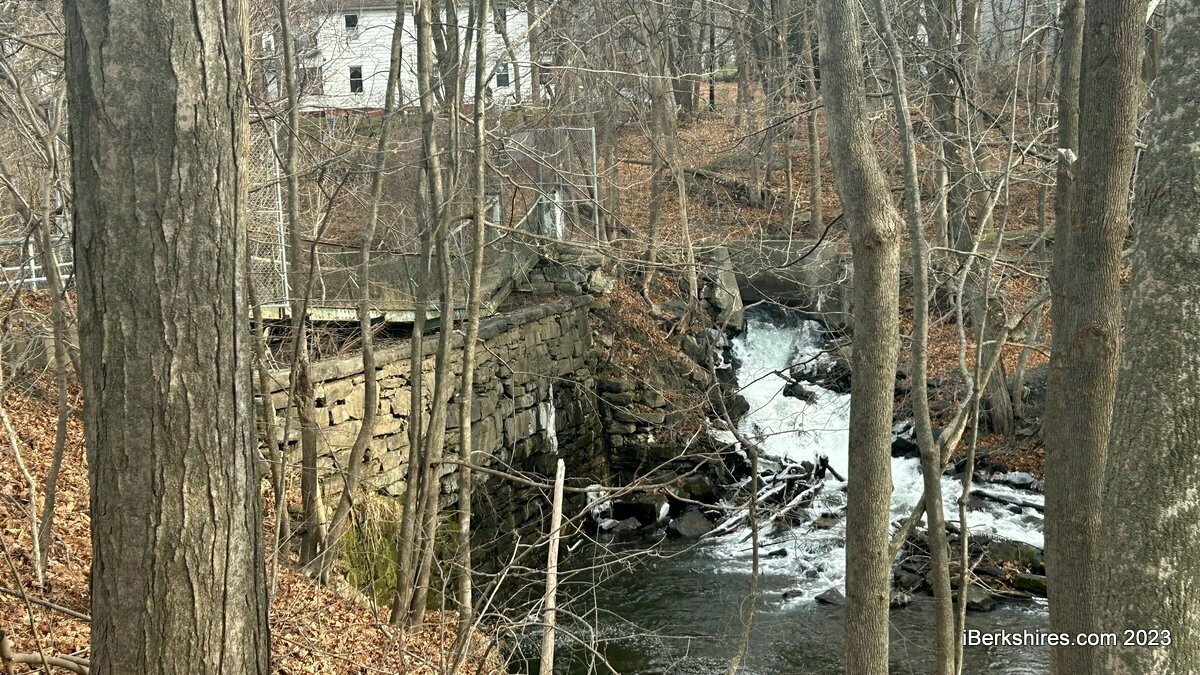
The classified "high hazard" structure is about 200 feet long 26 1/2 wide with a collapsed bridge and danger sign warding people away.
"It is upstream of several businesses, residents, and roads, and its failure could cause as a result loss of life and substantial damages," Doyle-Breen said.
Testing over the last five years has identified more than 35,000 cubic yards of accumulated sediment with elevated levels of metals and pH, among others. Much of it will be removed to create a new storm channel and the sediment will ultimately be taken out of state and the remaining will be capped.
About 1,200 feet of the existing streambed on the west branch of the Housatonic River will be restored and there will be about 18 inches of clean soil and plantings. Invasive species will also be removed.
The dam was built in 1832 and was used for power generation for a woolen mill until the 1920s. The owner is deceased and the city has no interest in taking over, leaving demolition the only viable option.
A letter included in the NOI from Mayor Peter Marchetti reports that the Bel Air parcel has been identified in the assessor's records as being owned by the city since the mid-1950s. Since that date, no one has been assessed for real estate taxes, paid the taxes, or made any claim or use of the parcel.
The records establishing the city's ownership of the parcel cannot be found, he reported.
As of the 1952 relocation of Wahconah Street, the owner of the Bel Air Pond was identified as "Owner Unknown." The last identified owners of the Bel Air Pond were James & E. H. Wilson Inc. and the last conveyance from the company was the 1928 deed recorded in 1932.
"Based on the existing history of the parcel, it is my opinion that the City has the ability and authority to enter onto the Bel Air Parcel and take actions as needed to secure the property and protect the public," Marchetti wrote.
Late last year, a public hearing was held for the dam removal.
Berkshire Environmental Action Team Executive Director Jane Winn said the state "really followed through with environmental justice outreach" at the beginning but feels like that has dropped off.
"I just feel like the public really got cut out right after that one meeting," she said.
Lenox Avenue resident Michael Murray said this is "long overdue" and that a traffic and pedestrian management system will be key.
Commissioner Jonathan Lothrop wanted to know exactly how much of the contaminated sediment will be removed.
"I've seen personally so many projects in this community that the estimated amount of bad material was X and then once construction began, it became a lot bigger than what the estimates were so I guess it would be nice to know what kind of contingency be plan was in place if and when that occurs and who would get that cost," he said, acknowledging that it may be "a little beyond" the purview of the commission.
Tags: ARPA, dams, demolition,