Pittsfield Historical Panel Delays CYC Demolition
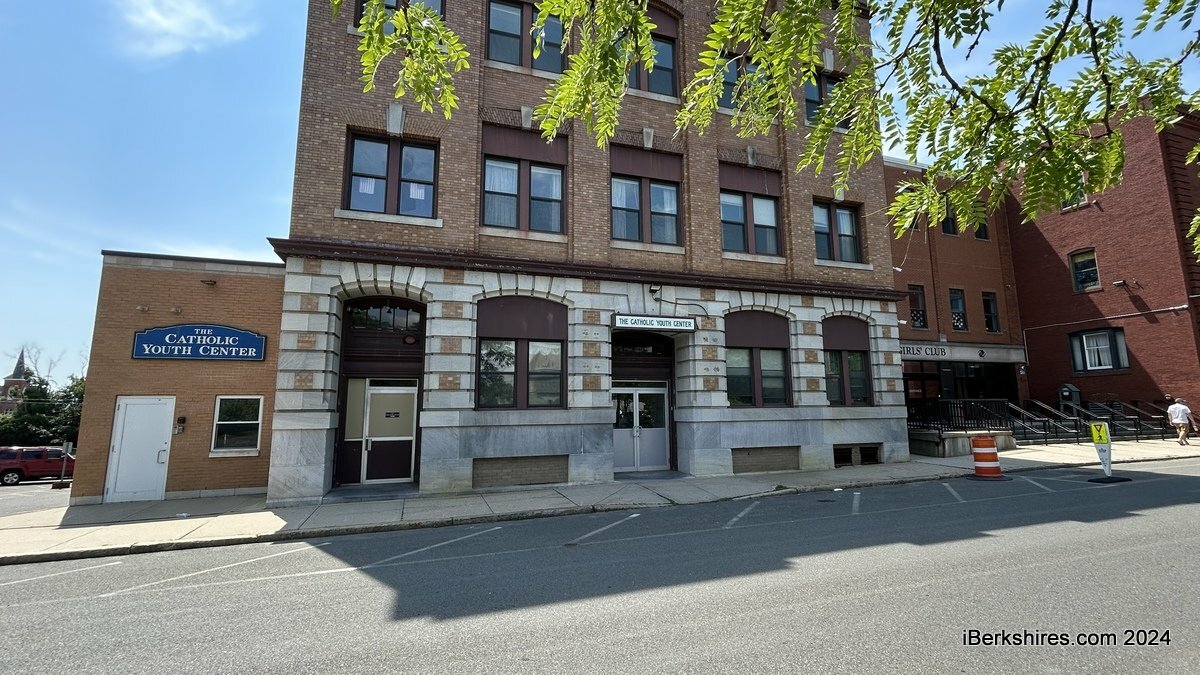
PITTSFIELD, Mass. — The Historical Commission wants to see a better effort to preserve the former Catholic Youth Center rather than a plan to level it.
On Monday, the panel issued a one-year demolition delay for the more than 75-year-old Melville Street property. The Boys and Girls Club of the Berkshires would like to demolish the CYC to make way for an expanded playground for its child-care program.
The CYC is on the commission's list of endangered properties. The club feels that it is not historic but commissioners disagree.
"I would argue that this building does, in fact, play a significant role in kind of the urban fabric of this part of downtown and the streetscape along Melville Street," Commissioner Matthew Herzberg said, adding that he recognizes the dilemma but a playground is "not a good trade."
The nonprofit purchased the abutting property in 2015 and it has reportedly been out of use since at least 2012.
"We would like to demolish the bounds of the building at this point in time because it's surplus to us," Vice President Thomas Hamel said.
"The land is most valuable to us and it would allow us to expand our child-care programs by creating a better layout of a playground. The cost to rehab this building is in excess of what our budget is and as the application shows, we believe that we would have to spend over $2 million to bring this small building to code. That would be very detrimental to our programs because it would require us to take from our program income to do this capital improvement."
He explained that the club acquired the property after the Notre Dame Church and the CYC closed its operations "in order to protect our property on Melville Street."
"We knew that it was a deteriorated building," he said. "We acquired it relatively inexpensive and we acquired it from the Springfield diocese. We agreed when we acquired it that it would not be used for any purposes inconsistent with the diocese teachings and that, in fact, is in our deed."
The boiler is "shot" and there is no heat, Hamel added. The club has demolished the rear portion of the building that had housed a basketball court because it had "deteriorated beyond a point of being usable."
"We don't see it as a historical historic building though we recognize it is over 75 years old and we respect the process of having to come before you to discuss it, dialogue it, and obtain any public input," he said, reporting no "communications from anybody in the public telling us the historic value of this building, only their historic memories."
Years ago, there was dialogue with developer David Carver about transforming it into housing but it would have required the club to substantially transfer a lot of the parking to satisfy zoning requirements and the club said, "Thank you but no thank you."
"Even the thought of David Carver coming in and making it housing, that seemed to be at one point a possibility and maybe it didn't work for you because of parking but it worked for him," Commissioner Ann-Marie Harris pointed out.
The panel also wanted a more in-depth historical analysis than what was provided, such as a Form B.
"I feel like with the write-up that you had done, that it didn't give that justice. It went up to 1959 and it just kind of dropped," Harris said.
Commissioner Jeffry Bradway said the panel needs a lot more documentation on this property with information about its architecture, historical significance, and impact on the community. Photographs, maps, and newspaper articles were also encouraged.
"I think this is a significant building in itself and its relationship to the neighborhood," he said.
Commissioner Carol Nichols would like the owners to explore additional options for use that salvage the building, saying, "It's beautiful, the front is gorgeous, the facade is beautiful. It does have historic significance, and I think it is a major piece of architecture in that area."
"I don't know how well you publicize it, about the building being torn down, just memories, but I wonder just how public the announcement was about the possible demolition of the building," she said.
Herzberg was hesitant about making the club put more work into its proposal because his opinion wouldn't change.
"I think it would be irresponsible of us to allow this building to be taken down without the demolition delay so for me to make a request that they jump through all these hoops and then just say, 'Well, no, I still want the demolition delay.' I'm not sure that's fair to the applicant," he said.
With the demolition delay process, the applicant holds a public meeting within 60 days and after the meeting, the one-year delay begins.
Tags: historic buildings, historical commission,