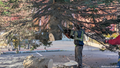
Tamarack Hollow founders Daniel Cohen, left, and Aimee Gelinas, state Rep. John Barrett III, outdoor guide Vicki Zacharewicz and Tamarack board member Peter Scherff break ground for an educational center.
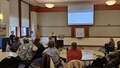
Julie Richburg, the Trustees' lead ecologist of inland natural resources, commends Tamarack Hollow's conservation work.
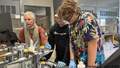
Dancer and instructor Noel Staples-Freeman dances to the beat.
The education center will allow Tamarack to hold programming without worrying about the weather.
WINDSOR, Mass. — Aimee Gelinas and Daniel Cohen have led hikes and other programming at Tamarack Hollow Nature and Cultural Center for more than a decade.
Now an upcoming educational center will create new opportunities to connect people with the natural world and the folklore traditions that honor it.
Last week, the nonprofit held a ceremonial groundbreaking for a 900-square-foot wooden structure with a full foundation and a composting toilet. The excavation process began this week, and completion is expected in 2026.
"This is such a big day for Dan and I," Gelinas said. "We have been working hard for this for 10 years."
For Cohen, it is "very gratifying."
"It's been kind of a dream, an idea of ours for a long time and to see it coming to fruition is really amazing," he said.
The organization received a $50,000 matching grant three years ago from the Massachusetts Cultural Council's Facilities Fund in partnership with MassDevelopment. Through donations, they were able to match it.
The center is estimated to cost around $200,000 and fundraising efforts continue.
Gelinas and Cohen hold guided hikes, snowshoeing, tracking, wild edibles, and plant and tree identification events throughout the year but are limited without a facility to hold indoor programming.
"The building will provide our organization with a much-needed indoor educational space so we can provide programs for schools, teacher training, youth centers, intergenerational programs, lectures, music classes, and more right here on site," Gelinas explained.
"Regardless of the weather."
The conservation and educational nonprofit's mission is to educate about the diverse natural and cultural world through programs for all ages that inspire stewardship of natural, and cultural resources.
With two full-time staff, it serves more than 5,000 people per year.
"We strive to inspire environmental and cultural awareness, appreciation, and stewardship by providing meaningful and engaging year-round educational opportunities for the public through diverse hands-on learning opportunities that connect people's culture and place," Gelinas explained.
"Our mission is to educate the public about the importance of stewarding our natural world, as well as folkloric traditions from world cultures that intrinsically connect music with the rhythms of the natural world. Through awareness and appreciation of the environment and diverse cultures, we can better understand each other and ourselves."
The nonprofit is also conserving 88 acres of rare boreal spruce fir and hardwood forest. The type of terrain, which includes the balsam fir and red spruce species, only grows in a small pocket of the state, with fields, watershed and a waterfall for future generations of fauna, flora, and people, she said.
They began their journey on the land in the early 2000s and in the last two years, have saved a 30-acre plot, a 26-acre plot, and the waterfall. The trail system is now about a two-mile loop.
Tamarack Hollow's land stretches along the northern border of Notchview, a property owned by the Trustees of Reservations. Julie Richburg, the Trustees' lead ecologist of inland natural resources, said they are amazing neighbors.
She commended Gelinas' work with youth and said the local wildlife thank them for preserving the land.
"This forest is really going to be impacted by climate change. It already is," she said.
"We're going to be able to have this land protected, cared for amazingly well, and using that foundation to teach generations, from drummers to kids to older people, people of all different knowledge levels."
State Rep. John Barrett III said the Legislature does something right when its funds something like Tamarack Hollow.
"I can say our money is well spent in the programs that are being developed here and other cultural organizations not just in the Berkshires but throughout Massachusetts," he added.
"You've done good."
Board members, family, and friends clapped and cheered the nonprofit's milestone.
"You guys were really the foundation, in your own way, of how we got here," Gelinas said.
She dedicated the evening, Aug. 21, to her beloved parents because of their unwavering support and belief in this project from the beginning. The next day would have been their 60th wedding anniversary.
Nephew and godson Matthew Gelinas was also commended for his work on the property as an intern for the last several years.
If you would like to contribute information on this article, contact us at info@iberkshires.com.
Your Comments
iBerkshires.com welcomes critical, respectful dialogue. Name-calling, personal attacks, libel, slander or foul language is not allowed. All comments are reviewed before posting and will be deleted or edited as necessary.
No Comments
Drury High Students Get a Taste of Local Beef
By Breanna SteeleiBerkshires Staff
The pilot program is being funded by a $180K federal grant and is part of a partnership of Berkshire Agricultural Ventures and Mass Farms to School.
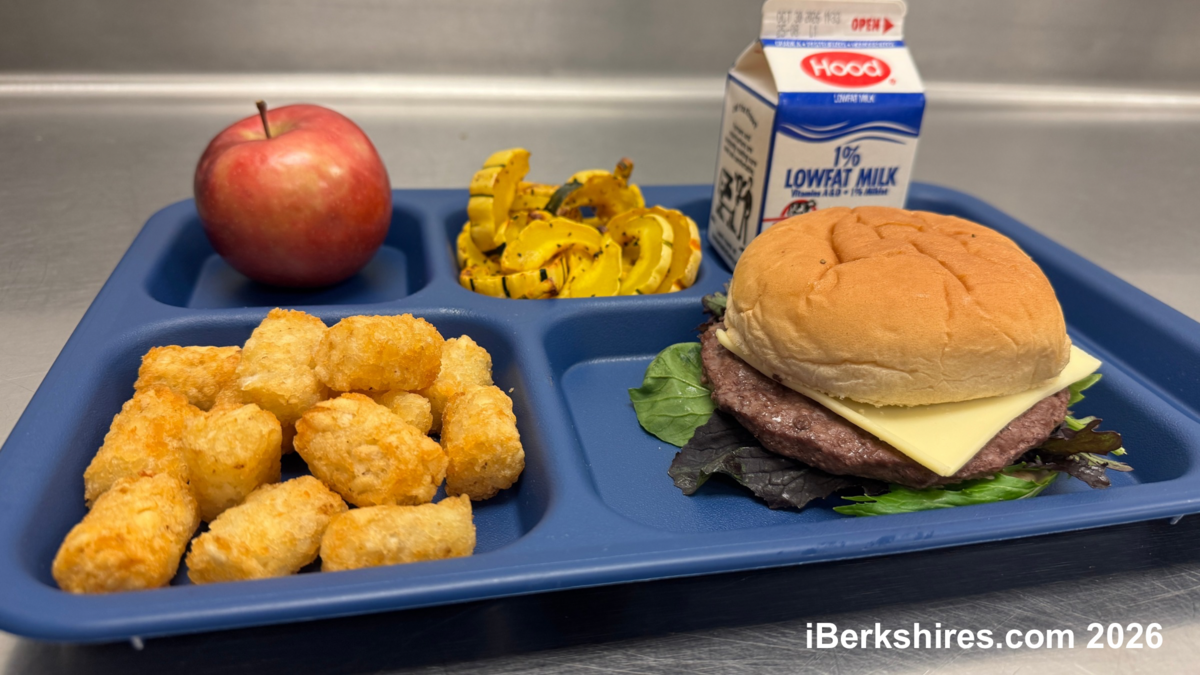
NORTH ADAMS, Mass. — Drury High School students don't have to ask "where's the beef" from, now that the school has partnered to bring local meat into its food service system.
Nonprofit Berkshire Agricultural Ventures (BAV) is partnering with Mass Farms to School to bring locally produced ground beef to school cafeterias as part of a pilot initiative funded by a $180,133 USDA Patrick Leahy Farm to School Grant. The program is named for the retired Vermont senator who wrote the original legislation in 2010.
North Adams Public Schools is one of two school district partners on the pilot project, Lenox being the other.
BAV hopes the project can takeoff and expand into more schools or institutions.
"We're really hoping that it takes off, and that we, in the sense of we can work with, or more schools can be part of this in the future, and we can kind of work out the kinks, which I think is part of what this is all about" said Audrey Hackett, BAV's communications and development manager.
She said part of the nonprofit's mission is to help strengthen the local food system and work with local farmers.
"Part of BAV's larger work to strengthen our local food system. So a lot of what we do is work directly with farmers and support a lot of livestock farmers," she said. "More than 40 percent of our farmers in our region are livestock, and so we work directly with them oftentimes, but it's also increasingly an opportunity to work, you know, a level up at the food system level to bring together partners for projects like this that bring more local food into to our not only our schools. I mean, there are lots of opportunities across institutions throughout our region, hospitals, prison systems, nursing homes, and all of that remains to be done."
Last week, students were having burgers made from meat brought by Marty's Local, a regional food distributor that works with more than 160 farms and food producers.
Marty's Local CEO Sandra Thomas said it was great to partner with BAV to help bring the meat to the school, citing that getting more local meat into the market fills a gap in the local food system. Thomas was able to work with Cherry Point Beef, a Western Mass distributor that sources cattle from four local farms.
Food Services Director Thomas Lark said they are excited to be a part of the program and that it's important to be able to showcase local food on the menu, especially for the students to be able to try these new things.
"We want them to see local food on the menu, to know that it's coming from somewhere they recognize. A lot of the time with school lunch, there's a little impression of like, oh, what's this? Where did this come from?" he said. "And so, this is a great way to say, this is what it is. This is where it comes from. Like, it's just down the road. You've driven past here before, and have them understand that, like, we're serving local stuff too. It's not mystery meat from far away."
Lark also said they have been working with the meat since earlier this year, testing out new ideas to bring to the students like a Korean beef bowl.
"Was a new thing, but we thought new ingredient, new recipe, let's really highlight it, and it was pretty successful. We're running it again next Monday. Actually, Marty's truck was here this morning delivering the beef for next Monday, and we're going to run that again. And that was one where the students who were willing to try it really liked it, and were telling their friends like, "Oh, you should have gotten this." So we're excited for Monday, we'll probably see even more kids trying it out," he said.
The North Adams Public Schools were highlighted last year by the state for its farm-to-school initiatives to bring fresh, local produce to students.
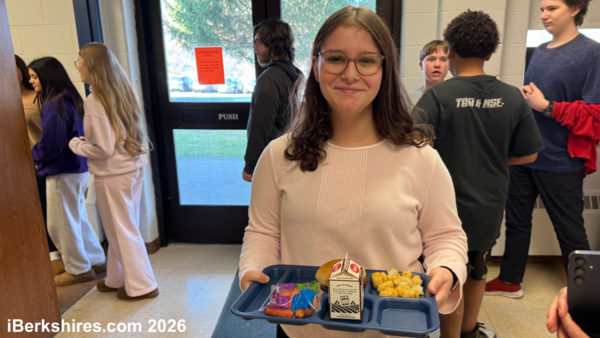
A couple students who had the burger for lunch said it was good.
Drury High School students don't have to ask "where's the beef" from, now that the school has partnered to bring local meat into its food service system. click for more
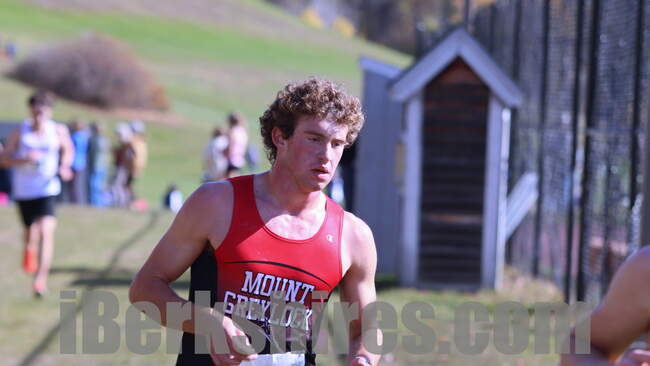
Senior Patrick Holland Saturday finished in fourth place to lead the Mount Greylock boys cross country team to a Western Massachusetts Class B Championship at Stanley Park. click for more
However, preparations for the project are starting now with the removal of trees, placement of utility poles and installation of drainage down Oak Street this fall — dependent on weather.
click for more
Voters sent a strong message on Tuesday, with Democrats flipping seats across the country and easily returning the state's Democratic leadership to office. click for more