North Adams Schools Seeing Bright Spots on MCAS Scores
NORTH ADAMS, Mass. — The public schools are seeing some ups and downs in MCAS scores for 2024 but improvement overall from last year compared to state data.
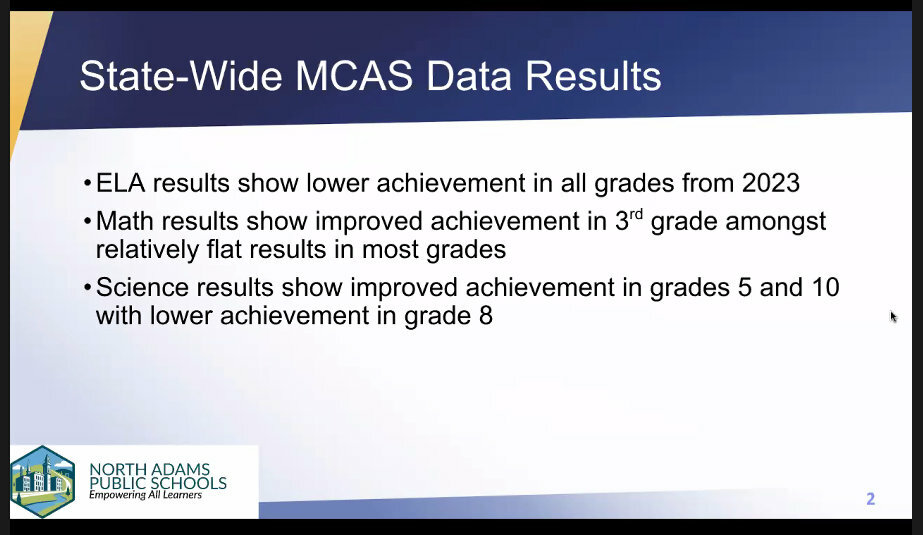
"One of the things that they identified statewide was that even though everybody was hoping that the scores would show up now that we're farther away from the pandemic, statewide, they saw a drop in ELA scores this past year," Timothy Callahan, assistant superintendent of curriculum, instruction, and assessment, told the School Committee on Monday.
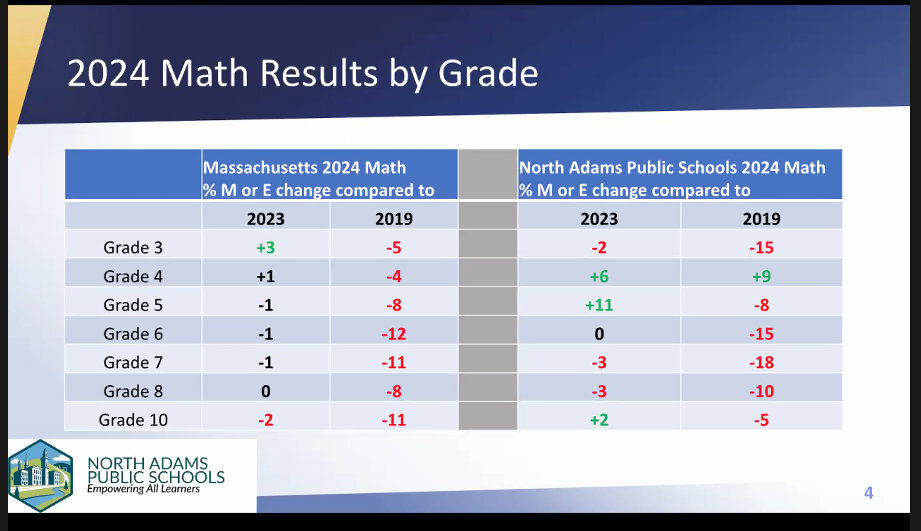
"They also showed flat results in math, other than an improvement in third grade statewide, and then science results show improvement in [Grades] 5 and 10."
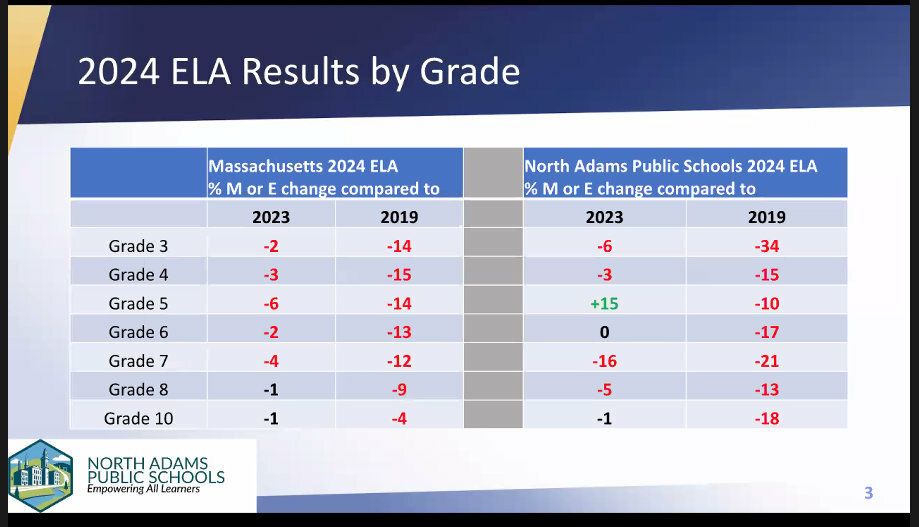
The school system saw drops at or below the state levels on the Massachusetts Comprehensive Assessment System tests in English language arts in Grades 3-10, with the exception of Grade 5, which outperformed the state numbers by more than 20 points.
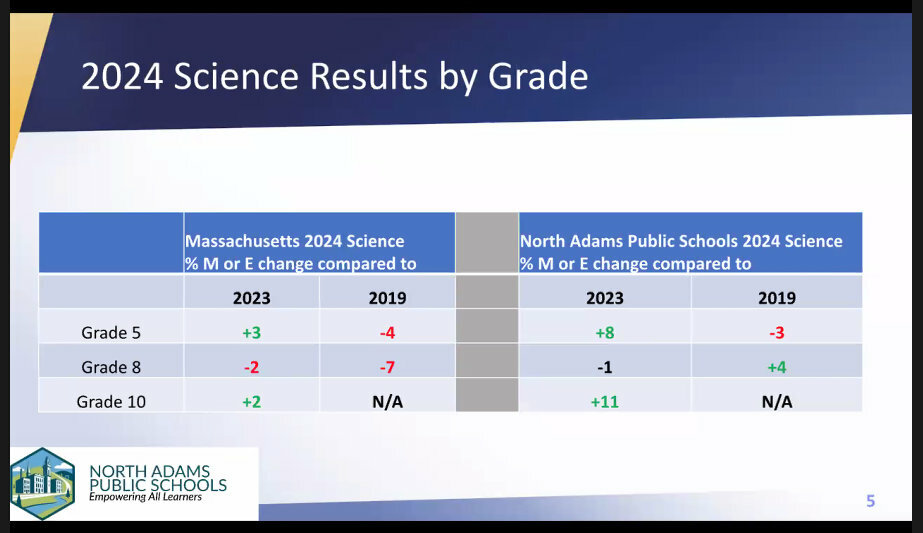
In math results, the schools did on par or better particularly in Grades 4, 5 and 10. Students also performed at or better on the science tests, which are given in Grades 5, 8 and 10.
"We had significant improvement from last year in Grade 5 [ELA]. So that's something that we looked at in our analysis," Callahan said. "We're seeing an upward trajectory in science across the board over time, whereas the state has seen flatter scores."
He noted there was an "enormous, really, really sharp decline" in reading and language because of the pandemic.
"If half of the students aren't reading at grade level coming in, then interventionists themselves cannot possibly solve that problem. So it has to be a whole school effort," he said.
He explained that the state has two accountability components: normative as compared to similar schools and a criterion which reaching targets. School not reaching certain certain targets, amount other factors, have an accountability status of "requiring assistance or intervention."
Overall, the school system is considered as making "moderate," or 37 percent, progress toward targets and not requiring assistance. However, Brayton and Drury High School, while making progress, are requiring assistance.
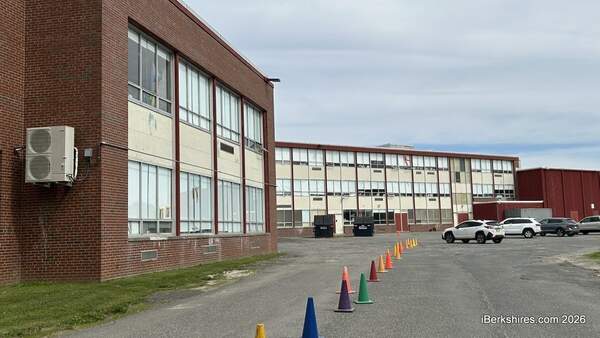
Callahan noted that Brayton is no longer a K-6 school and the grades now housed there will not be taking the MCAS.
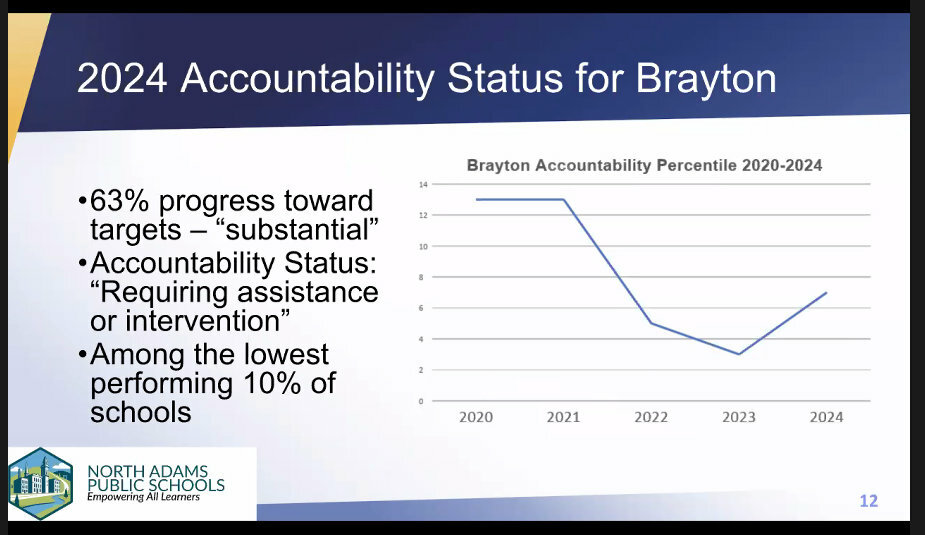
Brayton had actually shown 63 percent, or "substantial," progress on targets as a K-6 but was among the lowest 10 percent of schools and thus its status is "requiring assistance."
"Even though we'll have access to statewide support, the support will look a little bit different this year because we don't have MCAS to prepare for," Callahan said. "We still obviously have education to prepare for, to prepare students to the next grade level, but that accountability is based on last year's."
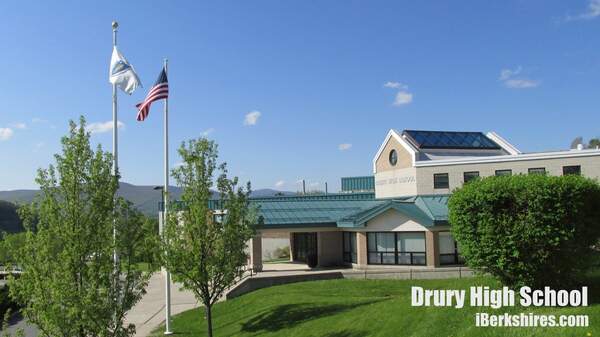
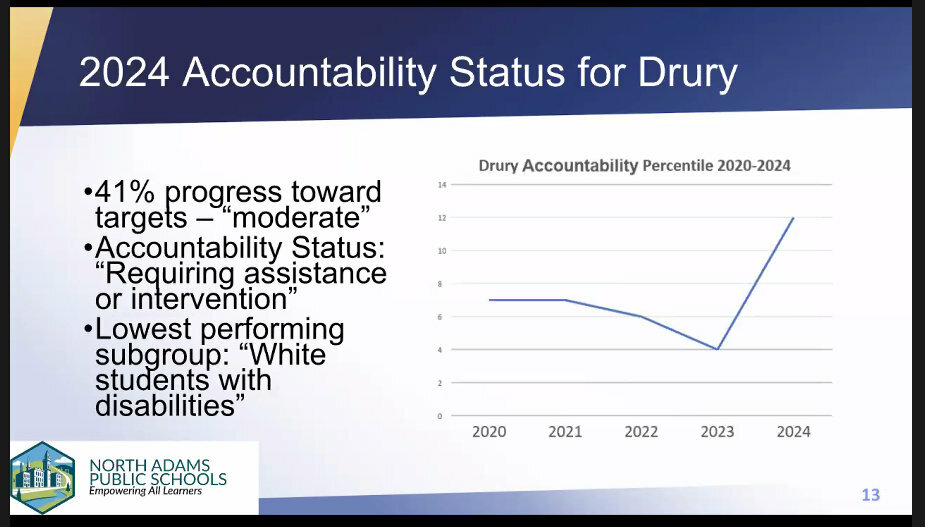
Drury posted a 41 percent, or "moderate," progress and will continue receiving assistance.
"We're outside of that [bottom] 10 percent but [remains needing assistance] because of the lowest performing subgroup, which is white students with disabilities. The white racial demographic is our largest subpopulation," Callahan said. "For the first time in the history of the Accountability Center in Massachusetts, Drury is out of that bottom 10 percent. So kudos to the Drury, faculty and staff, for getting out of that status and to make that upward move."
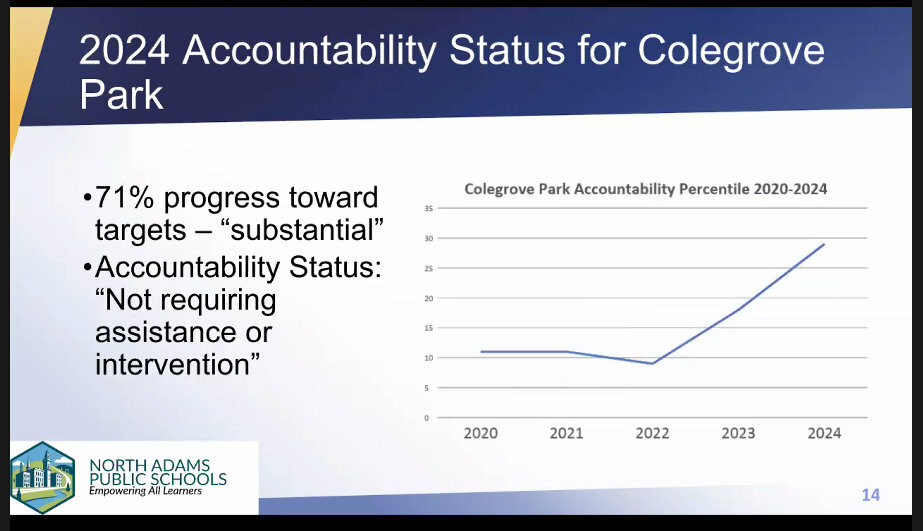
Colegrove Park saw a 71 percent "substantial" progress and requires no assistance.
"Now we have two consecutive years of significant growth in the accountability status, and this is our newest renovated school, and it has the highest performance," he said. "[Principal] Amy Meehan and her staff have done an amazing job of focusing on improved student outcomes."
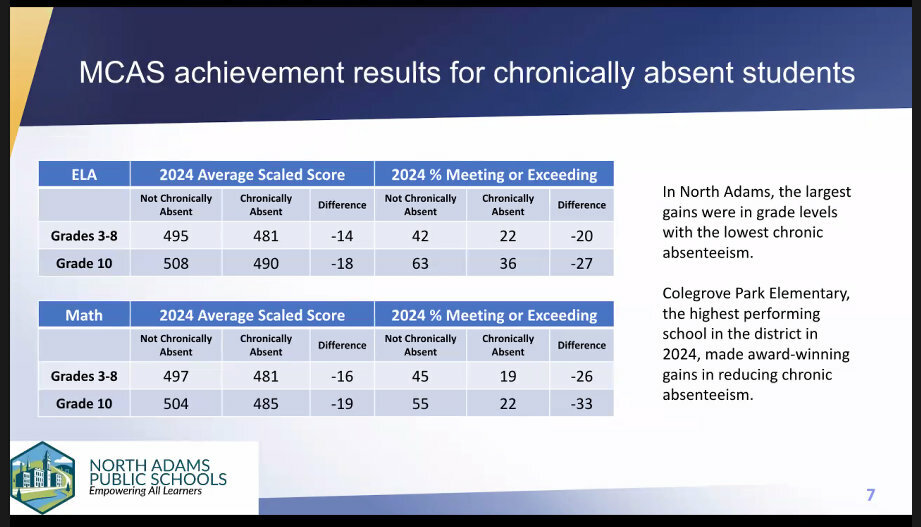
Administrators are looking at Grades 4 and 5 that had "really disproportionately high performance from this year to last year," which Callahan said partially correlated with the increase in attendance and the low chronic absenteeism rate. He said it also correlates to the school's internal data about educator effectiveness.
"We had really effective educators in those classrooms and those grades, and that relates to what we observed in the school wide walk through," he said particularly in Colegrove and Brayton. "A big part of our plan over the past two years has been to provide more modeling, more coaching, more teachers seeing each others teach, more collaboration, so they can learn from each other and improve their practices to lead to improve student outcomes. ...
"So we're trending upward. We're making progress. All three of our schools that were reported on had an upward trajectory and accountability."
The School Committee also approved the acceptance of two grants, $400 from North Adams Elks Lodge 487 and $6,000 from General Dynamics Mission Systems for STEM (science, technology, engineering and math).
Tags: MCAS, NAPS,