Dalton Space Needs Assessed for Safety Facility
DALTON, Mass. — Earlier this month, the Public Safety Facility Advisory Committee approved the draft space needs assessment for the town's police department.
The proposed one-story building would be 13,350 gross square feet, a size determined to accommodate future growth and accreditation requirements. An additional outbuilding of 1,800 square feet is also planned.
Now that the document has been approved, Jacunski Humes Architects LLC can begin evaluating options for a proposed police facility.
Options include building a new facility on a vacant site, remodeling an existing building, or demolishing and rebuilding on a potential site.
The evaluation will utilize four model locations provided by the committee. More information on the ranked properties here.
During a Select Board meeting, committee co-chair Craig Wilbur explained that, based on the study and his prior projects, the estimated cost is between $800 and $1,000 per square foot.
This estimate depends on factors including building amenities, site restrictions, and finishes, among other things, he said.
"Just the cost of construction alone, not the acquisition of property, somewhere between $12 million or $13 and a half million dollars," Wilbur said.
The $800 to $1,000 per square foot range includes equipment costs; however, it is too early in the process to determine the exact amount needed to equip the station.
The building would be fitted with furniture, equipment, and accessories to operate the facility. Some things may be brought from the police department but other items may have to be procured, Wilbur said.
The facility will include a dispatch center. Gabrielle Taglieri, communication center director, said the state owns the center, which underwent upgrades approximately two years ago.
She said additional equipment will be needed to create two fully functional dispatch stations, rather than the current one and a half.
"We would be looking at upgrading our antenna, a lot of that depends on where the facility is…but, I'm pretty confident moving forward that when it comes to our portion for the communication center, state funding with the development grant will assist," Taglieri said.
Wilbur emphasized that it is too early to tell what the cost of the facility will be, including the equipment. However, part of what the architect will do is look at all the equipment the station and communication has and determine what is needed for the facility.
The space needs study, committee co-chair Don Davis said, is based on recommendations from Brian Humes, owner of Jacunski Humes Architects LLC of Berlin, Conn., to ensure the facility meets state and federal accreditation standards.
Davis said the inclusion of a training room in the facility may reduce the department's budget by eliminating the need for law enforcement to travel for training.
There is always grant money available, including potential regionalization or dispatch grants, he said.
Board members said they would like to see the "good, better, best" options demonstrating what the town can feasibly obtain.
Humes' analysis of the properties will determine the town's potential uses for the parcels ranked by the committee for the study.
The committee hopes to have the analysis complete by the end of April.
The descriptions of the various spaces in the assessment came from discussions between Humes and the department. The square footage allocations for each space are based on industry standards and comparisons to other similar-sized departments. More information on the draft space needs assessment here.
Additionally, Humes took a future-focused approach, anticipating growth in staffing and departmental functions, to ensure the proposed facility could accommodate the department's needs over the next 20 to 50 years.
Each section of the station is broken down into 24 sections, each of which includes square footage allocations for the needs for each area.
Sections include a space for the public, a Communications Dispatch Center, administration space, a sally port, prisoner processing, a detention center, an area that would be utilized for training, meetings, and an Emergency Operations Center, another section for interviews and public permitting, a records clerk, an investigations and detectives bureau, general office, animal control officer, a quiet room or lactation room, patrol functions, and more.
The storage outbuilding includes sections for road supplies storage, bulk evidence storage, found property storage, and department equipment storage bay. Each of these sections also has square footage allocations based on need.
The reason municipalities choose to build an outbuilding is because they are less expensive to build than the main building.
"These are all required spaces in a police department that aren't negotiable. The size of them as [Humes] will say is negotiable but then you're starting to cut down functionality," Wilbur said.
"So, if something requires 200 square feet and you want to cut it down to 100 does that make sense for the space now to be rendered useless. And those are the topics that we've been having in the committee about how we can reduce it and if we can reduce it."
Vice Chair Dan Esko said his goal is reducing the building footprint enough to save money for taxpayers while still getting the police facility the town needs.
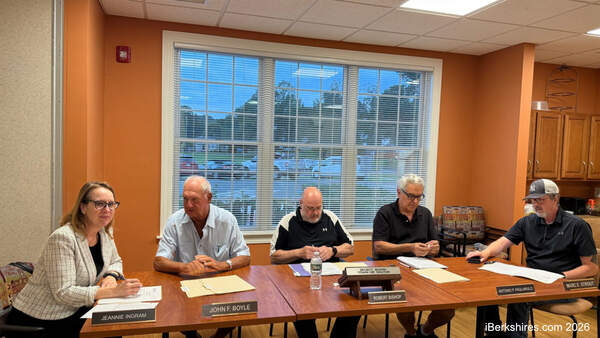
"We can’t forget a part of this station will be taken up by the communication center," said John Boyle, board member.
"and Emergency Management," Davis added.
"Esko brings up a good point–how can we keep the price down. There is only one way we can" Boyle said adding that he agrees with Davis that the spaces included in the proposed station are "all pretty much mandated."
Boyle said that property acquisition is a high cost, and that the town already owns property. He emphasized that he has previously advocated using the old Dalton High property for town use.
The lot is designated for housing and would require a town meeting vote to approve building a station on that location.
Davis said that the old Dalton High property is one of the locations Humes is evaluating
"Our committee has been working very hard, every member of our committee has dug in and worked every avenue," Davis said.
The committee is still strategizing and navigating possible options for the proposed facility, whether it is building a new facility on a vacant site, remodeling an existing building, or demolishing and rebuilding on a potential site, the committee representative emphasized.
Board member Robert Collins said he has attended a number of committee meetings where the idea of regionalization to qualify for additional grant funding has been discussed.
"In order for this committee to be able to do justice to the town I think we have to really consider regionalization so we can tap into some of the other possibilities that our legislators can help generate some of the larger funds for building this size," he said.
"I mean we have Windsor, Hinsdale, Peru that would fall into the regionalization territory plan that not only the state but the federal government has also promoted."
Chair Robert W. Bishop Jr. cautioned about regionalization because the town does not want to put itself in a position that could cost more money.
"I am all for regionalization but do it correctly," he said.
The decision on regionalization should come from the board so the committee has a direction, Wilbur said.
"If regionalization is something of importance to the town add that to our task and we will include it," he said.
One possibility is a hybrid regionalization model, where the municipalities share services but are managed under their own town staff, Davis said.
"The concept of regionalization does not change the design of the building. We are not adding more square feet for regionalization; we are adding more processes to the police department," Wilbur said.
"I think what not what we're saying is that regionalization or no regionalization the building itself wouldn't change based on that alone."
Tags: construction, public safety,