Dalton Officials Talk Housing Options for Old Dalton High Property
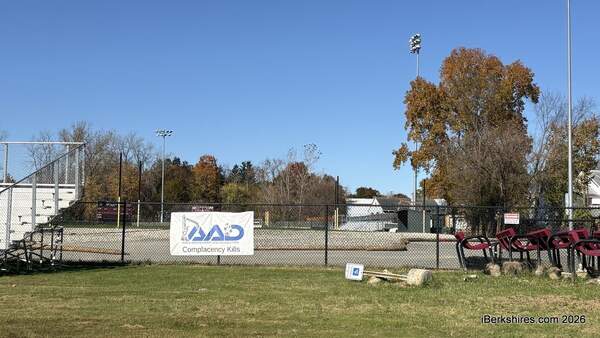
DALTON, Mass.—The Berkshire Regional Planning Commission presented possible options for affordable housing at the old Dalton High property, located in the field in next to the Senior Center, during a Select Board meeting last month.
Over the last year, BRPC Community Planning Program Manager CJ Hoss has been in communication with Town Manager Thomas Hutcheson to discuss the type of projects the town can consider for the parcel.
"This brief analysis rose to the top as far as trying to understand the parcel we're sitting on to the south of the parking lot, essentially what potential housing possibilities could be for this parcel," Hoss said.
The 1928 school building was torn down a few years ago; it had last been used as Nessacus Middle School until the new Nessacus opened in 1998. There had been a number of proposals for the building in the past, including for assisted living or municipal buildings, but none came to fruition. A portion of the property was used to build the Senior Center.
The town is still very early in the process and there are still a lot of things the town has to consider but the analysis "is a very basic level, but still technically accurate introduction to the options that would be available," Hutcheson said.
The location is in the R3 zoning district so the types of housing allowed on the parcel would be a single family, two family, or multifamily.
BRPC looked at what it thought was a potential developable area, "which is essentially a portion of the parking lot and to the south, which measured out to be approximately 2.88 acres," Hoss said.
Based on the parcel's frontage, permitting, dimensional requirements, and "getting creative with parcel sizing," BRPC came up with options on how the parcel can be divided up to allow for different scenarios.
For a single-family homes, the parcel can be divided up anywhere from 11 to 15 total lots if the town went the Approval Not Required (ANR) plan or full-blow subdivision process, Hoss said.
There is not a lot of benefit for a two-family lots project because the town could only have nine to 10 of those if it went the ANR route or a similar amount under a subdivision plan, Hoss said.
A multifamily project is a little more complicated and it would not make sense to subdivide it. Since the parcel is "pretty squared off" the town could have up to 24 units under the existing zoning.
"You could really approach this in a number of ways in the existing zoning where you could also look at having a mix of single family and two family, and there's ways you could fit all three into that area If you're looking for some diversity and housing units," Hoss said. "A lot of this comes down to what the town's goals are moving forward."
There are other options that the town can consider, including three-family units, a cottage court, trying to create some more flexibility in the existing multi-family category, or a townhouse units, Hoss said.
These types of options would require amending the zoning bylaws.
Since the town owns the land it has a lot of flexibility in what ask for in its request for proposals so that project meets the town's end goal, Hoss said.
"You have a lot of wiggle room for what you can ask for. If you want income restricted units as part of a vision for the property you can ask someone to present that and give bonus points for that. If you want this to be a focus on senior housing you can ask for that as well. I mean you can require that in an RFP," he said.
Board members did express concerns of flooding in the area but that is being worked on with the Walker Brook project.
When the discussion to add housing on the lot was first raised in 2015, many residents expressed their desire to have single-family homes, Select Board member Marc Strout said.
Select Board member John Boyle agreed, saying voters shot down a previously approved plan by Berkshire Housing Development Corp. at a town meeting in 2015 that would have added 33 affordable housing units at market-rate prices to the parcel.
"A group of what I consider small-minded citizens developed a petition, took it to the town meeting, and got the plan rescinded. So, there's still a lot of bitterness and division over that but that's in the past," Boyle said.
"What's in the future is there's a great deal of sentiment … in the neighborhood and the town, for the town to retain that property for future municipal use."
Although it would unlikely happen anytime soon, residents have expressed an interest in seeing the lot used for municipal buildings whether it's a public safety building, town offices, or even a library, Boyle said.
"All this stuff about houses and sizes is, I think, irrelevant because I think there's no future in it," Boyle said.
If the town were to change the route to use the parcel for municipal use then they would have to go back to town meeting for approval, Select Board chair Joe Diver said.
When the town demolished the old school for a million dollars there was a commitment that housing was going to be the priority in order to build up more of a tax revenue to repay those funds, Diver said.
"I think housing is the way personally and also as a member of the board and a voter who attended that meeting who voted to demolish the old Dalton high school and build housing," Select Board member Dan Esko said.
Tags: housing, municipal property,