Joint Transportation Panel Hears How Chapter 90 Bill Helps Berkshires, State
BOSTON — A bill proposed by Gov. Maura Healey would bring $5.3 million more in state Chapter 90 road aid to the Berkshires.
Testimony before the Joint Committee on Transportation on Thursday (held in person and virtually) pointed to the need to address deferred maintenance, jobs, infrastructure battered by New England winters and climate change, and communities burdened by increasing costs.
"I know that transportation funding is so, so important. Infrastructure funding is so integral to the economy of the state," said Healey, appearing before the committee. "It's a challenging topic, but we took a look at things and think that this is a way forward that'll result in better outcomes for the entirety of the state."
The bill includes a five-year $1.5 billion authorization to enable effective capital planning that would increase the annual $200 million Chapter 90 aid by $100 million.
More importantly, that extra $100 million would be disbursed based on road mileage alone. The current formula takes into account population and workforce, which rural towns say hampers their ability to maintain their infrastructure.
"This is an important provision as it acknowledges that while population and workforce may be elastic, our road miles are not and the cost of maintaining them increases annually," said Lenox Town Manager Jay Green, who sat on the Chapter 90 Advisory Group with transportation professionals and local leaders. "This dual formula distribution system addresses community equity by assisting municipalities that do not normally rank high using the traditional formula that is a large number of miles but a small population and often a bedroom community.
"These are rural communities with limited ability to generate revenues to augment Chapter 90 funds for their road maintenance."
In Adams, where he had formerly been town administrator, only gets $275,000 a year for its 55 miles of road.
It's estimated 85 percent of municipalities would receive at least a 45 percent increase over their regular apportionment, which has changed much in the last dozen years.
The bill also calls for $200 million for culverts and small bridges, $500 million for the state Department of Transportation's road and bridge lifecycle asset management, and $185 million for MassDOT safety and congestion initiatives.
Becket Town Administrator Katherine A. Warden, representing a community of less than 2,000 with half its 59 miles of road gravel, said her town is facing a significant challenge with deteriorating culverts — 40 of them.
One collapsed culvert attributed to severe weather has reduced a road to one lane.
"The current expenses to address this situation are estimated $137,500 to cover the engineering permitting and reviews," she said. "Additionally, we will require $750,000 to construct a small bridge that aligns with the stream crossing standards. ...
"In total, we are looking at $887,000 to complete one project with an annual budget of $9 million, you can imagine what an undertaking this cost is, and what a challenge it would be to replace another five culverts that are currently also at risk of failure."
She noted there are 25,000 culverts and small branches across the state.
"It's important to note that the proposed funding is desperately needed, particularly given where the many structures that are undersized, addressing these infrastructure challenges is critical for ensuring public safety and environmental protection," Warden said. "On behalf of the small towns across the commonwealth, I urge the committee to support this bill that will provide resources necessary to address these critical infrastructure needs."
Matt Woodson, secretary for administration and finance, said the increase in Chapter 90 is coupled with a plan to dedicate about $765 million to the Commonwealth Transportation fund, to leverage nearly $8 million of new transportation borrowing over the next 10 years.
"It allows us to expand the Chapter 90 program using new borrowing capacity in the Commonwealth Transportation Fund, CTF Fund, with confidence we can afford to cover the increased size of the program without carrying out other priorities in our capital plans," he said. "Second, it will boost vital funding for all 351 cities and towns to the state, across the state, from the largest to the smallest, with big commitment to rural communities we have heard and you know, the scale of the need.
"I will point out that the last time this formula was updated was in 2012 nearly 13 years ago, and the cost to keep maintaining the same infrastructure has gone up significantly since it was last adjusted."
Representatives from the AFL-CIO and Massachusetts Aggregate and Asphalt Pavement Association spoke to the construction jobs it would create.
"Despite the best efforts of our towns and cities over the years and their hard working municipal employees, decades of deferred maintenance and underinvestment have led to decaying bridges and roads that can't measure up to cold New England weather," said AFL-CIO President Chrissy Lynch. "When we support good jobs in our local communities, we also give those same workers economic stability to stay in our local communities.
Linda Dunleavy, representing the Franklin Regional Council of Governments, said her district was the most rural, with 71,000 people over 725 square miles. It's looking at decline of 25 percent by 2050, according to a study.
"We need a strong economy, we need to build jobs and we need to build housing and we need a strong infrastructure, a transportation infrastructure," to blunt that decline, she said.
The average amount of Chapter 90 for each community is $230,000, but it costs $340,000 to pave a mile, Dunleavy continued. "Increasing by $100 million increases the average by 75 percent. .... but it shows you how the $200 million formula disadvantages very rural communities. ...
"Our towns would use the extra money to very carefully plan how to deal with their infrastructure instead of just dealing with emergencies instead or doing the bare minimum."
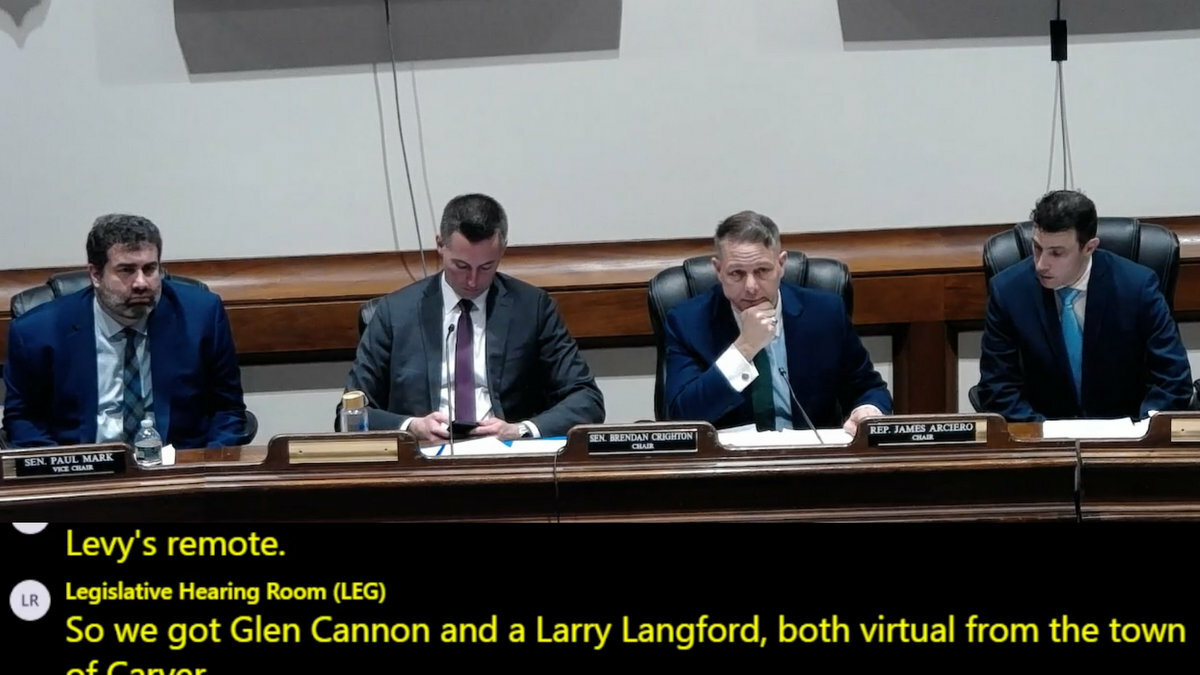
The committee members, which include state Sen. Paul Mark, plan on making some road trips to take more testimony on the bill.
Tags: Chapter 90, public hearing,