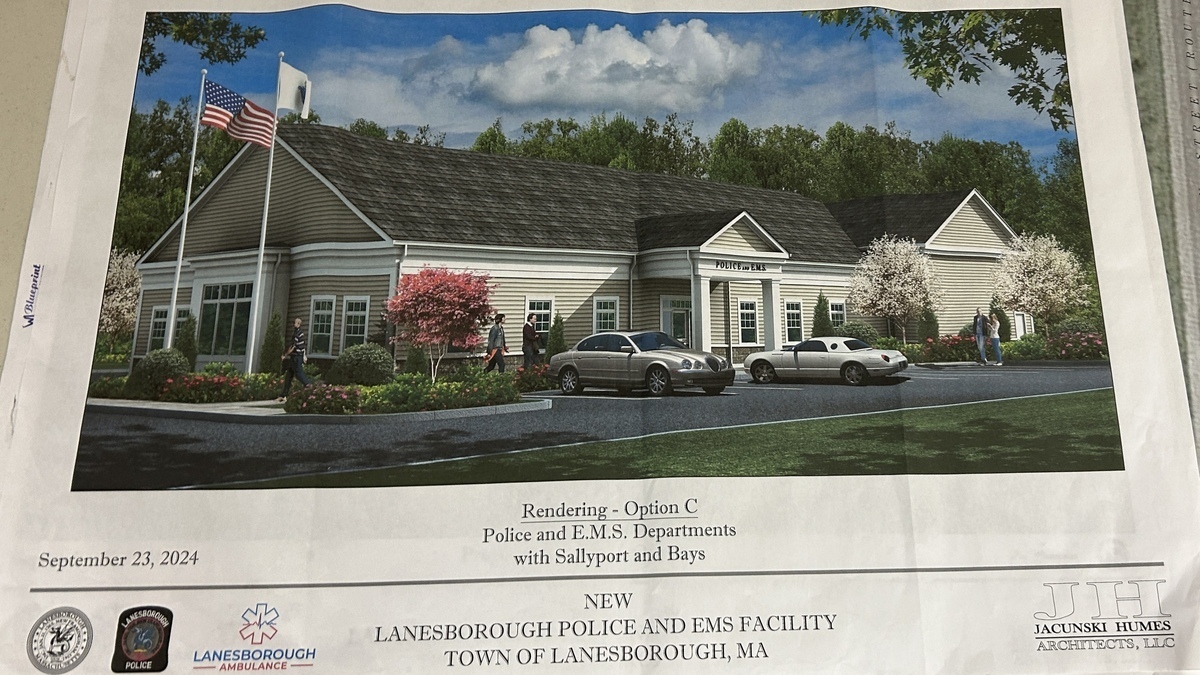
Lanesborough Picks Information Panel for Public Safety Proposal
LANESBOROUGH, Mass. — The town has a public safety building proposal to present to taxpayers, and now, an informational committee will help move the process forward.
On Monday, the Select Board voted to form a public safety building informational outreach committee and re-appointed four members: Dean Clement, Daniel MacWhinnie, Mark Siegars, and Lisa Dachinger.
"The Public Safety Building Committee has done their job. Now we need, hopefully with some of those same bodies, to form a new committee of some type and move forward," Select Board member Timothy Sorrell explained.
Earlier this month, the town officials voted to advance a $7.3 million combined police/emergency medical services facility to town meeting, discarding the option for a $6.5 million separate build. The same design, then priced at $5.9 million, was shot down in 2023.
"There is the option to go to what could be a debt exclusion, which requires a two-thirds majority at either a special town meeting or an annual town meeting, and that can be followed by inclusion in a ballot," Town Administrator Gina Dario said.
Siegars advised that if the question goes to a ballot first with a fixed project budget, that amount can't be changed for a subsequent special town meeting vote.
"In our discussions, there are committee members who are willing to stay on if you wanted to continue the committee or appoint to new one, who have volunteered to be involved with any public information sessions to try to answer the questions with the idea that that they would also explore further and work with Gina and town counsel on specifically what the question should be for a special town meeting, and if, if warranted a subsequent ballot vote," he reported.
Chairman Michael Murphy echoed the former committees' arguments that the town can't explore grants and financing until it has approved an amount.
"If I remember from the previous committee, and from this committee, there was a lot of feelings that no matter what we set the amount at, I know it's intimidating amount, but that if we can get that amount approved, there was confidence from both committees that we can find sources of money that will greatly reduce the cost to the taxpayers," he said.
"But that's a message that seems to get lost for me."
Many people have reportedly told Select Board member Deborah Maynard that they want to see the numbers in "black and white," including the total cost and all possible financial assistance.
Dario pointed out that the former Police Station Committee did much of that research, and it is archived on the town website. She feels the information campaign needs to simplify that information to bring before voters, recognizing that both former panels did a great job.
"There's a lot of information there, and I think, if anything, that we know just from working with the community, we need to put it in one place, make it very accessible," she said.
Throughout this process, Siegars has found "you have to learn how to listen and talk to people."
"We may all be able to understand each other, but I know on the committee, it took a while for us all to speak the same language," he said.
"So when somebody expressed a concern or an interest, we knew what they were talking about. We knew enough to ask questions to make sure we understood what they were asking about because I think part of it's fear and part of it's the unknown."
Tags: Lanesborough Police Station,