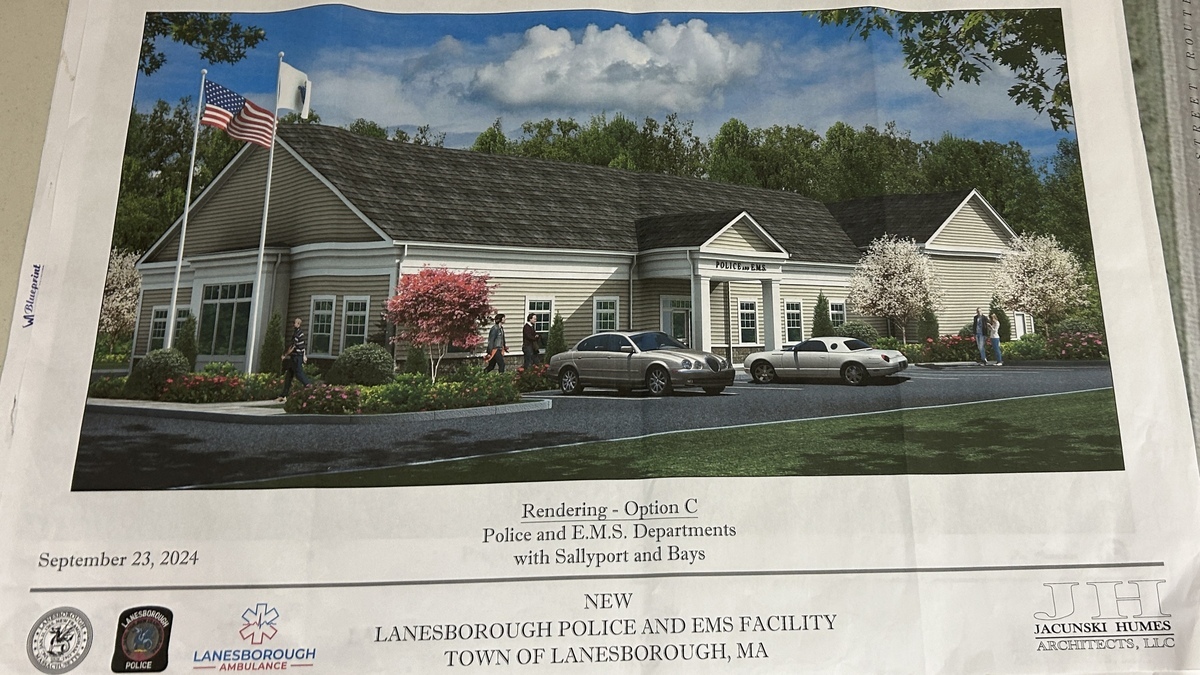
Lanesborough Advancing Combined Police/EMS Proposal
LANESBOROUGH, Mass. — Town officials will again propose a combined police and EMS facility to voters. This time, for a couple of million dollars more.
On Monday, the Select Board voted to advance a $7.3 million combined police/emergency medical services facility to town meeting, discarding the option for a $6.5 million separate build. The same design, then priced at $5.9 million, was shot down in 2023.
"We can't go to a town meeting and give them two options," said Selectman Timothy Sorrell, the town's former police chief.
"We have to decide, I'm ready tonight to make a motion on what I think is the best decision."
Members agreed that this option has stood the test of time and makes the most sense. Selectwoman Deborah Maynard noted it was a tough decision to make as a person on a fixed income, "but it's something that we need."
"I ran for Select Board in 2020 because I couldn't believe this town made our Police Department work in such a decrepit building for years," Chair Michael Murphy said.
"That bothered me enough that I finally chose to run."
The 7,222 square-foot combined police and EMS build would cost about $7,365,868. A 4,814-square-foot police station with a separate two or three-bay EMS facility would be $6,509,900, but the Select Board was advised that it might not be worth the money.
"The Lanesborough ambulance clearly needs a place that meets their needs. The Police Department, while temporarily situated in a rented facility, clearly needs a place that meets their needs. The committee's work clearly shows that residents support a combined police and ambulance, public safety facility," Public Safety Building Committee member Lisa Dachinger said.
She understands that funding a major project like this raises concerns about its impact on property taxes, recognizing that "no one at this moment can say with any certainty exactly what this project will cost and what the actual out-of-pocket expenses to our taxpayers will be when it is finished."
Dachinger strongly believes that if residents are offered the opportunity to vote on a Proposition 2.5 debt exclusion, the town will have a "yes" or "no" answer on funding the project.
"If the vote is 'yes,' it will allow the town to continue to move forward and get a better handle on how much it might cost," she said.
"…If the vote is 'no,' that will be the end of it. I urge you not to kick the can down the road, but instead to empower our residents now to have a say in ensuring our town's public safety department needs are met in a fiscally responsible way by employing a Proposition 2.5 debt exclusion for a public safety complex facility."
Similarly, committee Chair Mark Siegars feels the joint facility is "probably the best." Also the chair of the Council on Aging, he reported that many of the town's seniors have higher incomes, and they should not be used as an excuse not to do the right thing.
"This idea that we're impacting fixed income people and seniors, Lanesborough has never qualified for any public assistance because our standard of living, average household income in Lanesborough, is pretty high for Berkshire County," he said.
Legal counsel will be consulted about pushing the Proposition 2.5 debt exclusion vote to a special town meeting. A "yes" vote would allow the question to be put on the town's ballot.
"Good luck to us all," Murphy said.
Tags: police station, public safety buildings,