Berkshires Bach Concludes Season

Print Story | Email Story
GREAT BARRINGTON, Mass. — The Berkshire Bach Society concludes its 2024-2025 season on June 28, 5pm, at St. Paul's Episcopal Church in Stockbridge with a solo recital by Cleveland Orchestra cellist Dane Johansen.
 
The program includes three suites for unaccompanied cello by J.S. Bach, Benjamin Britten, and Gaspar Cassadó.
 
"We're pleased to present a recital by Dane Johansen to complete our 35th season," said Terrill McDade, Executive Director of the Berkshire Bach Society.  "Mr. Johansen has chosen a program that shows the lasting influence of J.S. Bach and how composers in different generations followed his example in exploring the cello as a solo instrument. The seeds of the later works are embedded in the originals, particularly the sixth suite with its extraordinary range and technical challenges. The recital is an opportunity to experience the rich sonority of unaccompanied cello—so close to the human voice—as it speaks to us in multiple dialects—from Baroque to post-Romantic to Modern. Regardless of style or time, Dane Johansen's exquisite playing of this repertoire touches the heart in a profound way."
 
Berkshire Bach audiences may remember Dane Johansen as the cellist featured in the film Strangers on the Earth that opened the BBS Portals season in September.  In 2014 Johansen walked the Camino de Santiago, the nearly 600-mile ancient pilgrimage route from France to Santiago de Compostela, Spain, with his cello on his back and stops in churches along the way to play Bach cello suites.  During the trek he attracted a growing audience of fellow pilgrims and experienced a revolution in his thinking about performing music for others.
 
A native of Fairbanks, Alaska, Johansen is a graduate of the Juilliard School of Music in New York City. a past member of the Escher String Quartet, and a member of the Cleveland Orchestra since 2016.  A decade after his memorable Camino, he brings his artistry to Berkshire Bach and showcases just how Bach's original model reached across the centuries to prompt English composer Benjamin Britten and Spanish cellist Gaspar Cassadó to create cello suites of their own. In Britten's case, the work was written for Russian cellist Mstislav Rostropovich who gave the first performance in 1965. For Gaspar Cassadó, the work was written and dedicated to a friend in 1926 and interpreted by the composer, a protégé of cello great Pablo Casals.  Casals is credited with rediscovering and popularizing Bach's suites for solo cello in the early 20th century.   
 
Join Berkshire Bach for Dane Johansen:  Solo Cello Suites at 5pm on Saturday, June 28, at St. Paul's Church in Stockbridge, MA.  Tickets: $45 Nonmembers | $40 Berkshire Bach Members | $10 Card to Culture.  Children and Students with valid ID are admitted free.
 
Visit www.berkshirebach.org/events for more information and to purchase tickets.
If you would like to contribute information on this article, contact us at info@iberkshires.com.

Becket Looks to Wind Power for Energy Savings

By Breanna SteeleiBerkshires Staff

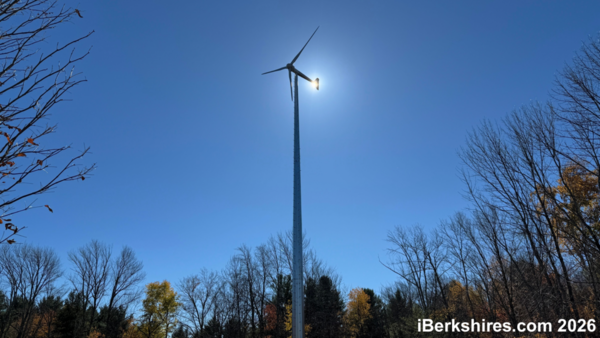
The single turbine is a low maintenance and has a 50-year life. The town went with wind power after finding a solar installation would be too difficult. 

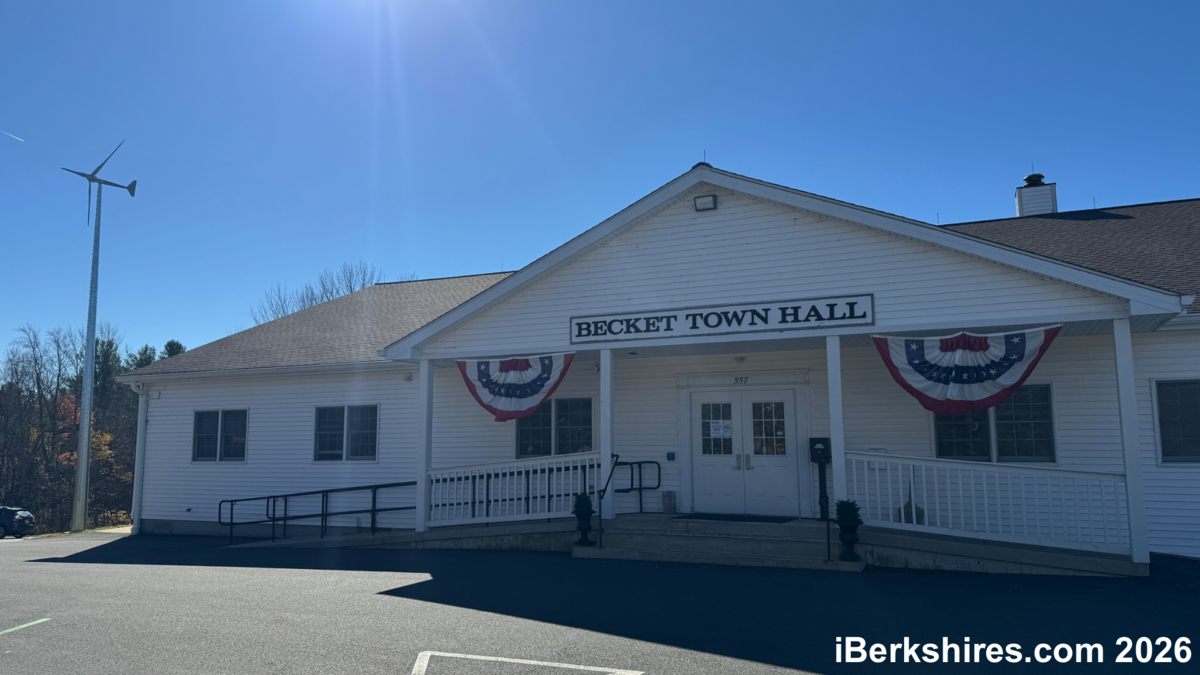
BECKET, Mass. — The town unveiled a wind turbine Monday that will reduce electricity costs and show the benefits of renewable energy produced by wind.

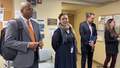
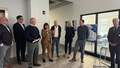
Residents, town and state officials gathered outside the Town Hall for the ribbon cutting on a project first conceived nearly a dozen years ago.

The wind turbine stands 100-feet tall next to Town Hall and is from Oklahoma manufacturer Bergey Wind Power. It has a 50-year life and is a direct-drive permanent-magnet design, meaning it has no gearbox, making it low maintenance.

According to Garth Klimchuk, chair of the Becket Energy Committee, the town started discussions about a wind turbine in 2014. The turbine is expected to generate about 36,000 kilowatt-hours. Klimchuk said Town Hall uses about 24,000 kilowatt-hours, with excess power expected to go to the Highway Department. This is expected to save $9,000 annually from the electricity cost.

"This turbine is just going to be such a good thing for the town. It is really incredible. Zero-cost electricity. Zero cost to the town. Carbon free. Just a huge, huge milestone for us," he said.

The town received a grant from the state Department of Energy Resources totaling $139,500. The remaining funding for the project will come from a direct-pay investment tax credit under the federal Inflation Reduction Act. If the town does not receive the funding, voters at the annual town allocated $100,000 just in case, but Klimchuk said the town will only need about $60,000 to $70,000 if necessary.

"It's going to help the community. Hopefully, it'll lower our tax bills. And as we look at everything going around around the world right now, energy volatility has been with us for a long time. It's going to stay with us for a long time," said state Sen. Paul Mark. "So any move we can make as a community, whether as Becket specifically, as Berkshire County as a whole, but anything we can do to bring some of the reliability into our own hands, to produce a bit on our own, and just guarantee that in a renewable, safe way moving into the future, I think is going to pay off dividends."

The town has spent more than a decade reducing municipal energy consumption in a variety of ways including HVAC upgrades and LED street light conversions, bringing it to a Level 2 Green Community status.

While solar had been considered, interconnection constraints and limited grant opportunities made it harder to achieve. But the high elevation of Town Hall and a Small Wind Site evaluation done in 2023 and 2024 found the site was perfect for a turbine with favorably high winds.

State Rep. Leigh Davis praised the project as an example of a small town addressing a larger energy challenge through persistence and collaboration. She stressed that the single turbine represents a practical step toward reducing reliance on fossil fuels and said Becket's effort could serve as a model for communities across the commonwealth. 

"You hear about all these kind of big wind farms and solar farms and all these ways that we're gonna you know create green energy, but at the same time what we're not being sensitive to the landscape, and what I appreciate about this is that this is it's a single turbine, but it represents so much more," she said. "You're right. It's really adding to the ability for this town to contribute to green energy and to bringing our reliance on gasoline fuels back down to solving big problems."

Mark Rabinsky, deputy director of DOER's Green Communities Division, said the state supports municipalities with technical assistance and grants, and that reducing municipal energy costs can leave more resources for other local priorities. He presented the turbine as an example of state support working alongside local knowledge and decision-making. 

"I think that this is a really a great example of what green communities can do," he said. "I'm obviously a really big fan of the green communities program, but I think that connection between the state, what we're doing at the state, and that local level, and relying on the local knowledge here with Becket is a true testament to what we're doing."

Select Board Chair William Elovirta thanked everyone for being here and shared his memories of first coming tp Becket in 1946 before utility electricity arrived. His family and neighbors used small 32-volt generating plants and batteries. He recalled utility workers installing poles and wires by hand around 1947.  

View Full Story

More South Berkshire Stories