image description
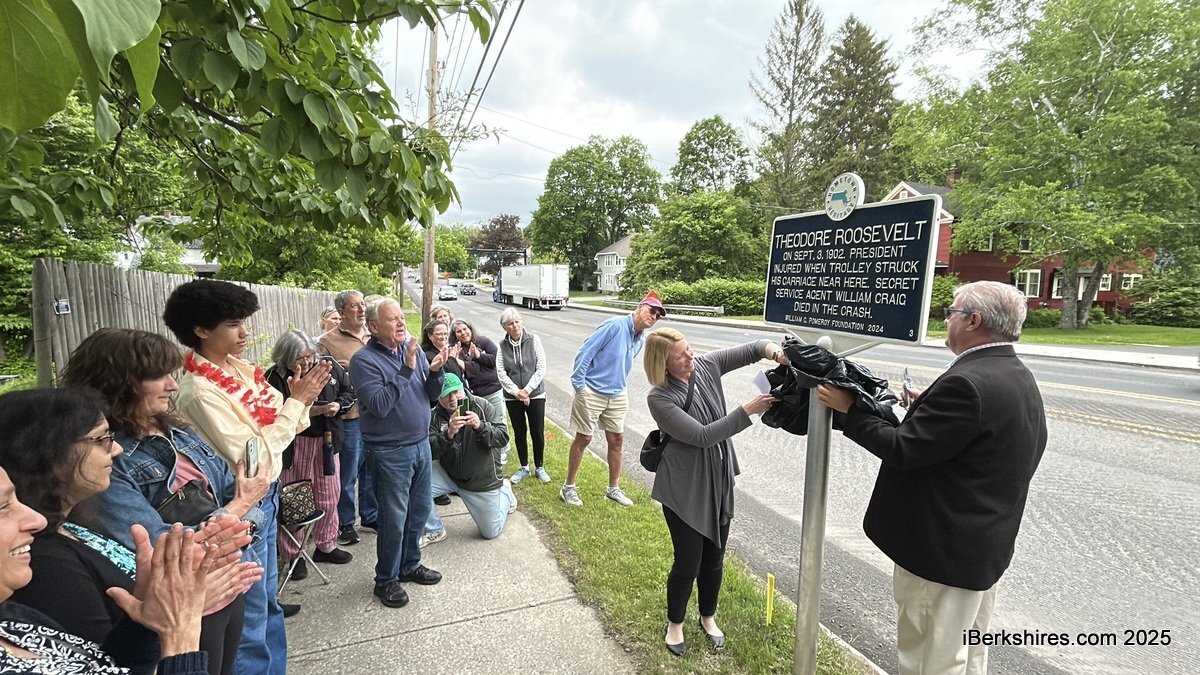
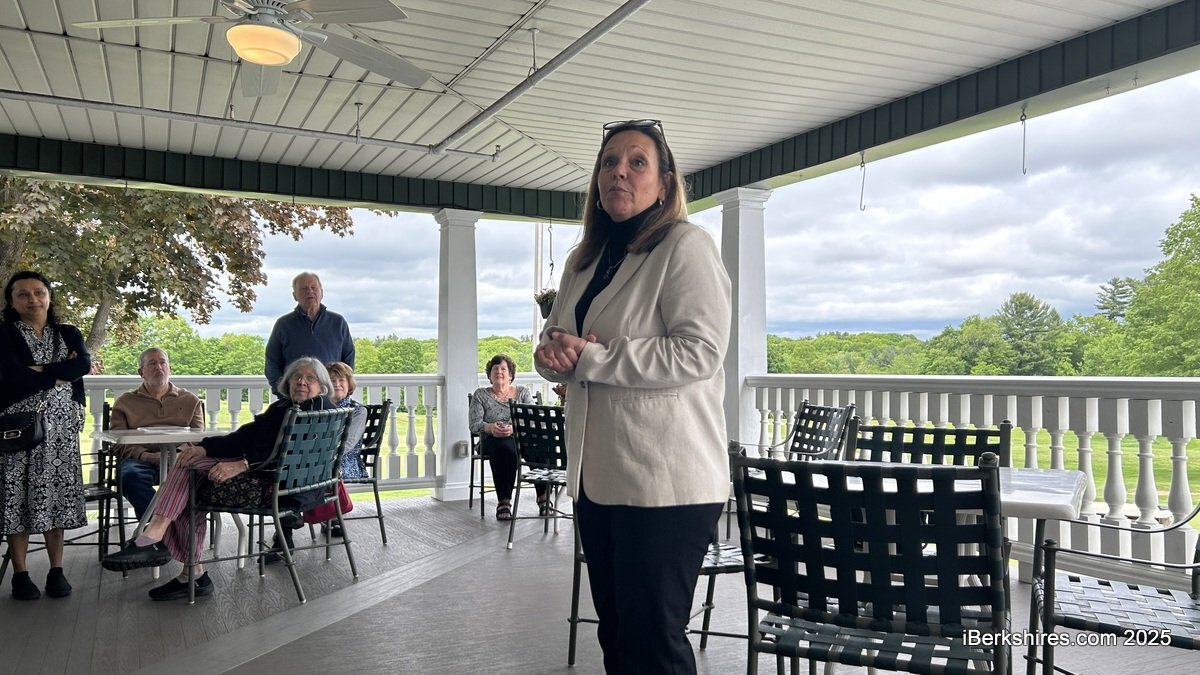
Berkshire Historical Society Executive Director Lesley Herzberg and Mayor Peter Marchetti unveil a sign recognizing the fatal accident that involved President Roosevelt in 1902.
image description
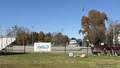
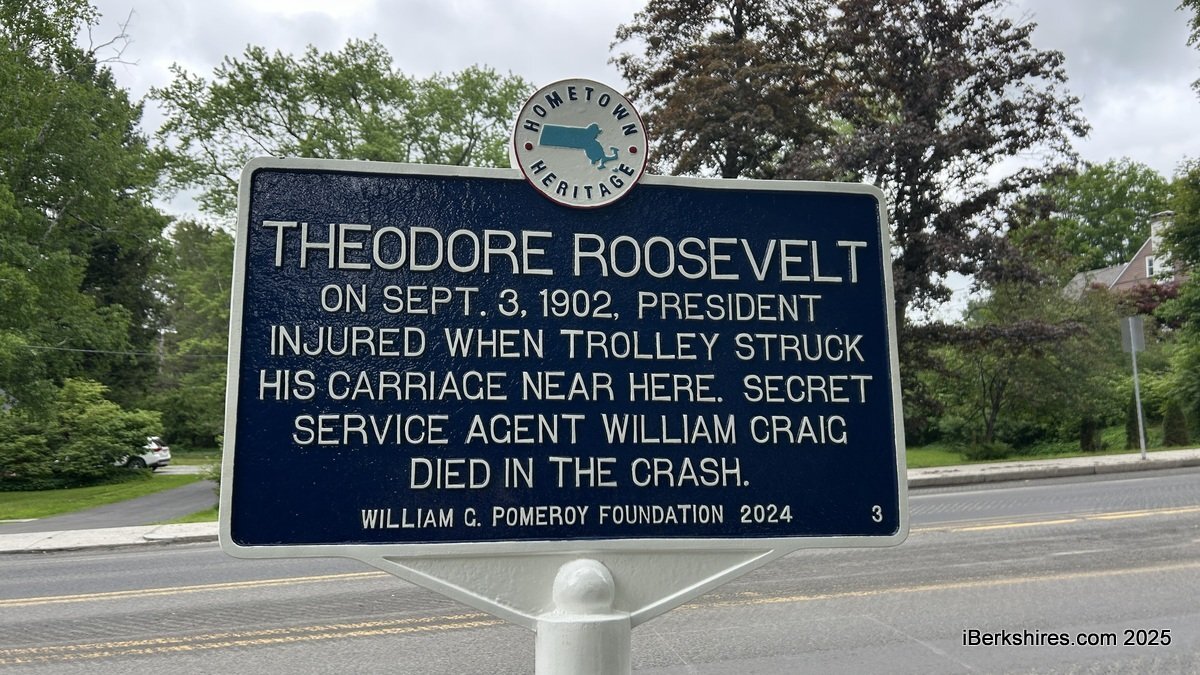
The new sign noting the event that injured Teddy Roosevelt and killed his Secret Service agent on their way to the Country Club of Pittsfield.
image description
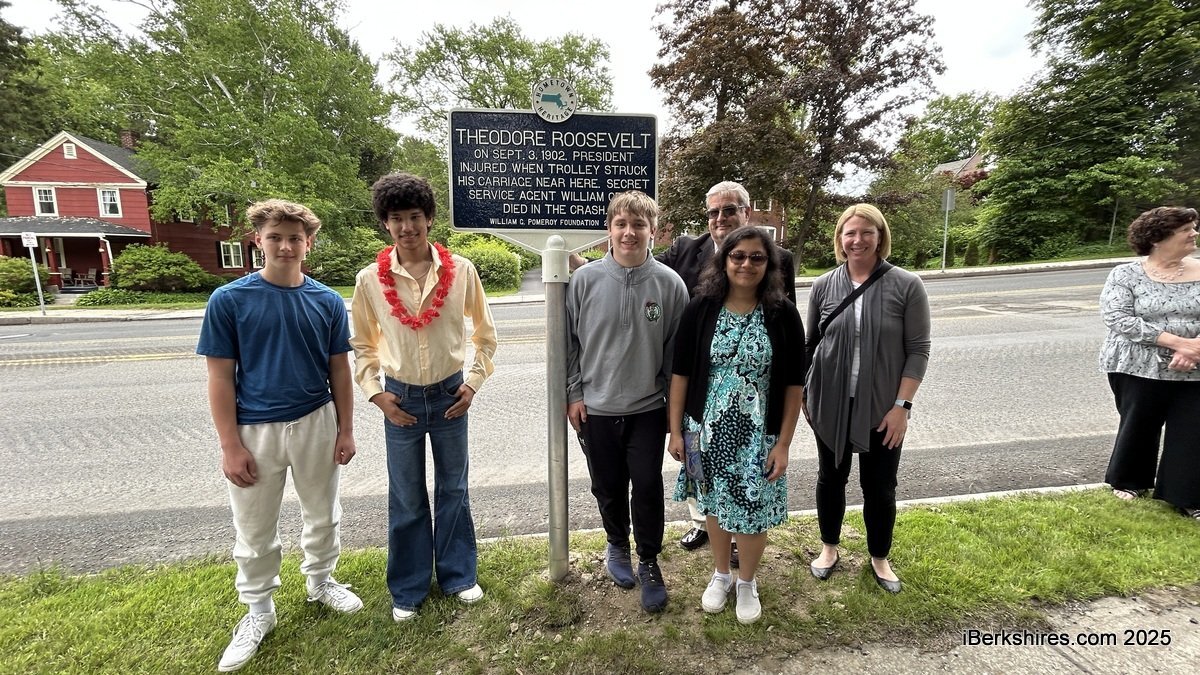
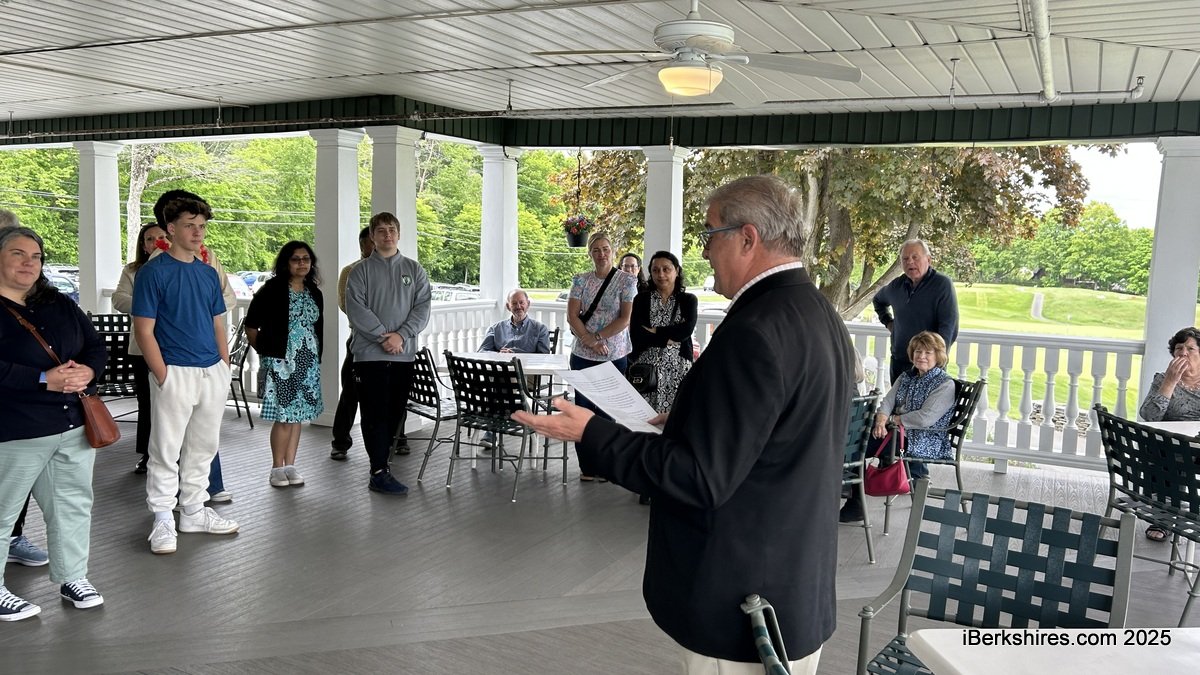
Members of the Herberg Middle School Civics Club attended.
image description
image description

South Street Sign Marks 1902 Roosevelt Trolley Incident
By Brittany PolitoiBerkshires Staff
Print Story | Email Story

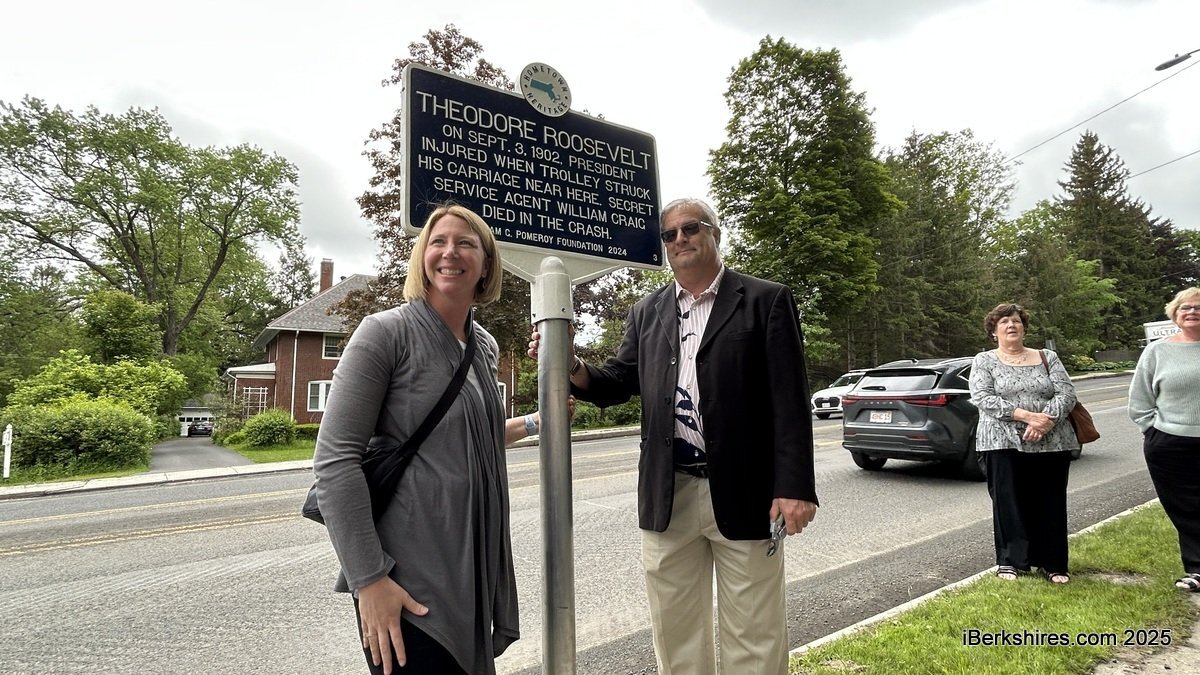
Mayor Peter Marchetti says its fitting the city memorializes William Craig, the first Secret Service agent killed in the line of duty. 

PITTSFIELD, Mass. — A sign now commemorates the location of an incident that made President Teddy Roosevelt say, "If you're set on risking your life, go to Pittsfield, Mass., and take a trolley ride."

The Berkshire County Historical Society last week unveiled a new historical marker near the corner of South Street and Mountain Drive that commemorates the trolley accident which killed Secret Service Officer William Craig and injured Theodore Roosevelt.

"We are here today because on September 3, 1902, President Theodore Roosevelt was visiting Pittsfield as part of a barnstorming tour through New England in support of local Republican candidates. Roosevelt was traveling in an open landau carriage from the center of the city to its outskirts along South Street. His destination was the Country Club of Pittsfield, where he was scheduled to sign the club's register before heading on to Lenox to deliver a speech," society Executive Director Lesley Herzberg said to a small crowd at the Country Club of Pittsfield.

Trolleys were supposed to be off duty that day, but one got a late start and, while attempting to arrive before the presidential party, crashed into Roosevelt's landau with deadly results.

"Agent Craig became aware of the approaching danger and stood, attempting to protect the president. He was thrown directly into the path of the trolley and was crushed under its wheels," Herzberg explained.

"… Roosevelt injured his leg, which he ignored at the time, more concerned with losing Craig. However, this injury plagued him and would require surgery at an Indianapolis hospital later that month."

The marker took five years of collaboration between the Historical Society, the city, the William Pomeroy Foundation, the Theodore Roosevelt Association, local historian Dr. Richard Henneberry, and the Herberg Middle School Civics Club.

It was funded by the William Pomeroy Foundation.

"This incident marked the first time in American history that a Secret Service agent was killed in the line of duty," Marchetti said.

"As we just recently celebrated Memorial Day, honoring men and women who made the ultimate sacrifice to our nation through their service in our armed forces, it is also fitting that we are here also taking this moment to remember the sacrifice of Agent Craig. Agent Craig, who diligently served both President McKinley and President Roosevelt, should always be remembered for his sacrifice to the country and the sacrifice for the nation."

When speaking about the agent, Roosevelt is quoted as saying, "The man who was killed was one of whom I was fond of and whom I greatly prized for his loyalty and faithfulness."

Secret Service member, who wished not to be named, said he appreciated the effort, and that "It means a lot to us." He had learned a lot he didn't know about Agent Craig in the last few weeks.

"All of us, when we go through our training academy, we do learn about those that were killed in the line of duty, but it's a fresh reminder for us, too, with things like this," he said.
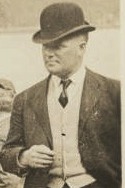

William Craig, from the Officer Down Memorial Page. 
Craig was 48 years old and a native of Scotland. He had an adventurous life before immigrating to Chicago with his mother and sister. A former bodyguard to Queen Victoria, he served 12 years in the British army and was with the detachment that spent three years traveling to Khartoum in the failed attempt to rescue the ill-fated Major Gen. Charles Gordon. 
 
According to the Chicago Tribune, he was a physical director at the Armour Institute and the Yale-Princeton public school, where he gave exhibitions of his expert swordsmanship and boxing. He joined the Secret Service in 1900, working out of Alabama, where we helped bring down a gang of counterfeiters. He served in Pittsburgh and then joined the White House detail in 1901. He was to be married the next spring.
 
He is buried in Chicago's Oak Woods Cemetery. 

During the pandemic, BCHS was contacted by the Theodore Roosevelt Association asking if there was a marker on the site of the infamous trolley incident.

"When we realized there wasn't, we went on a journey to make this marker a reality," Herzberg explained.

After unveiling the sign, Historical Society members, city officials, and former Herberg students, who helped secure a grant and contributed to the research on the incident, gathered at the Country Club of Pittsfield.


Henneberry's daughter, Ellen Henneberry, explained that her Pittsfield native father is not a local historian but a neurobiologist. He currently resides in the state of Florida.

"This was a passion project of his, and he worked with a local city engineer on the research," she said. "I'm so happy that I could be here."

The 1902 trolley accident:
 
On Sept. 3, 1902, President Theodore Roosevelt was visiting Pittsfield, as part of a barnstorming tour through New England in support of local Republican candidates. Roosevelt was traveling in an open landau carriage from the center of the city to its outskirts along South Street. His destination was the Country Club of Pittsfield, where he was scheduled to sign the club's register before heading on to Lenox to deliver a speech. The driver and owner of the carriage, David J. Pratt was sitting on the raised front bench with Agent Craig. Inside the carriage were President Roosevelt, Massachusetts Governor Winthrop Crane, and Roosevelt's secretary George Cortelyou.
 
The carriage had made the descent from the center of town and was crossing the culvert over Wampenum Brook to start ascending "Howard Hill" (as it was locally known). The road narrowed at this point and carriages were forced to cross the trolley tracks, moving from the east to the west side of the street.
 
Trolleys were supposed to be off duty that day, per orders from the Secret Service. Inexplicably, trolley Number 29 was utilized by the owners and guests of the Pittsfield Electric Street Railway to the County Club. The trolley riders aboard Number 29 got a late start and wanted to arrive at their destination before the presidential party. The owners may have urged trolley driver Euclid Madden to speed up — he would later state that he thought that he would use the momentum built up going downhill to speed past the president's carriage.
 
Unfortunately, this did not happen. As the carriage crossed the trolley tracks, the two conveyances collided, with deadly results.
 
Agent Craig had become aware of the approaching danger and stood, attempting to protect the president. He was thrown directly into the path of the trolley and was crushed under its wheels. David Pratt also received serious injuries. The passengers were all thrown out of the carriage and injured, though none of these were life-threatening.
 
Roosevelt injured his leg, which he ignored at the time, more concerned with losing Craig. However, this injury plagued him and would require surgery at an Indianapolis hospital later that month.
 
He told an audience sometime later, "If you're set on risking your life, go to Pittsfield, Mass., and take a trolley ride."


Tags: historical event,   historical marker,   memorial,   secret service,   
If you would like to contribute information on this article, contact us at info@iberkshires.com.

PCTV Turns 40, Anniversary Celebration This Friday

By Breanna SteeleiBekshires Staff

PITTSFIELD, Mass. — Pittsfield Community Television is turning 40 this week, and it's celebrating with its viewers and listeners.

This Friday, Sept. 18, PCTV will celebrate at the Berkshire Hills Country Club. Ryan Peterson, WTEN News10 ABC anchor and Pittsfield High School graduate, will give the keynote address. 

Executive Director Shawn Serre, who has been with the station for over 32 years, said it's their chance to celebrate all they have been able to bring to the community.

"It's a chance to reflect on everything that the organization has done over those years, all the people that have been involved. From board members to volunteers to producers to crew people to staff members, and all the different programs that we've produced," he said. "Everything from public programming to education, sports, graduations, parades, government meetings and forums, and election night coverage, and all kinds of other things that just year upon year of history that we've been able to create and document here for the Pittsfield community over those years." 

Serre took over as executive director about nine years ago. Originally a volunteer fresh out of college.

The original board included former mayor Edward Reilly, Dan Dillon, Diane Morgenstern, Bernard Avalle, and John Fukes of the Berkshire Athenaeum. The operation was all-volunteer until PCTV hired the first executive director in January 1989.

PCTV has operated out of its station on Federico Drive since 1999. But originally they worked out of a basement. 

"The first location that we ever had, we had all of our equipment stored in cardboard boxes in the basement of the Berkshire Athenaeum, because the Berkshire Athenaeum at the time was very gracious and allowed us to have some space while we sort of got our feet on the ground and sort of got things organized," he said. "But we had no location. We had no studio. We just had this equipment that was ordered with the money that we had from the original cable franchise grant."

"So that lasted a couple of years, and then we signed and got a lease over in our first studio location, which was over on Fourth Street in Pittsfield," Serre continued. "That was around the time that I first got involved, just before we moved to Fourth Street. So I was there in the basement of the library, opening those boxes up and seeing what we had for equipment. So we stayed there at Fourth Street for about 10 years, and then this building that we're currently in now, over on Federico Drive, was constructed in 1998. It was built kind of custom-made for the cable company and for us and for one other company." 

Serre said one of their proudest moments was saving the radio station WTBR-FM back in 2018. PCTV made space for them so they could continue operation.

"We carved out some space here in our facility for that, and we've been operating that radio station ever since. So those are some of the big milestones of growth of the organization over the years, and the things that we've done," he said.

They have also invested in advanced technology to keep their programming accessible to all.

"Technologically, there's another whole series of things that we've gone through," he said. "We've started out with a single cable TV channel. We grew to three cable TV channels. We started out as standard definition on videotape, and we grew to digital, and then to high definition, and then everything went to the internet. So we're able to offer video on demand and live streams and video on social media. And then with the radio station, we also have a live stream there and podcasting. So we've seen a lot of technological change and tried to roll with that over the years."

Serre said that PCTV strives to keep people informed while also allowing space for people to create their own media.

"The whole idea behind PEG [Public Education and Government Access]...the whole idea behind that back in the 70s and 80s was that people could be left behind with the technology that's available to the big corporations," he said. "So, if you had a cable system at the time, ordinary people maybe they had camcorders at home, but they didn't have access to a TV studio; they didn't have access to the kind of technology that we had to allow them to create programs and share it with the community. So we filled that gap, and that was one of the main things that we did. And then also to be able to create programming for viewers and for the city, so that the municipal meetings can be shown, and so school committee meetings can be shown, and it really brings people in and involved."

View Full Story

More Pittsfield Stories