Northampton Teacher Mounts Challenge for 1st Mass Seat
.JPG)
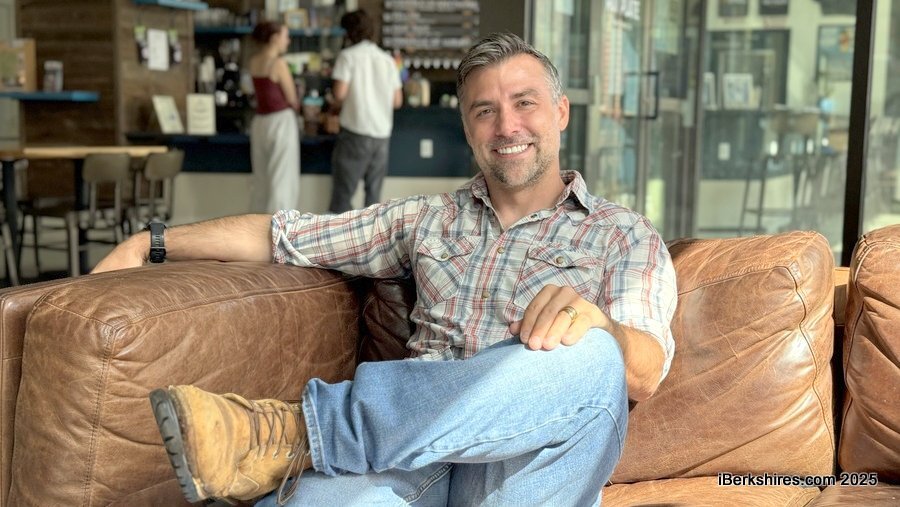
Jeromie Whalen is driving a distinctive yellow Toyota 'Vanana' as part of his campaign branding.
PITTSFIELD, Mass. — For Jeromie Whalen, his race for the seat in the state's 1st Congressional District is more than a campaign: It's a movement.
"I'm a public servant, I'm not a politician, and I say that with pride, because over the last 36 years, we've seen what a politician and a suit and tie that's beholden to corporations has gotten us," Whalen said.
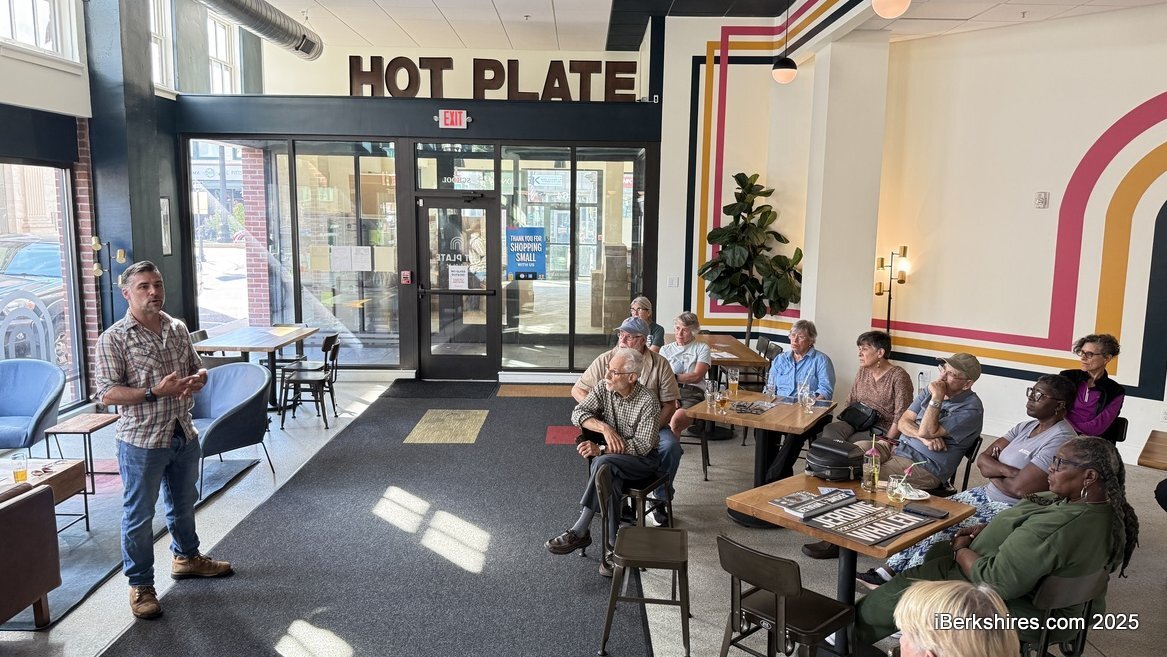
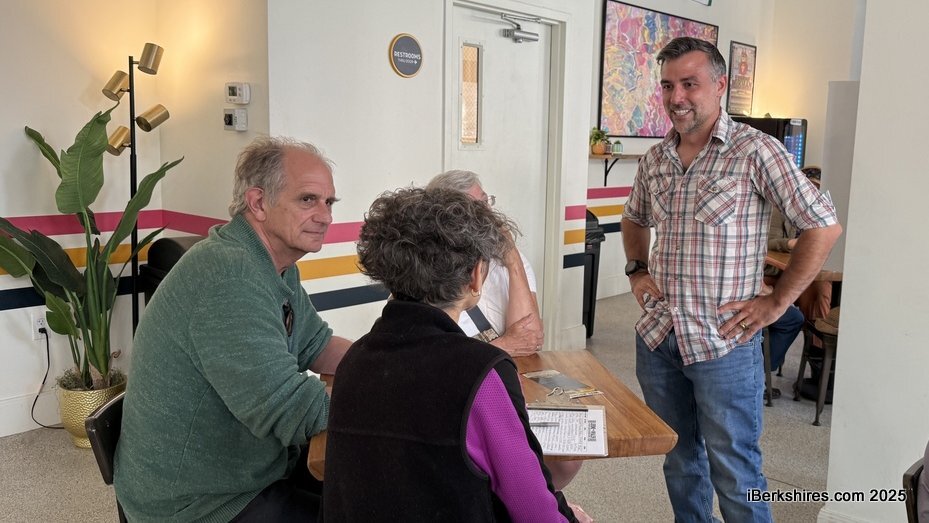
In his yellow "Vanana" van, the South Hadley resident took to the road for his first campaign tour, visiting more than 20 towns and cities and culminating in a campaign rally Saturday at noon at Springfield City Hall. On Thursday, he was at Barrington Brewery in Great Barrington early in the afternoon and stopped at Hot Plate Brewing in Pittsfield at 3.
He said his campaign is not just a rethinking of what the Democratic Party stands for and redefining the party as whole.
"It's also a rethinking of how we approach campaign finance and some of the larger systems that we think that we're stuck with because of rulings like Citizens United and the likes, and saying that we can do it our way," Whalen said.
"We can get small donors to band together to fund campaigns in a grassroots way, in an authentic and meaningful way that is beholden to the people and not to corporations."
It's a reconsideration and rethinking of what the true heart of the Democratic Party is and rejecting the things that politicians, like veteran Congressman Richard Neal, whom he's challenging in next year's Democratic primary, are doing on a donor basis, Whalen said.
"The other thing that's not lost on me is that when I win this seat, it sets a precedent. There's different types of power that are wielded," he said.
One type of power is the experience and longevity of a person within the seat, but Whalen pointed to examples like Alexandria Ocasio-Cortez, who ousted a 10-term congressman, saying when a true leader stands up, they can turn heads.
"That is just as powerful as any kind of ranking member of a committee and so, this is our chance to redefine a bunch of different things: redefine politics, redefine the Democratic Party, but also put Western Mass on the map," he said.
"Bring the funding that we deserve in, set the tone for the entire nation, and really set Western Central Mass as an example."
On his website, Whalen highlights the more than two dozen topics that he built his platform on. Health care, economy, and education were the main topics of his stop Thursday.
Whalen has experienced the "broken health-care system" firsthand, with his mother's recent diagnosis of cancer. The bills should never be in the back of the patients and their family's minds, he said.
"We see that every other developed country in the world has, to some degree, a universal health care system, and we have to ask ourselves, why don't we," Whalen said.
"The number of times that I have had conversations with people that are more worried about the bill that they're going to get after a hospital stay, then the health of themselves or a loved one is unacceptable. The economics behind it makes sense. It's not something that is unattainable within the richest country in the world, and we need to prioritize the universal health care system."
The country needs to have a comprehensive tax reform that shifts the burden from the working class over to the billionaires, he said.
"I see the Amazon driver go by every day, and on a hot day, I get him that Gatorade, and I say, 'thank you, and I appreciate you.' Meanwhile, [Amazon owner] Jeff Bezos is out there at an Italian wedding for $50 million," Whalen said.
There is a disconnect with the wealth in this country and there is a need to focus on how how money can be put back into the pockets of the middle and working class.
"That also means looking at living wages, not just minimum wage, but living wage," he said highlighting the Massachusetts Institute of Technology's calculator that calculates "the exact amount" needed to not just survive but live comfortably, grow into a first home, raise a family, and all the things that is connected to the idea of the American Dream.
"I want that American Dream for everybody, and what that means is taxing billionaires their fair share," he said.
Lastly, education. Whalen said as a public high school teacher, he is disgusted that the country has gotten rid of grant funding and public school funding to the degree it has and it is time to restore the nearly dismantled U.S. Department of Education
"To not have that support and to not prioritize the education system in the United States is not OK," Whalen said. "I will ensure that we are not losing [funds.] We are bringing funds in for our public schools and I take that very seriously."
He was inspired in part to run after the last presidential election, believing his students had been "desensitized" from being constantly bombarded with things "that tear us apart as a community."
"Over that time, I've just watched the animosity and the vitriol and the hate just bubble to the surface more and more, tear apart our communities within Western Central Massachusetts, and it all reached a tipping point with Trump getting elected the second time," Whalen said.
The second prompt to run was when he began looking into how much corporations donate to politicians, specifically taking aim at Neal, who's represented all or part of Western Mass since 1989. Currently the ranking member on the powerful Ways & Means Committee, the representative will be seeking his 20th term next year.
Whalen criticized how 75 percent of Neal's campaign funds come from corporate and political action committee money, which he believes makes him less beholden to regular constituents.
"[This] results in Richard Neal not showing up for a town hall in the Berkshires since 2017. Not representing the communities in which he is supposed to be representing, not advocating strongly for all of the top-down attacks that I experienced in the classroom and beyond," Whalen said.
"The lack of leadership and the failure of leadership has made it where we are trying as best as possible in a really kind of grassroots way, from everybody to teachers like myself, to nurses, to our first responders, to union workers, and trades people taking the brunt of all of these ills of society and the lack of funding that we're seeing coming in, and it just became something that was unacceptable to me."
He assembled a campaign team in March and April, took a year's leave of absence, and began reaching out to local organizations to listen to community concerns in Western and Central Massachusetts.
"The things that had come up repeatedly was the visibility and the accessibility of Richie Neal. Everyone has a story of reaching out to his office and not getting any response. Everybody has a story of inviting him to an event and being ghosted. And that's not leadership," Whalen said.
"In my book, leadership means that regardless of what the issue is or the individual that's inviting you there, you're going to show up for them and you're going to love them and appreciate them, especially when we're thinking about district one, because it's a large district. We're talking about 83 municipalities stretching over 30 percent of the land mass in Massachusetts."
Whalen recognized the challenges and revitalization efforts taking place in urban areas, which have faced issues related to post-industrialization. He emphasized the importance of representing diverse cultures and communities.
"I have this little yellow van that I drive around in. I've been putting a lot of miles on it and talking to a lot of people face to face, and they appreciate that, because that's what representation means," Whalen said.
"When you're not beholden to corporations, you're beholden to the actual people that you represent. It means truly supporting them in reaching and meeting them within those communities."
Tags: 1st Mass, Congress, election 2025,