image description
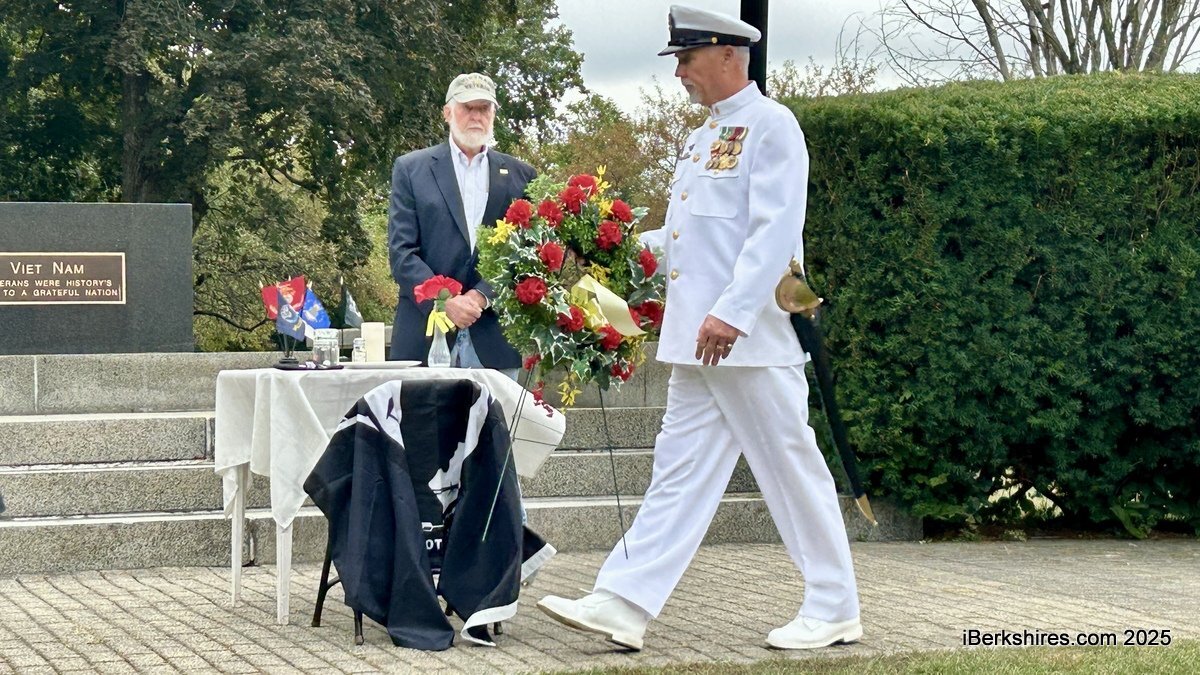
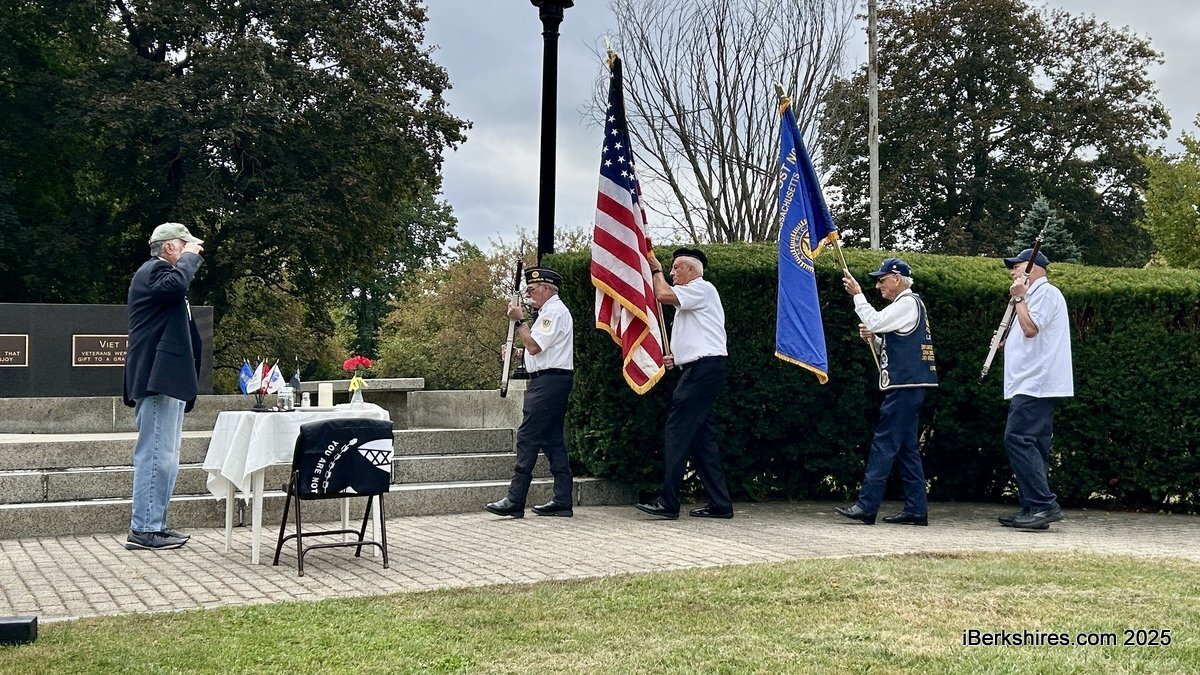
Mark Harris, vice commander American Legion Post 68 in Pittsfield, places the wreath at the POW/MIA table of remembrance at Friday's memorial.
image description
Charles Persip American Legion Post 68 began holding the memorial three years ago.
image description
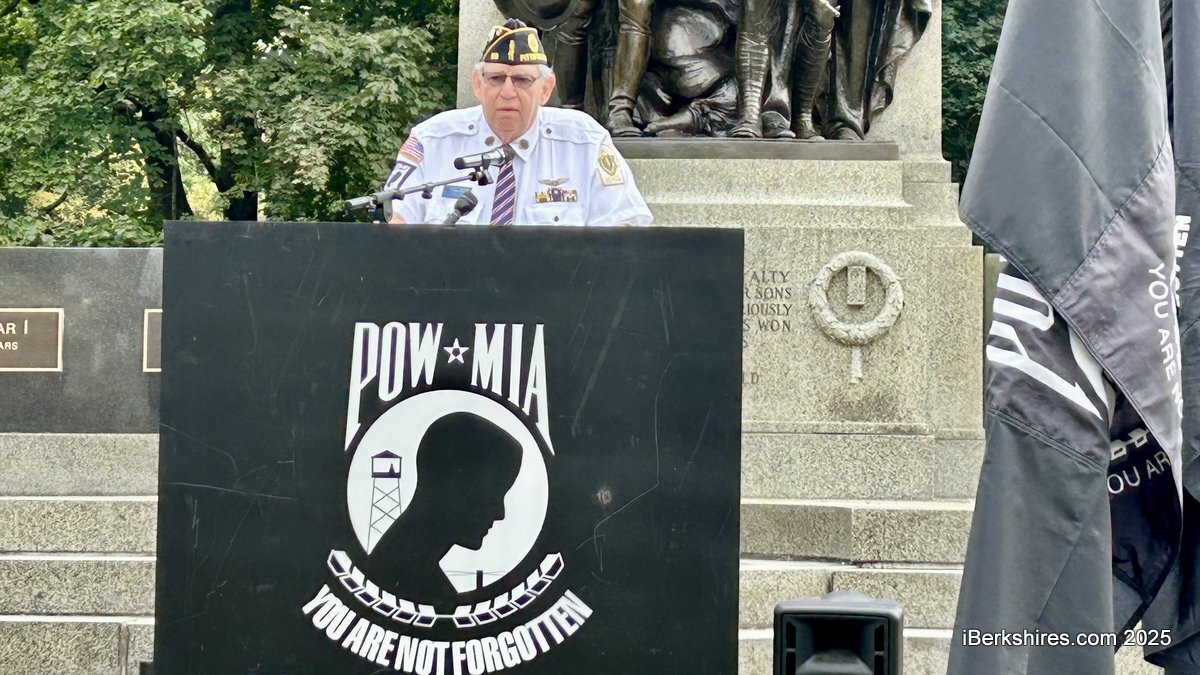
Post 68 Cmdr. Woody Vaspra says the Defense Department continues to search for the 138,000 missing service members since World War I.
image description
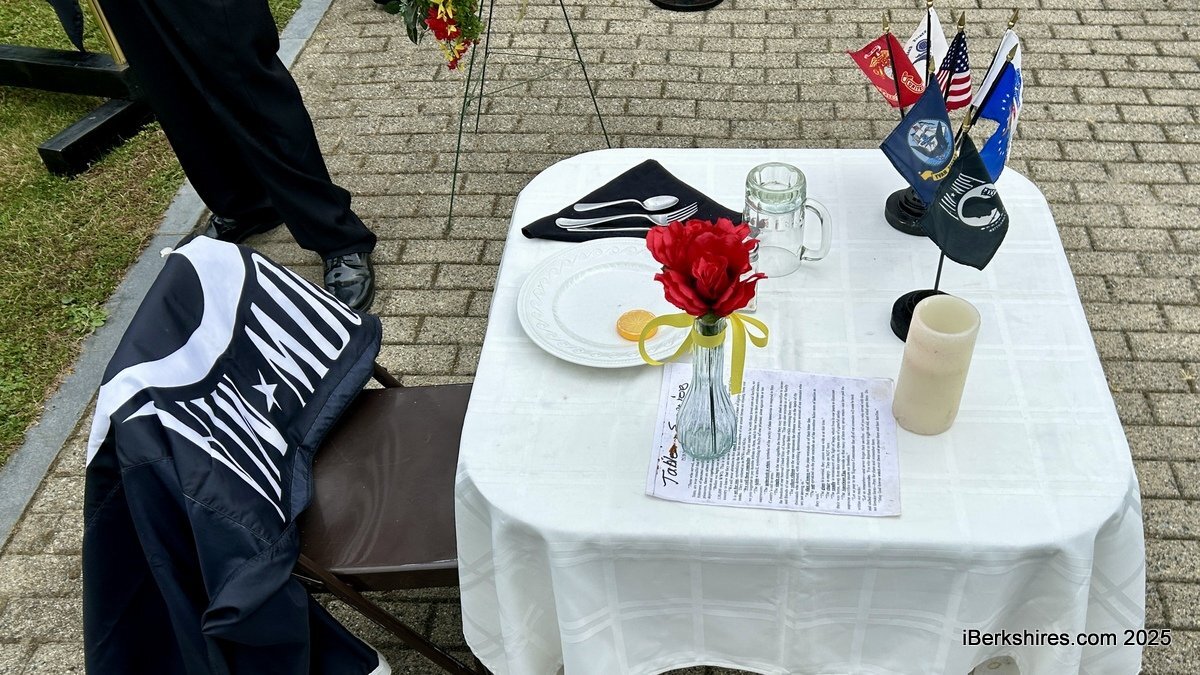
The table of remembrance is symbolic of the prisoner alone, the blood that's been shed and the family waiting for their return.

Pittsfield Remembers POW/MIA Servicemembers
By Brittany PolitoiBerkshires Staff
Print Story | Email Story

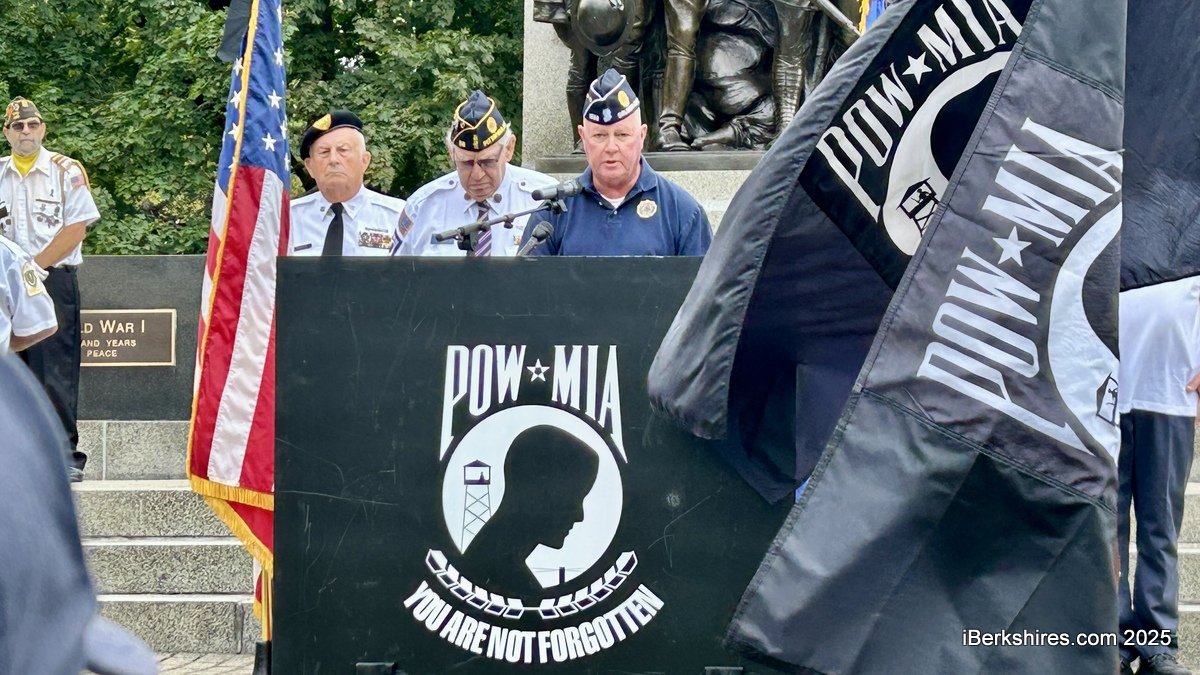
Brian Sedgwick, commander of the New Lebanon, N.Y., American Legion post, was the keynote speaker for the event. 

PITTSFIELD, Mass. — Local veterans gathered on Friday to honor prisoners of war and service members missing in action, and to underscore efforts to unite them with descendants. 

The Charles Persip American Legion Post 68 held its third annual POW/MIA Remembrance Ceremony at the Veterans Memorial Park. Keynote speaker Brian Sedgewick, commander of American Legion Post 1236 of New Lebanon, N.Y., reported that more than 200 missing servicemen were identified in the last year. 

This includes 159 from World War 2, 55 from the Korean War, and eight from the Vietnam War.  

"We're actually making progress," he said. 

"In over 50 countries around the world, there are active investigations going on, where you have investigators out there interviewing actual witnesses, descendants of witnesses, family members that actually took part in burying American service personnel who may have a recollection of where they might be. All over the world, our investigators are out there just trying their best to find as many as we can possibly bring home for the next of kin." 

He added, "We must never forget and continue to strive to bring as many of the fallen service members home to their loved ones as can." 

Last year, two World War II casualties were returned home after being identified eight decades later: Marine Pfc. Erwin S. King of Clarksburg, who was killed in action during the Battle of Guadalcanal, and Army Air Forces Pfc. Bernard Calvi of North Adams, who died in the notorious Cabanatuan Prison Camp in the Philippines.

Congress and the president solidified the POW/MIA recognition day in 1979 after a drive for more accountability from families of more than 2,500 Vietnam War POWs and MIAs. There have been more than 138,000 since World War I.

The Charles Persip American Legion Post 68 held the inaugural ceremony in 2023. Army veteran Henry "Hank" Morris had attended a fellow Vietnam veteran's funeral in Albuquerque, N.M., the prior year and was inspired to start the tradition.

"The Defense Department remembers and honors those Americans who were POWs and those who served and never returned home. DOD's POW/MIA Accounting Agency continues to search for the missing, fulfilling the nation's promise to leave no service member behind," American Legion Post 68 Cmdr. Woody Vaspra explained. 

"The agency has been searching for remains of service members in 45 nations in an effort to bring closure to the loved ones, and it also strengthens diplomatic ties with those nations." 

Vaspra shared his personal connection to this day. 


"I, for myself, had a friend who was a POW for eight years, and he came back, and he didn't last too long, but at least he made it back to see his family," he said. 

"Then my roommate and pilot trainer was shot down, and he was missing in action, and they finally, after a while, found his remains. He's now on the Vietnam Wall, and that's why I'm very active in these activities, to honor those gentlemen and everybody else." 

Sedgewick pointed to the National POW/MIA Flag Act, which he said reaffirms the country's commitment to its missing, "And ensures that the words emblazoned on the flag communicate a clear message of our unwavering support and commitment to our nation's heroes and their families." 

"The message is this: You are not forgotten. Private citizens, organizations, and businesses are free to display this flag, and are very much encouraged to display their flag on a daily basis. We do it to respect and honor those who have helped, who have been held in captivity and returned, as well as those who have yet to come home from the past conflicts around the globe," he added. 

"By being here today, you and I are part of a global effort to bring recognition to this noble mission and remind the families of this special category of brave patriots that they are truly not forgotten." 

Tyrone Bellinger from the Vietnam Veterans of America Chapter 65 recited the POW/MIA table of remembrance: 

"The table is small symbolizing the frailty of one prisoner alone against his or her suppressors. The tablecloth is white, symbolic of the purity of their intention to respond to their country's call to arms. The single rose in a vase signifies the blood they were willing to shed and sacrifice to ensure the freedom of our beloved United States of America. The rose also reminds us of the families and friends of our missing comrades who keep the faith while awaiting their return. The yellow ribbon on the vase represents the ribbons worn on lapels of thousands with demand with the unyielding determination of proper account for their comrades that are not among us. A slice of lemon on the plate represents the bitter fate,"

"The salt sprinkled on a plate reminds us of the countless volunteers, the families, as they wait. The glass is inverted they cannot toast with us at that time. The chair is empty. They are not here. The candle is reminiscent of the Light of Hope, which lives in our hearts to eliminate their way home from their captors to the open arms of a grateful nation. The American flag reminds us that many of them may never return and paid the supreme sacrifice to ensure our freedom."


Tags: POW/MIA,   veterans memorial,   
If you would like to contribute information on this article, contact us at info@iberkshires.com.

Youth For The Future: Adwita Arunkumar

By Breanna SteeleiBerkshires Staff

PITTSFIELD, Mass. — Williams Elementary School fourth-grader Adwita Arunkumar has been selected as our April Youth for the Future for her mentoring of a younger child.

Youth for the Future is a 12-month series that honors young individuals that have made an impact on their community. This year's sponsor is Patriot Car Wash. Nominate a youth here

Adwita has cortical visual impairment; she has been working with her teacher, Lynn Shortis, and her, paraprofessional Nadine Henner.

"My journey with CVI means that I learned in a different way. I work hard every day with Miss Henner and Miss Lynn, to show how smart I am," she said.

"Adwita is a remarkable student. She's a remarkable child. She has, as she shared, cortical visual impairment, which is a brain-based visual processing disorder, which means the information coming in through the eyes is interfered with somewhere along the pathways, and we never quite know what's being interpreted and how and how it's being seen," said Shortis.

"So she has a lot of accommodations and specialized instruction to help her learn."

Recently Adwita has chosen to mentor 4-year-old Cayden Ziemba, who is also visually impaired.

"I decided to be a mentor to Cayden so that she can learn some new things. I teach her how to walk with the cane, with the diagonal and tap technique, I am teaching her Braille," she said. "I enjoy spending time with Cayden, playing games and being a good role model."

Shortis said the mentoring opportunity came up when Cayden was entering preschool at Williams, and they introduced her to Adwita. 

"Adwita works really, really hard academically. She's very smart, but there are a lot of challenges in that, because of the way that it's so visual and she's a natural. She's just, it's automatic," Shortis said. "It's kind of like a switch is turned on and she becomes this extremely confident and proud person in this teacher role."

Adwita also has been helping Cayden on how to use her cane on the bus and became a mentor in a unexpected ways.

"Immediately at the start of this year, she would meet Cayden at the bus. She has taught Cayden how to use her cane to go down the bus stairs. Again, Adwita learned that skill, so it wasn't something I had to say to her, this is what you need to have Cayden do. She just automatically picked that up and transferred that information," said Shortis. "Cayden is now going down the bus step steps independently with her cane. And then she really works hard with Adwita in traveling through the hallways, Adwita leads her to her class every morning, helps her put her things away and get ready for her morning."

Adwita said she hopes Cayden can feel excited about school and that other students can feel good about themselves as well.

"I want them to know that Braille is cool to learn. You can feel the bumpiness with your fingers. I want people to know how you can still learn if your brain works differently sometimes. I need to have a lot of patience working with a 3-year-old. I need to be creative and energized," she said.

She hopes to one day take her mentoring skills to the head of the class as a teacher.

"I want to become a teacher and teach other students when I grow up. I might want to teach math, because I am great at it," she said. "I also want to teach others about CVI. CVI doesn't stop me from being able to do anything I want to. I want students to not feel stressed out and know that they can do anything they want by working hard and persevering."

Her one-to-one paraprofessional said she likes seeing the bond that has grown between the two girls, and can picture Adwita being a teacher one day.

"I do see her in the future being a teacher because of her patience, understanding and just natural-born instinctive skills on how to work with young children," Henner said.

Shortis also said their bond is quite special and their relationship has helped to bring out the confidence in each other.

"The beauty of it, there's just something about it their bond is, I don't even really have a word to describe the bond that the two of them have. I think they share something in common, that they're both visually impaired, and regardless of the fact that their visual impairment differs and the you know the cause of it differs," she said.

"They can relate. And they both have the cane. They're both learning some Braille. But there's something else that's there that just the two of them connected immediately, and you see it. You just you see it in their overall relationship."

 
View Full Story

More Pittsfield Stories