State Housing Secretary Hears Struggles, Opportunities in Southern Berkshire
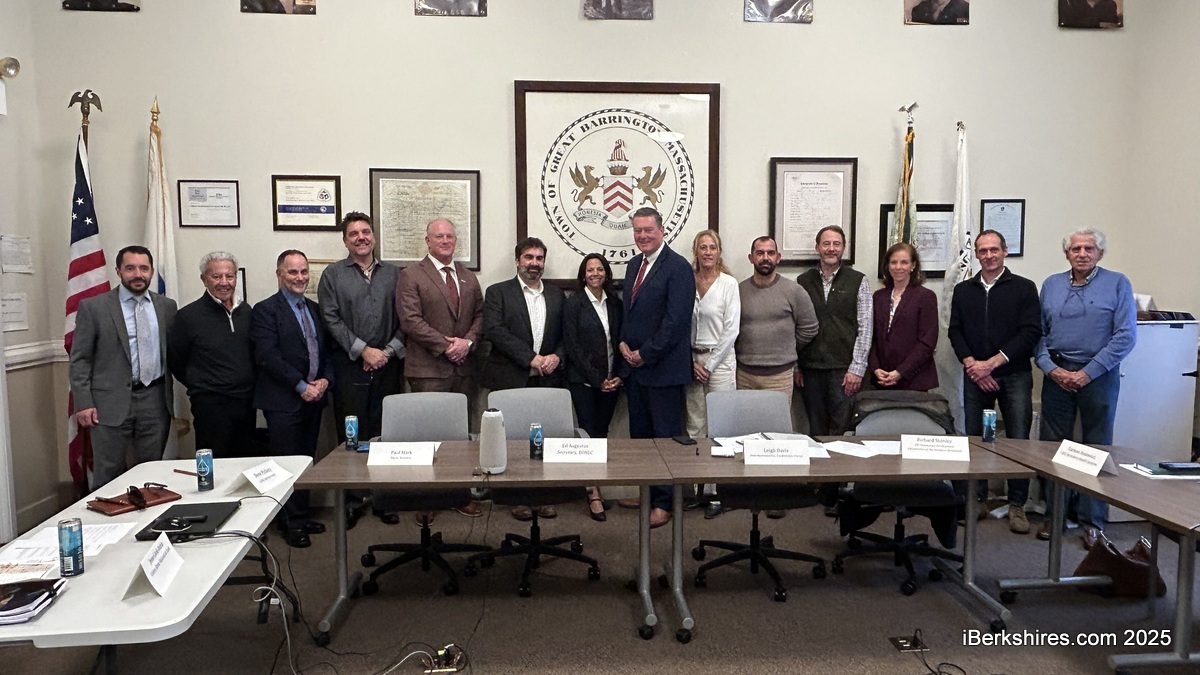
GREAT BARRINGTON, Mass. — State Secretary of Housing Edward Augustus visited Berkshire County on Tuesday to hear about the region's needs and see opportunities for adding more units.
"Partnering, that's really the theme," Augustus said after a roundtable discussion at Town Hall with developers and community leaders.
"The state can't do it all by itself, local communities can't do it, but together, there's a lot that we can do to take out some of the time, some of the cost of creating more units."
Massachusetts has 43,000 units of state-owned housing for eligible people who pay 30 percent of their income to live there. Augustus, who leads the Executive Office of Housing and Livable Communities, explained that the state is essentially buying affordability through direct and indirect subsidies.
"There are no other options like that out there, so to me, our job is to make sure that housing stays even though it may be 50, 60, 70, 80 years old and is in good repair and is healthy and safe and dignified," he said.
"And so we are pumping in significant dollars to try to upgrade public housing, to keep that important safety net part for folks who are only paying 30 percent of their income, whatever their income is, on housing."
Earlier in the day, he visited the Eagle Mill redevelopment project in Lee, which will provide dozens of affordable units in the former paper mill on West Center Street. Augustus said these units are affordable because the state is subsidizing them, as it put $16 million in tax credits into the project's first phase. The project also saw $5 million in state infrastructure funds.
State Rep. Leigh Davis coordinated the conversation to bring developers, employers, and government together. Representatives from Berkshire Health Systems, Hillcrest Educational Centers, and Greylock Federal Credit Union were included in the closed roundtable.
"I've always been a passionate advocate for housing, and not only affordable housing but workforce housing from a perspective that I really feel it's the foundation of a community, and without having housing, we won't have a sustainable business district, and we won't have the workforce that we need," Davis explained.
"I was really focusing on convening a group that represented different sectors, so it's very, very strategic and thoughtful about who came to this roundtable."
She has been focused on ensuring Great Barrington and the Southern Berkshires don't become seasonal home communities that are unaffordable for workforce employees. Without a focus on investment, she feels the area could go over the tipping point of becoming a community that's just for the wealthy and older populations.
Davis pointed to the shortage of emergency medical services and health-care workers and local businesses shortening their hours, explaining, "It's all about putting the future of the Berkshires first, and making sure that it's sustainable and it's a place that someone could literally live where they work."
"So for me, convening this is a moment that the people here can see that the Legislature is supporting them and that it's a two-way street, so that they could get their challenges and their frustrations and their creative solutions to the housing secretary, and have the two legislators, myself and state Sen. Paul Mark, here saying, 'We'll help you. We're partners,'" she added.
The state is working on bylaws for seasonal communities designations, and Davis sees this as a great opportunity for Great Barrington and Lee, even though they haven't been identified as seasonal. Eight Berkshire County communities have met the designation, meaning they have a significant seasonal population and employment fluctuations.
Davis has been making the case for Great Barrington and Lee to be included as seasonal hubs, explaining that people strategically purchase property in surrounding towns for lower tax rates but use the larger communities' infrastructure.
She explained, "We are not gateway cities, but we're gateways to the Berkshires."
Great Barrington borders four seasonal communities: Alford, Stockbridge, Tyringham, and Monterey. These towns have between 39 and 55.2 percent seasonal residents.
"We have infrastructure in place. We have town planners. We have shown ourselves to be players and partners in building housing," Davis said.
She feels Great Barrington and Lee could be seasonal community models for Berkshire County and the wider Commonwealth, and are ready for the designation. The former Select Board member also pointed out that Great Barrington has bylaws that discourage short-term rentals, which she helped write, but penalize the town in terms of seasonal communities standards.
The Affordable Homes Act gives seasonal communities that accept their designation several tools to address the housing crisis, including year-round occupancy restrictions, a new "attainable housing" for people below 250 percent of the area median income, housing trust funds, property tax exemption adjustments, and more.
Augustus is anxious for the eight Berkshire communities to accept their designation,
"We want people to use the benefits of that tool, we just need communities to say ‘yes' and it makes sense to them," he said.
Davis on Wednesday said Augustus had announced that nine more towns in the 3rd Berkshire District — Egremont, Great Barrington, Lee, Lenox, New Marlborough, Richmond, Sandisfield, Sheffield, and West Stockbridge — will now be added to the list of eligible municipalities for the Seasonal Communities designation.
"This is fantastic news for the region," she said via email. "This opens the door to new funding, tools, and state support, with a quick turnaround so towns can bring their designation to a vote before the 2026 town meeting season. We'll need to stay coordinated and build local support — more to come."
Tags: affordable housing, leigh davis, paul mark, state officials,