Berkshire Delegation Details Efforts to Help Berkshires
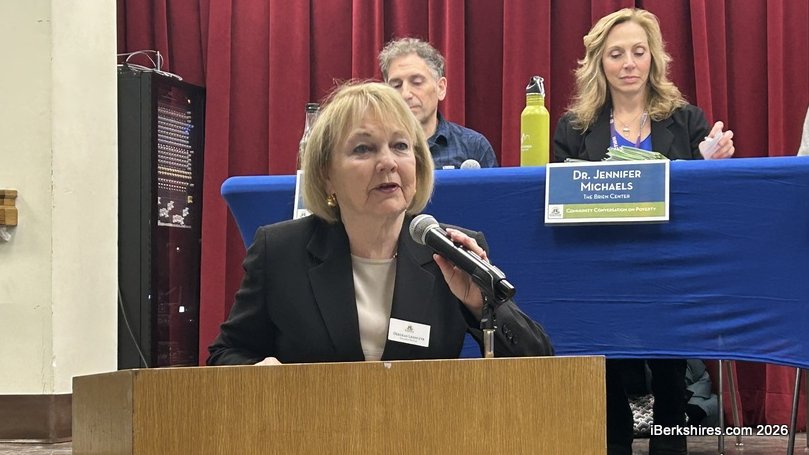
BCAC Executive Director Deborah Leonczyk opens the conversation.
State Sen. Paul Mark said state lawmakers are trying to ensure programs that are important to this region are funded well, have resources, and work in rural communities.
When it comes to policy, he said, they are trying to make decisions that better reflect the things people need to get out of economically challenging times. For example, the Legislature recently provided $35 million for fuel assistance in the current fiscal year.
The senator said he understood how some are struggling, recalling how when he was young, his father lost his job and his family "fell on some really hard times that lasted for a really long time."
"Whenever I talk about going through those hard times, I always like to point out that most of the time, my father still worked, and it didn't matter. We still needed food stamps. We still lost our house repeatedly. We still had to move around. I went to four different elementary schools because we were challenged through no fault of our own," Mark said.
"And so whenever I have a chance to talk, I tell that story, some version of it, because it's important to also remember there's a stigma, and that stigma doesn't need to be there. It shouldn't be there."
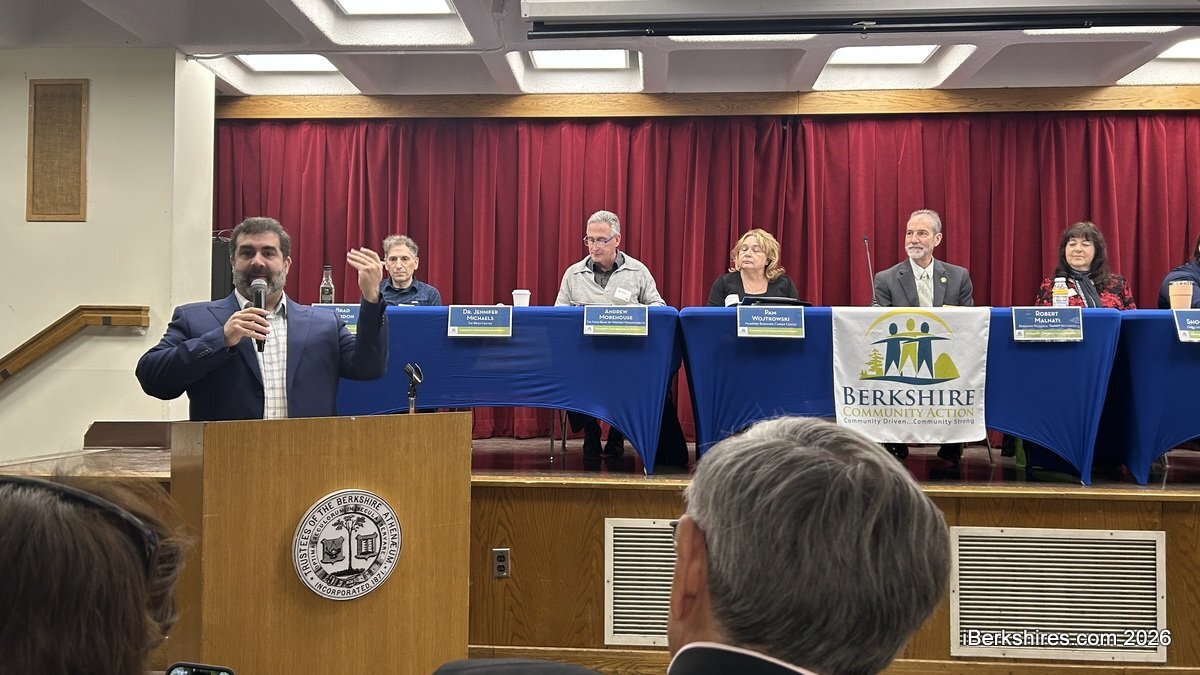
His comments came during Berkshire Community Action Council's March 27 community conversation on poverty featuring professionals in mental health care, housing, food, transportation, child care, financial literacy, and education.
The well-attended event at the Berkshire Athenaeum concluded with a working lunch and open forum. Members of the Berkshire delegation and Mayor Peter Marchetti began the conversation.
"All of this information that we're going to gather today from both you and the panelists is going to drive our next three-year strategic plan," explained Deborah Leonczyk, BCAC's executive director.
Being in the middle of the budget season, Mark said this is the time to be vocal about funding priorities, recognizing it will be "especially difficult this year."
"When you-know-who was the president the first time in 2017, I felt like we lost a partner in the federal government, but when he came back in 2025, I feel like we've gained an enemy," Mark said.
"And people in poverty, people in immigrant communities, people who are traditionally marginalized are under attack, and we're doing everything we can at the state level to try to fix that, to try to prompt people up, to try to push back against those cuts."
The event was interactive, with attendees taking an online survey with the results displayed on screen. At the time, 58 people in the room answered the survey identifying as white, and there were only seven respondents who identified with other races.
State Rep. Tricia Farley-Bouvier, watching the answers come through, observed that most of the attendees in the room were women.
"Something that does not surprise me but disturbs me is the race and ethnicity represented in this room," she said, explaining that she always looks at a space and asks who is not represented.
"… A demographic that is absolutely missing, and for a reason that is national, is we do not have our immigrant population represented. And why is that? It's because they're afraid, and they have every reason to be afraid."
She said one of her proudest days in the Legislature was the prior Wednesday, when the House passed the PROTECT (Promoting Rule of law, Oversight, Trust, and Equal Constitutional Treatment) Act.
The act was led by the Black and Latino Legislative Caucus and will now go to the Senate.
"They came up with these new policies that would make it better for immigrants and their families, and so we well-intentioned white people sat down, shut up, and listened, and then we got in line to back them up," Farley-Bouvier said.
"And so they came up with this new policy. It does not fix what's happening at the federal level. It will not stop raids. We can't do that in state government, but we can say people in Massachusetts, while they're on Massachusetts soil, will have due process. That's a big thing, due process."
State Rep. John Barrett III said almost every one of his earmarks last year went to an agency such as BCAC, and "those are the types of agencies we probably will continue to fund if we get a decent amount of earmarks."
The House has been told that it will be a bleak year financially, he said.
"We have serious problems, not only in health care, but in education, and that hasn't gotten a lot of publicity yet," Barrett said.
"We have a formula in this state that is supposed to help the poorer of our kids that are out there, and it ain't doing it."
He pointed to the Pittsfield Public Schools' more than $4 million budget shortfall for fiscal year 2027, and North Adams getting "nothing but the status quo" in the sense of funding.
Marchetti said he and North Adams Mayor Jennifer Macksey are working together to advocate for mental health and substance use disorder resources, and then spoke to the need for housing and wages.
Some 122 new housing units have opened in Pittsfield over the last year, with 37 of them permanent supportive housing, and with another 140 to 150 units coming online by the end of 2027, he said.
Pittsfield recently conducted a salary study, which Marchetti said he didn't need to know that some city employees are paid "very poorly."
"We have finished that salary study. We are evaluating that salary study, and I have a commitment that I made a year ago that's become even more difficult in these challenging budget times to get all of the people to the bottom of the new pay scale," he said.
"In some cases, we're talking $6,000 to $10,000 per employee. That's how underpaid they are."
Tags: BCAC, Berkshire delegation, poverty,