Mohican People Honored with Display in South Williamstown
The idea for the installation was inspired by a sculpture installation at Field Farm.
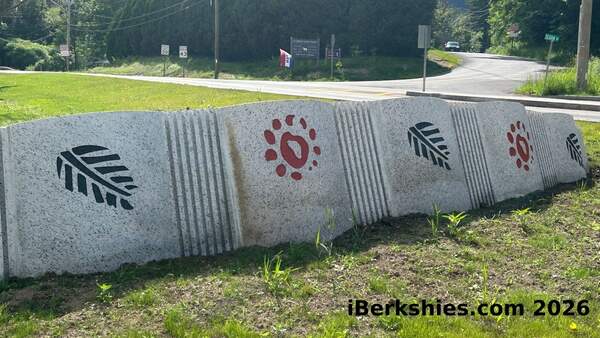
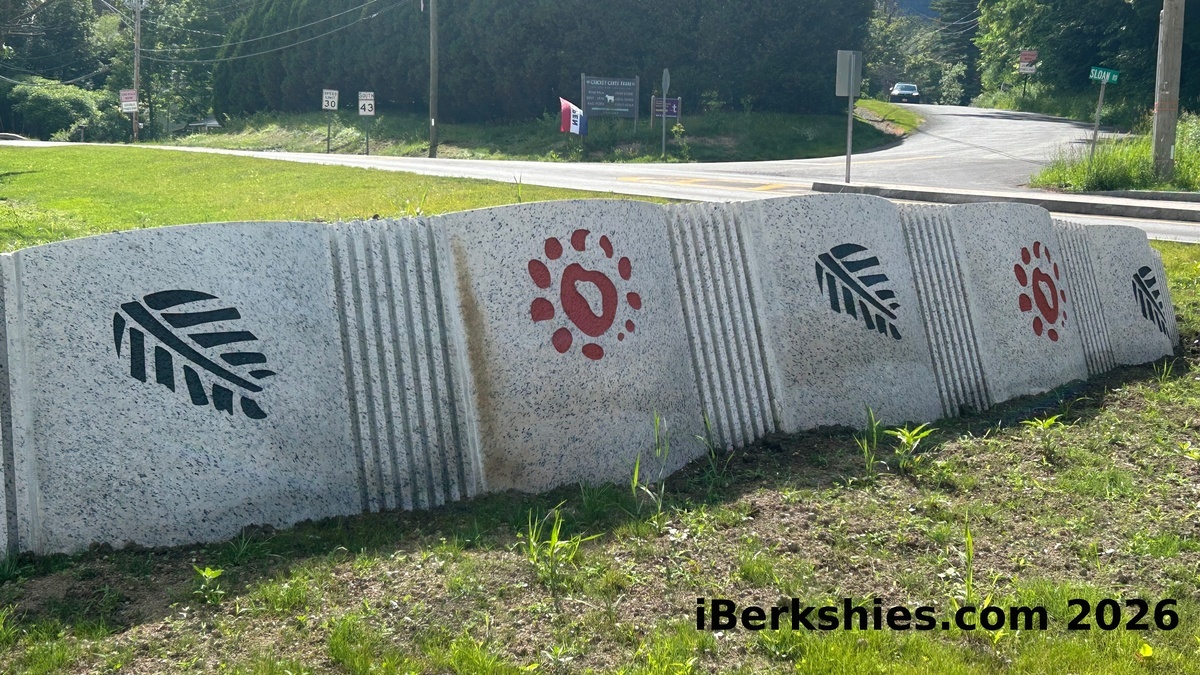
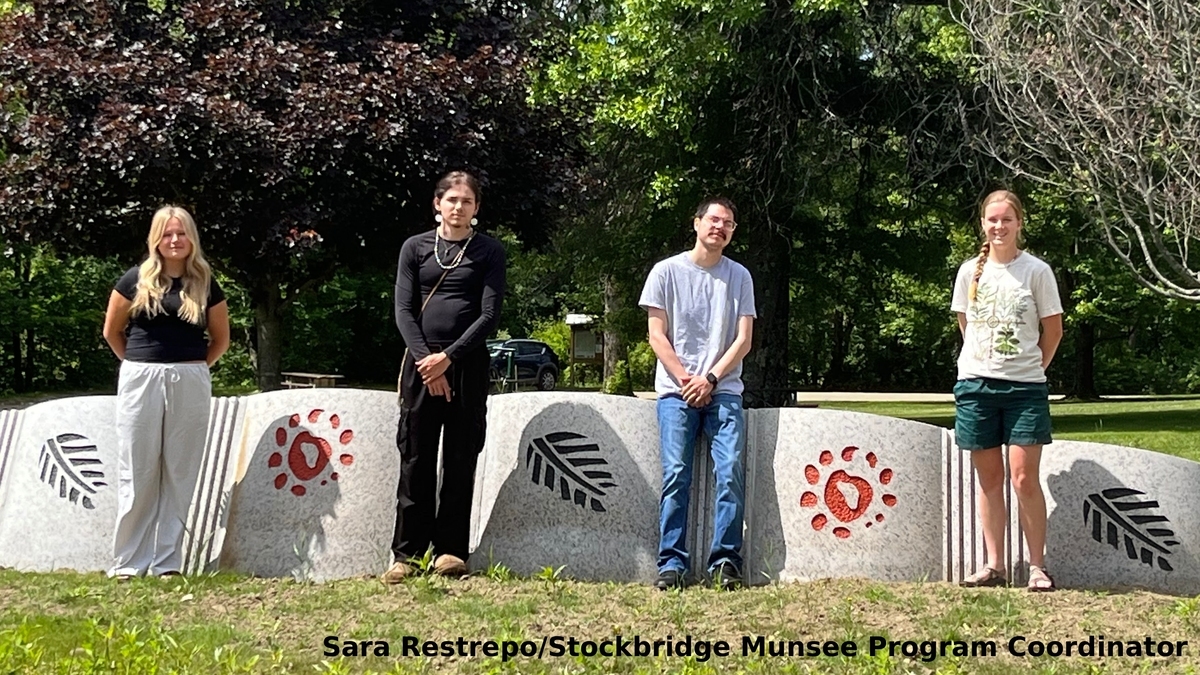
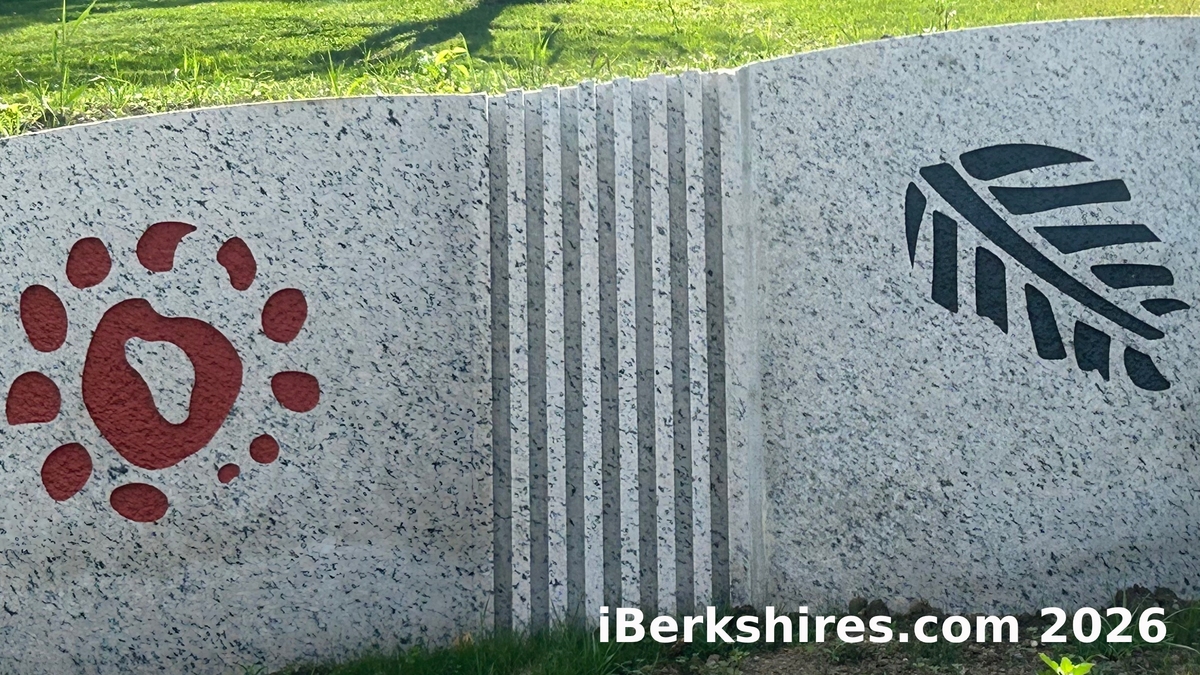
The large granite wall across from the Store at Five Corners is adorned with emblems inspired by the symbols that decorate baskets of the Mohican people. It provides a testament to the presence of the ancestors of the Stockbridge-Munsee Band of Mohican Indians, who, thousands of years ago, lived in the land now known as Berkshire County.
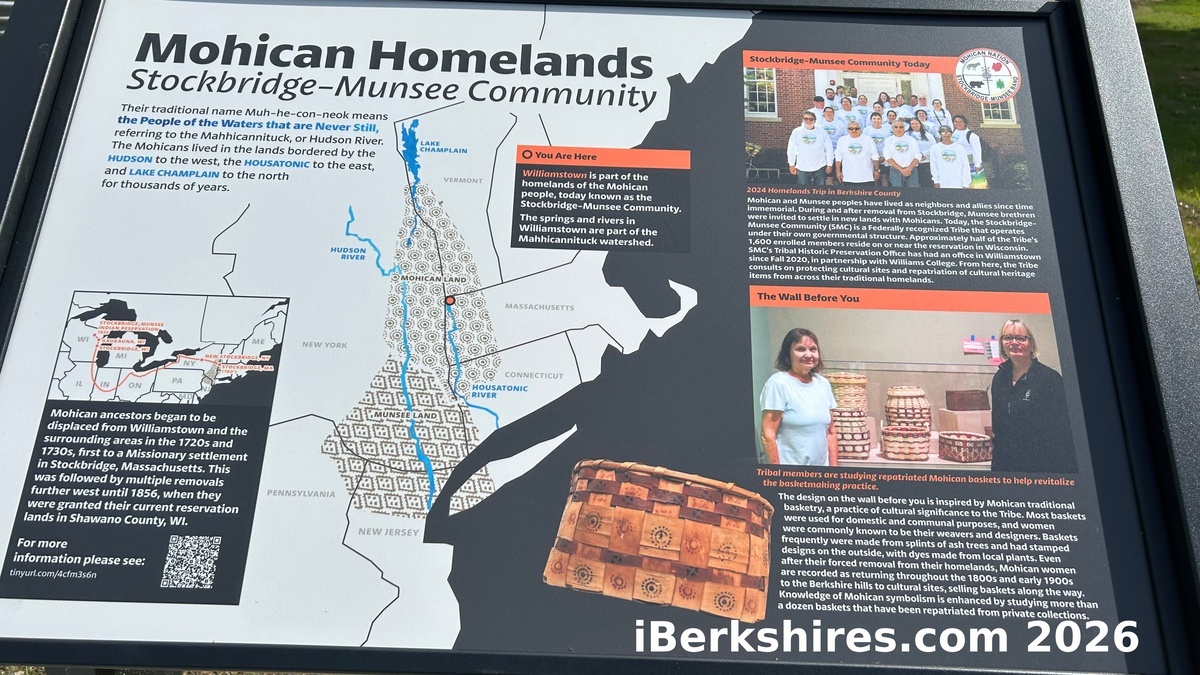
The black and red images of a leaf and bear claw are accompanied by an interpretive panel telling part of the story of the native people who fought with the Americans in their Revolutionary War and later were forcibly removed from the area in the late 18th century.
Today, the Mohican people persist with nearly 1,600 enrolled members on or near a reservation in Wisconsin.
But the Stockbridge-Munsee Community has never lost its connection to its ancestral home, and, in the last decade, more of the area's contemporary residents have worked to recognize that link.
Bette Craig thought the then-planned roundabout would offer an opportunity to highlight that historic link.
"It all started in 2021 when MassDOT was having a Zoom meeting to tell the local community about it and get feedback and so forth," Craig said on Thursday. "At the time, I was the president of the South Williamstown Community Association. I was saying things about [the proposed project], and one of the community people listening was Polly Macpherson, who I knew from the League of Women Voters.
"She got in touch with me, and we thought it was a wonderful opportunity to do some sort of art installation, maybe, at the roundabout, that referenced the Stockbridge-Munsee Community."
In the summer of 2022, the pair were taken with Rose B. Simpson's massive 12-foot "Ancestors" sculptures, part of an installation, "Counterculture," displayed by the Trustees of Reservations and the Williams College Museum of Art at Field Farm.
And they wondered if, perhaps, those cast-concrete statues could be acquired and installed in the center of the planned traffic circle.
The Massachusetts Department of Transportation did not think it would be an ideal location for Simpson's work.
"They were probably right," Craig said. "Trucks have gone right through the middle of the roundabout."
But Craig and Macpherson persevered, forming an advisory group that included a curator of contemporary projects from the Clark Art Institute, Robert Wiesenberger, then-Select Board member Randal Fippinger and WCMA Director of Exhibitions and Collection Management Noah Smalls, then a member of the town's diversity committee.
They also reached out early on to Bonnie Hartley, a tribal historic preservation manager with the Stockbridge-Munsee Community.
"After many deliberations, George Batchelor, the state highway landscape architect in charge of that sort of thing with MassDOT, said there could be something at Bloedel Park," Craig said.
Hartley explained that the Stockbridge-Munsee Community already was involved in the planning process for the roundabout.
"Our historic preservation office reviewed the plan to make sure there would be no ground disturbance to cultural sites," Hartley said. "After making sure those interests of the tribe were met, we thought about how we could raise visibility of the tribe's history in some way. DOT was open to an aesthetic treatment, I think they called it."
Those conversations culminated in the granite monument that adorns the site today.
"We worked with [MassDOT] to pick out what kind of stone," Hartley said. "We chose the designs that are engraved, which are Mohican basketry symbols, which are put on [baskets] with potato stamps and natural dyes.
"We felt those symbols resonated with the landscape and were a beautiful addition to the grounds there for people to learn more about the tribe and become interested in it."
MassDOT funded the wall, sourced from locally mined granite, and the explanatory signage.
"We've had the chance to do interpretive panels before, and we appreciate that MassDOT was open to including one," Hartley said. "They were open to a focus we wanted to bring. On a small sign, there's so much to say, but we wanted to situate that location in the larger Mohican territory and Munsee territory, show contemporary [tribe] members and highlight a contemporary member who is revitalizing the basketmaking practice."
The Stockbridge-Munsee Community, which maintains an office on Spring Street in Williamstown, was involved throughout the design process.
"We provided the basketry designs and verbally gave all our input," Hartley said. "We provided drafts of the interpretive text.
"We were very happy with the reproduction [of the symbols]. It's great to see, and it's wonderful to have an opportunity to be more visible in a homeland spot where our community has, historically, been erased.
"It is a public memory opportunity."
Tags: art installation, mohicans, public parks, roundabout,