Q&A with First District Incumbent John Barrett III
NORTH ADAMS, Mass. — On Sept. 1, voters in the First Berkshire District will decide whether they want to send a new representative to Beacon Hill in Boston.
John Barrett III has served the district in the State House of Representatives since 2017, when he was elected in a special election.
He is challenged this time around in the Democratic Party primary by Andrew Fitch, currently a city councilor in North Adams, where Barrett served as mayor for 26 years.
There is no Republican on the primary ballot for the First Berkshire seat so the primary will effectively be the election for the seat.
The two candidates met for their only debate on Aug. 13 at Williams College. iBerkshires.com reached out to both candidates to follow up on some of the points raised in the debate and get their thoughts on some other issues facing the district.
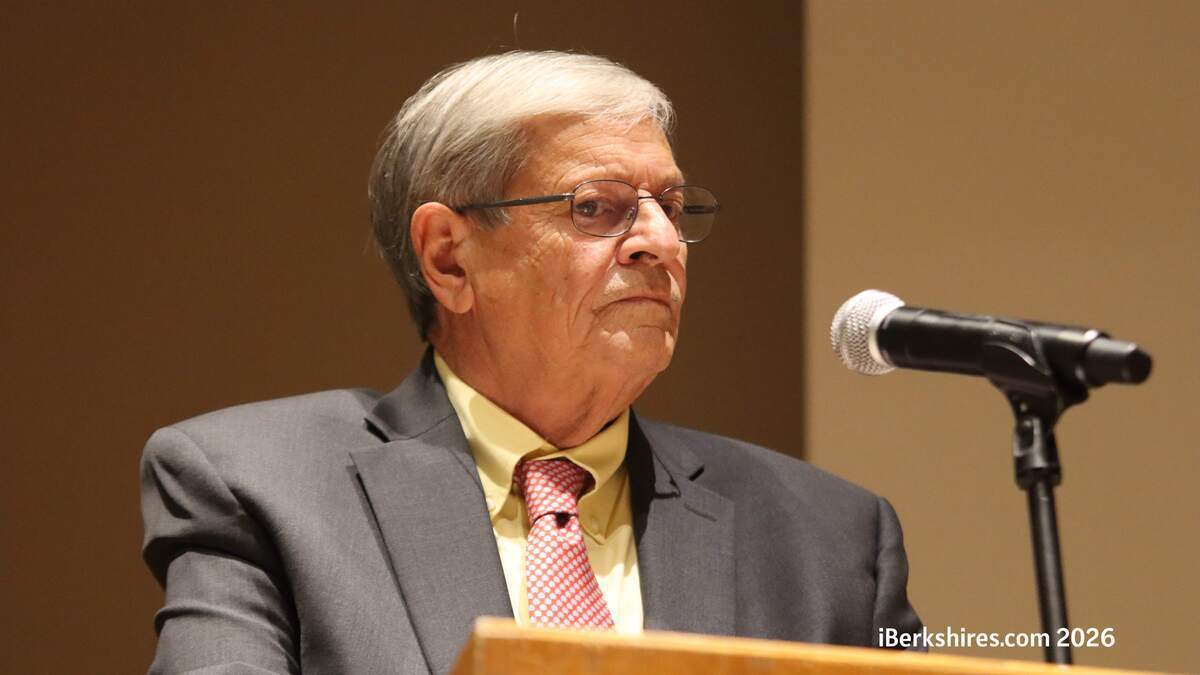
Below are excerpts from a conversation with incumbent John Barrett III:
Question: In addition to being a chance to talk to your constituents, a campaign is an opportunity to listen. What are you hearing about this summer?
John Barrett III: The only good thing about a campaign is you have to get out and pay more attention to the people and what they're saying, which I try to do anyway. I've done several town hall meetings with Sen. [Paul] Mark.
What I've really found out is healthcare is almost the No. 1 concern, and, of course, affordability, the cost of living is No. 2. And then there are concerns about, believe it or not, the infrastructure in communities.
Q: By that you mean you're hearing about public safety buildings in communities like Adams and North Adams?
Barrett: Public safety buildings, of course, have to be addressed, but what they are talking about were the conditions of their streets and sidewalks. The rural legislators were successful in changing the formula for Chapter 90 money … resulting in $3 million [in additional funds] to the First Berkshire District. We've tried to address that, but I think after the last winter, that was one of the concerns [constituents] had: Where is the money going? I've talked to managers and selectmen about this and, of course, the mayor [of North Adams], making sure this money has to go into infrastructure, not so much new equipment but the roads themselves.
Q: Going back to those first two priorities coming from constituents, what can the Legislature do in the next session to address things like healthcare?
Barrett: With healthcare, the House passed legislation the last week of the session addressing the need to get more primary-care physicians everywhere in Massachusetts, but especially in the rural areas. People have to wait up to a year, even longer, if they can even find one, to get an appointment. We passed legislation that will start funding incentives to bring primary-care physicians anywhere in the state. And really, we're going back to the insurance companies and saying, 'You have to pay for some of this cost.' The first year calls for 15 percent [from insurers] into a pool and the next year 20-25 percent. It creates a funding source to attract more primary-care physicians to Massachusetts. That was a very popular idea.
The other thing, of course, is nursing homes. We had to help the two nursing homes in Northern Berkshire with earmarks I got because of cuts in Medicare that are having a devastating impact on their survival. The final shoe won't drop until January when cuts from the federal government hit, which is why we were so frugal [in Boston] with the use of our reserves. We backfunded a lot of the increases in the Health Connector and Mass Health to try to keep the insurance rates fairly stable this year. But if what we think is going to happen happens in January, it will be a very serious situation with tremendous increases. The state government — the Legislature and governor — is sitting back to see what's going to happen. And this all comes out of the [federal] 'Great, Big, Beautiful Bill.'
Q: Are there other initiatives topping your agenda for the next term?
Barrett: Education funding, for sure. I don't think anyone in the Legislature disagrees with the fact that it has to be fixed, it has to be equitable. We've fought hard, as rural educators, the last five or six years to create funding for rural schools. … It will increase to $20 million this coming year, up from $12 million last year. That has to be funded even more. That has to get to $60 million in three years. That has to be fully funded. That's what's been determined to be needed to fill the gap. However, you also have districts that don't get rural aid money, like North Adams and Pittsfield. Something has to be done to address their situation. It's great that they're giving $160 per student [in additional Chapter 70 aid in FY27], which came up from $25 when it first started under the formula. But that hasn't worked. We have school districts like North Adams and Pittsfield that have lost students, so they're almost just level funded the past several years.
We have addressed a big need when we increased the circuit breaker money, for students from our districts who, because of a disability, have to be educated outside the district. We increased it to $151 million, which is about a 75 percent reimbursement for those students. It should be helpful, but it's not enough. Level funding [education] doesn't work with inflation and everything. I think the circuit breaker will make a big difference, that and rural aid. We established a commission to look at [education funding].
I think the salvation has been the Fair Share Act. I was the first representative to tap into that this year to increase rural aid. When it went to the Senate, they added a little more to it.
Q: The Fair Share Amendment certainly has augmented state revenues. But given the need from things like redoing Chapter 70, aren't increases in the state income tax inevitable?
Barrett: When we passed the budget this year, there was absolutely no tax increase. Outside the Fair Share Amendment, there have been no real tax increases at all since I've been there. That's why Fair Share helped so much, because that has been an increase for people making substantial amounts of money. Right now, there's a balance between affordability and providing services. We're trying to avoid any type of new taxes. That's a No. 1 priority when people are being hit at the local level with property taxes. I don't see [a state income tax hike] on the horizon any place. That's why we're sitting on $8 billion in reserves, the 'Rainy Day' funds, to fill the gap. And in the first month of this year, revenues are up substantially.
Q: Maybe tax increases aren't imminent, but are they inevitable?
Barrett: They're not on the horizon now. … To slap anymore taxes or fees on people right now when affordability is a concern — increasing electric rates and gas rates and all this other stuff — that's not what anyone wants to look at right now. That's the balance you want to find. People cannot afford it. The middle class is being squeezed right now. It's a tough time. That's the reason I tried to hang around.
Q: That raises the topic of experience. You have talked about your experience, and certainly your campaign materials emphasize that. Acknowledging that, arguably, no one has more experience in public service, how much is enough? In other words, you wouldn't say someone has to have served as a city mayor for 20 years to qualify to be a state representative, right?
Barrett: No, but I go beyond that. People forget I started on the McCann School Committee for eight years and was a county commissioner for four years. It's a unique situation that I was given that opportunity to fill those positions. Right, wrong or indifferent, I certainly have a lot of experience.
I thought long and hard about running this time. I really want to go off and do some other things. But I felt walking away at this time would be detrimental to the district I represented. That's why I made the decision to run. I didn't make that decision until rather later in the game. I don't think I have anything to prove, but I did it out of concern for the district and Berkshire County as a whole. That's the reason I did it. It's safe to assume the end is near.
Q: I won't put you on the spot and ask you to make a commitment on that point unless you want to.
Barrett: No [laughs]. But that's the reason I ran. I'm glad in the sense that I can still offer something to the district. When anyone wants to question energy, there have been many days I don't get back until midnight or 2 a.m. My record of attendance [on Beacon Hill] is right up there. I still have the energy and, most important, the fire in the belly. But the time is coming when there has to be someone on the bench.
Q: Another topic you brought up the other night at Williams is your commitment to constituent services. For people who don't know or haven't had to reach out to their representative for help, what are some specific examples of things you've been able to do — without getting into any names, obviously?
Barrett: I can go back to the days of COVID, what we went through in the early days and unknown days — first getting people tested, which was late to the game. We ended up losing 25 patients at the nursing home in Williamstown. That's when I really went off on [the Department of Public Health] at that time and their lack of taking the matter seriously. And we had people who were scared in dealing with it. Then we moved into the phases of getting people unemployment [benefits] that related to COVID.
And even today, we have people who have not received an unemployment check in 10 weeks. We have people literally breaking down and crying because they're in fear of losing their house. On Mass Health, we've had people being cut off for no reason because of bureaucracy that sometimes doesn't work. They are situations that are very, very sad.
And I've always taken pride in that I have two terrific aides, and I think if they did a survey in the First Berkshire District on these two individuals, they'd find that we try to show compassion and understanding and try to put a face on every request. We get to know that person quite well.
We have people who aren't computer literate, and we work with our local senior centers so they could help us … so [those residents] could file a claim.
Nearly every one was a desperate situation. That's the worst part of my job but the best part of my job: that we're able to help them. That's the big difference I've found in the transition from mayor to legislator. It's not the sexiest job in the world, but it's the most fulfilling because we can help people. We had a lady call us a couple of years ago who had been denied insurance to get a lung transplant. Somehow, someway, we got her the help she needed. In 48 hours, she was cleared to get the lung transplant.
The big thing where experience counts in constituent services is we know where to send them. That's where the experience factor comes in. We know if it's federal, we know what agencies they have to go through to get it done. A lot of the credit goes to my staff — two great people who have been with me for five years. I took them both right out of college. There's an old saying in politics that you're only as good as the people you surround yourself with. I've surrounded myself with two good people who are compassionate, understanding and go the extra mile. That's so important. A lot of people we help aren't even registered to vote, but they need help.
And I work closely with all our non-profits, especially those that help people, like Berkshire Community Action, BFAIR, non-profits as a whole. I direct a lot of my earmarks toward those agencies.
Q: I'm going to play devil's advocate here because it's part of my job. Doesn't every legislator do that?
Barrett: Absolutely.
Q: Wouldn't your successor?
Barrett: I don't know. All I know is it's top shelf with me. I assume it would be top with everyone. But in rural districts, it makes a big difference. In a city, you know where most people go? To their city councilor. [A House district] is a little broader based. But we're close to it. That's all I'm basically saying. I make it a top priority, and it bothers me when people need that help.
Q: And, like you said, some of them are not even registered voters, but they're all your constituents anyway.
Barrett: We don't ask if they're Democrat or Republican or anything else. We get right into it. It's very trying sometimes on the staff, too, because these people are desperate. That also is connected to my three years when I ran BerkshireWorks after I got out of the mayor's office, seeing people there with unemployment problems. It's terrible.
Q: I don't know how much time you spent looking at your opponent's campaign material and his agenda. But it's a lot. There's a lot there. Is there anything on his list of ideas that you disagree with?
Barrett: It appears from doing my prep for the debate … From what I can determine, he's for single-payer health insurance, and I've been on that for a while. He's interested in connecting the trails; we've already started that process. Many of the things he brought up, we're already working on and already done that. Are we successful in everything? No. But the major ones, I think we've been successful on.
We help communities meet their vision in helping them get the funding they need to carry it out, whether it's the Mohican Trail in Williamstown or the Greylock Glen in Adams or a walking trail in Windsor. Those are things we help them with. Or to get a culvert in Hancock, we get funding for that.
Look upon a legislator as a facilitator.
Anyone who is elected and thinks they're going to go to Boston and write a bill and get their name on it? That's not going to happen. That's not the job.
Q: Part of your job — one part — is chairing the House Committee on Operations, Facilities and Security. That's a mouthful, and it's not a name that lends itself to people reading it and saying, 'Oh, I know what that is.' Can you talk a little about what the committee has done during your tenure?
Barrett: I was vice chair of the [American Rescue Plan Act] committee when that money came out. Then I went to Ethics for two years because of my background as a mayor. Then, at the last minute, when committee assignments were made, I was switched to this and basically said, 'What is this?'
Basically, we said we want to tighten up, and because of your experience as an administrator in the community, we want you to make sure things are done properly. Everything that is now purchased over $10,000, our committee has a look at. We're making sure guidelines are followed for purchasing and stuff like that.
Actually, I was saying no to some of the large purchases they wanted to make. As chair, I said no and advised the speaker's office: I don't think we should purchase this at a time when we're cutting SNAP benefits at the federal or state level; we shouldn't go out and buy copiers. We've limped along so far, let's keep limping along.
As far as security, we're making sure the Internet system isn't breached, things like that.
[The committee] is actually overseeing the business office for the representatives. But, again, I had the reputation as a mayor of being hands on, watching every penny that went in and out the door. I'm glad they [appointed me] because we made some good changes.
Q: So, just to clarify, was it a new committee or was it already a standing committee?
Barrett: It was already there. They changed the direction of it and gave it more authority. Part of that change is to oversee the business manager's function, including the hiring of the business manager. It's not sexy, but it's important.
Q: So you're not interested in seeking another assignment?
Barrett: I like what I'm doing here. I'm really not interested in writing some big omnibus bill. I'm more down in the weeds to get things done.
Q: I know this is a local election, but it's not immune to the national political conversation, and this summer a big part of that is about age. We've seen that issue raised locally in both the U.S. House and Senate races. Are you concerned that it's a potential headwind for you in this race?
Barrett: I don't. I think some people are trying to make it about that on the other side. I only point to the fact that I certainly haven't slowed down, and my term is only two years. It really comes down to a year and a half, because the session ends on July 31. It's not a six-year term. It's not a four-year term.
You never know what's going to strike in life and how long you're going to be here. I'll let the people judge on that. I think I'm doing a pretty good job, and I know I have the fire in the belly. I think I've demonstrated at debates and anywhere I've spoken that I have a pretty good grasp of the issues.
I've been a resource to young political leaders who are coming along, whether a Williams College student who interned with me or an MCLA student, people like that.
And I have institutional knowledge, which I think is important. You don't get institutional knowledge and good experience unless you've been around a while, and I think that's an asset.
Early voting for the Sept. 1 primary began on Saturday. Registered Democratic and unenrolled voters can vote in the Democratic primary; registered Republicans can only vote on the Republican ballot.
The First Berkshire includes the city of North Adams and the Berkshire towns of Adams, Cheshire, Clarksburg, Florida, Hancock, Hinsdale, Lanesborough, New Ashford, Peru, Savoy, Williamstown and Windsor.
Read an interview with challenger Andrew Fitch here.
Tags: barrett, election 2026, primary, state representative,