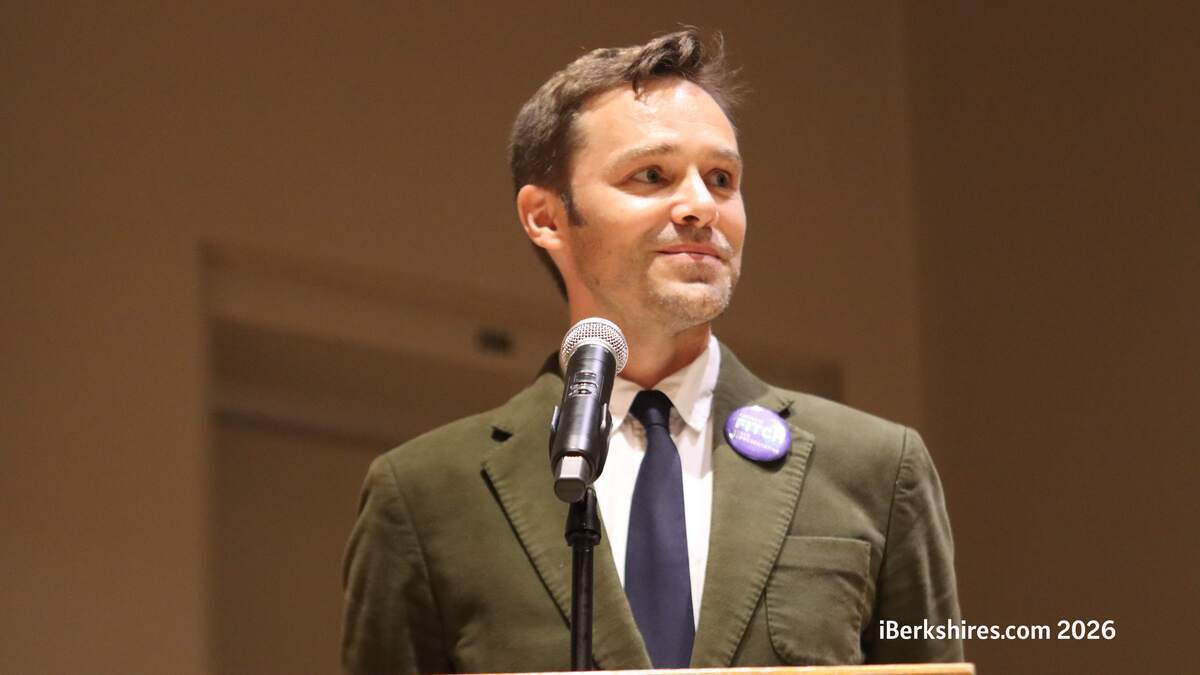
Q&A with State Representative Challenger Andrew Fitch
NORTH ADAMS, Mass. — On Sept. 1, voters in the First Berkshire District will decide whether they want to send a new representative to Beacon Hill in Boston.
Andrew Fitch, currently a city councilor in the district's largest municipality — and the commonwealth's smallest city — is challenging former North Adams Mayor John Barrett III, who won the First Berkshire seat in a 2017 special election, in the Democratic Party primary.
There is no Republican on the primary ballot for the First Berkshire seat so the primary will effectively be the election for the seat.
The two candidates met for their only debate on Aug. 13 at Williams College. iBerkshires.com reached out to both candidates to follow up on some of the points raised in the debate and get their thoughts on some other issues facing the district.
Below are excerpts from a conversation with challenger Andrew Fitch:
Question: From the very beginning, you talked about the campaign as a listening experience, and this week you're continuing that with the bike tour …
Andrew Fitch: Knocking on doors that have never been knocked on before. … I was riding through, I believe it was Hinsdale coming into Windsor, and they started to yell at me, 'No!' And then the guy was like, 'Wait a second. That's Andrew Fitch.' They actually knew who I was, and they were actually wanting to chat with me.
Q: What kind of specific things are you hearing from your potential constituents?
Fitch: When I'm at their doors? It depends on the community. That's the truth. But, overall, concern about rising costs, especially taxes. I heard this, first and foremost, in Adams, for example. A lot of folks, especially folks more senior in their years, are really concerned about rising property taxes and not really seeing much for those taxes other than: Costs have increased, so they have to keep up with that. We've delved into really robust conversations about expanding our tax bases so we can make this all more sustainable and people can afford to stay in their homes. There's been a lot of that conversation: People worried about being able to stay in their homes, people worried about being able to afford their tax bills.
People will also — and, again, this wildly depends on which town it is — talk about the topic of the moment in that town or the project of the moment in that town. Of course, for Adams, that was the Greylock Glen. People, largely, didn't seem to want to talk about it. They're frustrated, which I understand. It's not done yet, though. I think we'll get to a place where they are less frustrated or maybe even really excited about that opportunity there. The same thing with the bike path. Depending on which community — I did a lot of door knocking in Cheshire and Lanesborough, and we talked a lot about the bike path and how it's been used as an economic development tool, these snack shops that pop up alongside it and Berkshire Outfitters now has a location next to it.
Q: Are you hearing ideas you think you can act on?
Fitch: For sure. Because people will point out different former factory buildings, for example, that are just sitting there and could use redevelopment. They talk about the Berkshire Mall in Lanesborough, especially, obviously. They talk about their hopes there, and then we talk about, 'Maybe it could be housing.' It sounds like it's not going in that direction right now from the articles I'm reading. But I think just about everyone had a hope that it could evolve some housing, too. I don't know if that's happening or not, but that's something to advocate for down the road, I suppose.
When it comes to downtown North Adams and downtown Adams, we've been talking about, 'How can we build more density?' 'How can we incentivize housing developments above the buildings that are already there, partially vacant or sometimes even fully vacant?' 'How can we make those buildings on Park Street in Adams or Main Street in North Adams totally utilized again?'
Q: This question goes back to something that has been part of this campaign from Day 1 and was brought up by your opponent the other night: the question of experience. Your experience, even before you were a city councilor, how does experience as an entrepreneur translate to potentially being a representative on Beacon Hill?
Fitch: Backing up even further, I've had a bunch of different kinds of jobs. My first job out of grad school, I ran a small business myself with some support from other colleagues. There was a bookkeeper who helped me out, but I managed a suite of teachers and marketed these classes at this screen acting school in Boston. … I've met so many different kinds of folks who are going through career transitions, and I was helping to support that. I find that so interesting and informative in my work. Because that's basically what we're talking about right now, getting back to the jobs piece. I've done that work in different areas before, helping people up-level their careers so they can get better incomes.
Q: Career transition plays into a lot of the economic development work.
Fitch: Totally. I worked at, I think, four different companies in San Francisco over the course of nine years. Two of them were owned by the same parent company, however. That was a continuous thread in that company. The second one I went to was a coding school, a web development school, data science school and a startup work space. So I was producing all these community conversations like I do at Steeple City Social on a bimonthly basis, bringing in different speakers to talk about how they succeeded in their career, how they built their company, the challenges they went through. I gained a lot from that experience and the ecosystem development.
When it came to getting Steeple City Social started up, the way I say it to folks is I'm in the trenches with the community right now, doing this work. I'm doing dishes, I'm making cocktails, I'm making coffee, I'm helping to prepare sandwiches with my business partner, who is the baker. We're living the everyday realities of the vast majority of our population of struggling with transportation. If you don't have a car and bus routes get canceled last minute, our employees have a hard time getting to work. Most have cars, but not everybody. … And the housing challenges, too. Several of our staff members have already been through multiple apartments even though they've been with us a year, a year and a quarter at most. I'm hearing these issues from them. I'm feeling them myself when it comes to the renovation costs of the house that I own.
I have a really good understanding of the challenges we're facing right now and the challenges we're facing in the near future.
Q: I appreciate that you talked about people's concerns over property tax hikes. It was a little surprising to me, in watching the debate last week … I don't think the word 'taxes' came up at all during that discussion at Williams College. I mention that because, in looking at some of your priorities, there are things on there like universal childcare and things that are going to require some investment.
Fitch: Totally.
Q: Would you support increases on the revenue side?
Fitch: That's a good question that nobody has asked me yet. I don't want to say, 'No.' But I'm leaning toward no, quite frankly. I'm saying that, in this moment, because I don't know that this is the right time for that. People are really struggling. Our communities are really struggling. I'm on the North Adams Finance Committee through City Council. … We're just level-funding everything. We don't have wiggle room here. And we know our tax base cannot really shoulder much more of a burden. I would be very concerned. I think I would be a fool to say, 'Never would I vote to increase taxes.' But I don't think that's a winning battle right now.
Q: So are there offsets that would fund some of these priorities? Are there areas where the state could make cuts in expenditures to create funds for things like universal childcare? That's a big-ticket item.
Fitch: For sure. And I'm not saying [universal childcare] would be immediate. But I want to get started to lay the groundwork for all the things I've talked about right away. It's just a matter of how much time it will take to get to these things. But I intend to set up a campaign for all my priority areas to work on these things. That doesn't mean we need to increase taxes right now or at all. It does mean we start to find creative solutions immediately. Not everything requires money right away or even at all.
Some things are just policy changes or zoning regulation changes. I loved the way the commonwealth unlocked ADU by right across the commonwealth. That has not been utilized in our district to my knowledge even once since they made that switch. I've met people with ADUs before, but they created them 40 years ago. I was just chatting with a woman in Williamstown about that last night.
Q: This is a little bit of a different topic, but have you thought about what committee assignments you'd want?
Fitch: I don't yet know how much control I'd really have over that. But some curiosities of mine, for sure … The tourism one, there's a joint committee between the Senate and the House, but [Sen.] Paul Mark is on the Tourism, Arts and Cultural Development Committee. So before I say for sure which ones I'd want to be on, I'd want to have a strategy brainstorming with Paul Mark. If it's better for us to have a couple of people from the Berkshire delegation on the same committee, then yeah. I would want to factor that into my decisions of what I ask for. But things that I'm definitely curious about are, just looking at the House committees, Ways and Means is always a curiosity of mine, but, from what I understand, you have to wait your turn for that one. …. Another one that I'm curious about from the House side was the Federal Funding Policy and Accountability, because that's a big struggle right now. I'd love to dive into that and try to figure that out and see what we can do to mitigate losses.
And regarding joint committees … in this district there are a lot of farms, so I was thinking Agriculture and Fisheries, but I'm also so passionate about so many other things, too. I don't think I would push for this committee because I've already done over a decade of work on this: diversity, equity, inclusion and belonging work. … Housing, obviously, but I feel like somebody else from the Berkshire delegation is already on that, so I wouldn't push for that unless it was the right thing to do. Economic Development and Emerging Technologies, I think I'd be suited to or Community Development and Small Businesses.
I know that's very broad. It's a whole bunch of different areas.
Q: But, as you said, you can't pick and choose [your committee assignment], so it's good to have a few ideas.
Fitch: I will certainly ask, and I will certainly advocate.
I also will be showing up to as many committee meetings as I can, either virtually or on-site. I want to be very present in this community, and I will set up an excellent communication structure so we can provide really great constituent services for the needs that arise around here for individuals and groups. But I also want to show my colleagues on Beacon Hill that I'm serious, invested and will be working with them and won't be just in the district. I'll be in the trenches with them too. That's why I intend to be present in many committee meetings, and, fortunately, they're not all on site.
Q: You mention constituent services. That's something your opponent talks a lot about. You must be in that world as a city councilor, too. Is it a big part of that job?
Fitch: Oh, yeah.
Q: Are you responding to specific requests from your constituents?
Fitch: Including yesterday. Including this morning. Yes, totally. Sometimes, it's something simple, but, the more clear it becomes and the more one communicates we're open to working with people, the more that word spreads. So it seems to me — I haven't checked in with each of my colleagues on the council — but I seem to be one of the most 'reached out to' of the city councilors, I think that's because I'm out and about so much. People literally see me and say, 'Oh, I've been meaning to ask you about something, can I follow up?' 'Sure, shoot me a text. Here's my number and we'll set up a time.' Even before this campaign, any moment I have free time that I'm not working, I just slot people in for meetings. I love coffee, I love food, I love hanging out and chatting with people. It's one of my favorite things to do. Constituent services, I think, is the bread and butter of any elected officials: providing high quality constituent services. That's just something you have to do. It's also something I really enjoy to do. I intend to create a really good structure right off the bat — a really great communications structure.
I want to make sure I build a great structure like that and immediately hire a great staffer to help support all this. I can shoulder a lot of this myself, but I cannot stretch myself too much either. If I'm going to be a good collaborator on Beacon Hill, I also need to have support with constituent services. That's where staff members come in. I've actually met one of Rep. Barrett's staffers when I was on Beacon Hill, and she is just this lovely person. I'd love to match that — maybe even with her directly. I have no idea if she'd be interested in working with me as well, but she's lovely. She's so good, and you can hear her voice on the phone with that positive tone. I think that's important to people, that state reps and their staff members are listening to them and then taking action and following up. I'll build that in from Day One.
Q: I'm hesitant to bring national issues into a local primary. However, one of the things people are talking about nationally in races all over the country — and right in our backyard with the U.S. Senate race — is the issue of the age of elected representatives and making room for a new generation of leadership. You haven't really directly, I don't think, talked about your opponent's age.
Fitch: Nor do I intend to.
Q: But you're riding a bike 100 miles over the course of four days.
Fitch: Five, actually, I had to extend it.
Q: You introduced your parents at the debate the other night. … It's there. It's a part of the conversation, the age question. Is there danger there of that backfiring with older voters, potentially. Older people vote in high numbers.
Fitch: Yeah, totally.
Q: And if you're saying that — and I'm not saying you are — but if there's a perception that older people should step aside at different levels of government, is that going to have a boomerang effect with some voters?
Fitch: It's certainly possible. But that's in part because I'm a polite and caring person, and I'm not going to go and tell someone they shouldn't be doing something because of their age or background or something. That's ridiculous. That's not who I am. That's not what my campaign is about at all. There's always a risk of people perceiving that and maybe being turned off by that. But the truth is I'm just out here being myself. I do a trek like this every single year. Actually, my campaign team was like, 'No, you're not doing that this year. You need to be making phone calls and knocking on doors.' I said, 'No, I'm going to be knocking on doors along the way.' It's important for me to still be myself as I'm doing this campaign. I just feel like this is a really cool, interesting way to connect with people on these back roads and hill towns where people have never had their door knocked on before. … And it's interesting and it's uplifting, and I'm getting a tan. If people make that connection, so be it. But the truth is I'm really just being myself here.
I also don't really need to bring up age or energy or anything. So many people — honestly, literally, hundreds — have told me, 'We need your fresh blood. We need your fresh energy. It's time for change.' People are making whatever connections they're making on their own anyway. I'm very happy to not say it or point it out. I was never going to, and I never will. But people do seem to make that connection on their own and seem to really understand we do need fresh ideas and fresh energy and fresh leadership to bring us into the future.
Q: I promise this will be the last question about your opponent. Are there things — and I don't expect you to have studied his voting records — that you might have done differently, specific votes, differences of opinion you may have had with him over the years?
Fitch: The truth is, no I have not really looked into his record. That was kind of intentional. I told him this too, because he and I chatted before this got started. I said, 'John, whether or not you end up running,' … absolutely no hard feelings, but I'm still going to pursue this, because I do think it is time and I have the enthusiasm, the ideas, the experience, the knowledge to help bring us into the future. But no disrespect to you. This is not a takedown campaign, and I do really respect everything you've done, and that's the truth for sure. I've heard from so many people great things he's done or individuals he's helped out. It's great. So I haven't looked too much at his record.
I can comment, however, on the approach. I always struggle with whether I should say these things, because I just said this is not a takedown campaign. … One thing I have to offer that I don't think he has to offer as well as a candidate is presence in our community. As somebody who has launched a whole bunch of different kinds of initiatives in our community, from North Adams Pride to First Friday to running for City Council to several different community events, starting a business here in town — the incumbent was not around for or involved in any of that. That doesn't mean that that's bad, per se. But those are the kinds of things that I'm there for, that I want to be there for for everyone.
Q: I already mentioned your agenda. There are a lot of your points on your website. My next question is: There are a lot of points on your website.
Fitch: [Laughs] I know. I actually went a little overboard.
Q: It's an ambitious agenda. Give me one or two top priorities. Because there are only so many hours in a day and only so much bandwidth for a representative on Beacon Hill.
Fitch: Like, Week One of actions or key areas?
Q: Yes, if that makes sense.
Fitch: I have a broad variety of career experiences and local political experience and entrepreneurship experience, but I have not served as a state representative yet. So I would like to think in my first week, one thing I'd do is immediately reach out to the people who are already working on exploring a commission to re-do the Chapter 70 funding formula. Education funding is a big need of our communities here. It really places the burden on the municipalities, thus raising our taxes more and more. … This is Week One: Calling them, reaching out to them and saying, 'How can I hop on?' What needs doing? … And if I could actually jump onto this exploratory committee, I certainly would. At the very least, I'm signing onto it and asking what I can do to support the initiatives that are already happening. That's definitely Week One.
Another Week One initiative would be reaching out to — and I don't know how long this will take, which is why I want to start it Week One — the [Northern Tier] rail, or advocating for rail. Advocating for better transportation in general. I'm expanding this to two different sub-bullet points: one being passenger rail from North Adams to Boston. Sen. Jo Comerford is the person who stimulated that first study being done, as I understand it, so one of my first calls is to her office to say, 'I'm on board, literally and figuratively.' … Another area, too, is Berkshire Regional Transit, the other sub bullet of transportation I was talking about. I'm very curious about readjusting the Chapter 90 funding formula too, so we have more access to affordable transportation funding in terms of road repairs and expansion of and repairs to sidewalks and all of that. But Berkshire Regional Transit is having major issues right now: driver shortages, canceling routes last minute.
One more thing I'll mention in Week One, too, is getting to work on building solid relationships, I suppose specifically, with Mass Development and any other state agency that would be helping to redevelop underutilized properties. We have so many of them in this district. It's especially acute in places like North Adams and downtown Adams. I'm really curious about checking, 'How do you folks assess projects when it comes to funding?' … Another issue, and I don't know what state agency this is yet, but I'd intend to poke at it Week One, too, is figuring out the structure of our Gateway Cities model. I'm aware that the Gateway City designation has done a lot of good for the cities that other communities are connected to in different regions over the years. It has been adjusted before to broaden it and make others qualify for it.
I'm not saying we have to do this or this is the only way, but in North Adams, we sure feel like a Gateway City, but we are not a Gateway City because of our population size. To my understanding, we check all the other boxes except for the population size, so we don't qualify for the housing development incentive program, which, I believe, is the program responsible for conversion of bank buildings in downtown Pittsfield into housing. I just want to make sure we're able to unlock that here in our district as well, because I think we have the same needs.
I gave you more than I meant to.
Q: It sounds like a full week.
Fitch: Oh yeah.
Early voting for the Sept. 1 primary began on Saturday. Registered Democratic and unenrolled voters can vote in the Democratic primary; registered Republicans can only vote on the Republican ballot.
The First Berkshire includes the city of North Adams and the Berkshire towns of Adams, Cheshire, Clarksburg, Florida, Hancock, Hinsdale, Lanesborough, New Ashford, Peru, Savoy, Williamstown and Windsor.
Read an interview with incumbent John Barrett III here.
Tags: election 2026, primary, state representative,