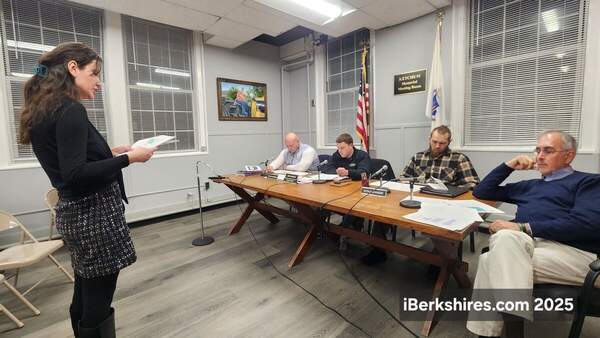
Lenox Select Board signs Adelphia contract, tables CTSB

By Kate AbbottPrint Story | Email Story
Feb. 26, Selectman Janet Pumphrey brought before the Lenox Select Board the contract with Adelphia Cable that she and the other members of the Five Town Cable Advisory Committee have been negotiating for the last two years. The CAC has met often weekly, and has retained an attorney who specializes in cable contacts. He and Chair Malcolm Chisolm feel the contract they have produced is the best they have seen in the Commonwealth, Pumphrey said. Whenever Adelphia tried to deny the CAC something they wanted, she said, they would find another contract Adelphia had signed with other towns, granting it. Pumphrey summarized the new contract’s advantages. Adelphia would set up remote origination points— installed cameras and hook-ups for film equipment— at the Lenox Town Hall, Lenox Memorial High School and Morris Elementary School. The contract specifically required Adelphia to install broadband fiber-optic cable in South County within three years. If they failed, the agreement would be halved, from a ten year to a five-year contract. Within six months of the installation, Adelphia must offer high-speed internet access to its users. To help ensure that cable was laid on schedule and reception was decent, Adelphia would post a $25,000 performance bond, which would pay damage if Adelphia performed inadequately. They could reduce the bond to $10,000 after the broadband cable upgrade. Adelphia also guaranteed universal coverage: any residence with electricity and telephone would get a cable hook-up at the ordinary rate, no matter how far it was from the nearest extension of the cable system. Adelphia must install cable service to any residence passed by cable within 14 days after the residents asked for it. Adelphia also owed customers a rebate if service was interrupted for 24 hours or more. The contract insisted Adelphia establish a procedure to resolve customer complaints. Every three years, Adelphia would send customer surveys on installations, billing and repairs. Once a year, it would provide for programming surveys on a frequently watched channel. The town could hold open performance evaluation sessions once a year. If the town received at least eight written complaints from subscribers, and Adelphia had been notified by them about signal quality within the last 21 days, the town would notify Adelphia, and Adelphia must correct the problem. Adelphia also agreed to provide more support for the local Public, Educational and Government (PEC) access provider: Adelphia would pay the town or the access corporation four percent of its gross annual revenues, for the access corporation’s salary and operating expenses (increased from 3 percent in the old contract). It would provide $50,000 in capital funding, and would add two additional channels within six weeks of the Adelphia upgrade. For the purpose of determining the access station’s share of the profits, ‘gross annual receipts’ would include receipts from internet services, if Federal law is changed to allow towns to use these funds. CTSB The select board also reviewed the CAC’s proposed agreement with Community Television of South Berkshire. This contract extended only for two years. If CTSB’s performance did not improve within the next year, towns could seek competing proposals. The contract also included damages for failure to perform, and allowed towns to withhold funds from the access corporation. If the agreement ended, all of the access corporation’s property would be transferred to the towns in which it lay. And the access corporation must report regularly to the CAC. Chair of the Select Board William ‘Smitty’ Pignatelli asked whether the CAC could do anything about Adelphia’s duplicating channels and rate hikes. Pumphrey said those were exactly what the CAC could not regulate. Towns had no authority to govern Adelphia’s commercial rates. The CAC had investigated the town’s options, and found the contract as it stood the least burdensome. If a town refused to sign the renewal license, to put pressure on Adelphia to lower its commercial rates, the select board would have to establish that the rate was ‘unreasonable’; Adelphia would sue in Federal Court, and the town would need hugely expensive specialist representation. Pignatelli also showed concern over Adelphia’s extremely shaky financial condition. Pumphrey said it was all the more important for owners to sign a contract, so that if Adelphia went entirely belly up, the town would have a contract to present to the next provider that stepped up. The board voted four to one to sign the Adelphia contract; Pignatelli remained opposed. They tabled the CTSB contract for more information. Selectman Timothy Doherty asked whether there was anyone else who could provide public access coverage to Lenox. CTSB’s programming has been inaudible and with a lot of static. Pumphrey said the CAC knew of one other possible person who did not yet have the equipment to offer public access programming — but might, by the time the CTSB contract expired. Pignatelli clarified that the money that funded CTSB was collected directly from Adelphia’s bills to subscribers. The town had no part in that process. Town Manager Gregory Federspiel and Pumphrey said that if the select board did not sign the contract with CTSB, CTSB would not get its funding from Adelphia. The contract, they reminded the board, set a performance standard and allowed towns to collect if the standard was not met. The CTSB contract used to be a part of the Adelphia contract, Pumphrey said. It had been separated out to give towns more control over the access station’s performance. Selectman Robert Akroyd and Doherty asked what would happen if the board did not sign: would the customers get a break on their cable bills? Pumphrey did not think so. Federspiel said he believed Adelphia was required to collect funding for an access station, whether or not Lenox signed. The board tabled the decision until he could find out for certain. In other business, the board agreed that Lenox could become CORI (Criminal Offender Record Information) certified. This process would run a background check on town volunteers who would work with children. Federspiel and the director of the community center would be eligible to receive this information. Pignatelli asked that only the police chief be privy to the CORI results. Federspiel said he would be more comfortable with that, actually. The board also approved the Fire Department’s use of Federal Grant funds to purchase an ATV and trailer, to carry equipment to fires and rescues on mountain slopes. The grant funds will also provide an infrared camera, and flashlights and radios that would not explode in hazardous circumstances. The board also confirmed Mitchell Kellar as a part-time firefighter and EMT. James McGrath, Pittsfield’s new director of community services, asked for and received confirmation that Lenox wanted to be part of Pittsfield’s weed harvesting program in 2003. The Lenox Environmental Committee asked the board’s endorsement for a Takeback Resolution: if it passed, manufacturers of consumer electronics would be encouraged to take back and recycle hazardous electronic parts, like the cathode ray tubes in televisions. Truck ban on New Lenox The board moved to support a truck ban on New Lenox Road, and to ask Pittsfield to support the ban on the road after it crossed the border. Selectman Terence Field, Doherty and Federspiel gave an update on the state of the reservoir repairs: the project should be out to bid by April. The price had risen, not for any extraordinary reason, but simply in adding up the components: a new gatehouse and spillways in the lower reservoir, and new spillways and upstream valves in the upper spillway, and repairs to the dam. They would regrade and flatten the dams, and raise them two feet. They needed to widen and reduce the spillways to bring the dam up to code, so it could withstand large storms. If Lenox saw a 24-hour storm with six to eight inches of rainfall, both dams could go. Federspiel said the estimate stood now at $3 million, and it could go higher. The largest unknown would be filler. The contractor hoped to be able to use gravel from the site. Soil samples indicated there was enough soil over the ledge there. But if the season was wet, the gravel might be too wet to use. Finally, in a public hearing on water and sewer rates, the board set 2003 rates as Department of Public Works Jeffrey Vincet asked: water $4.35 a gallon; sewer $365 a gallon; sewer flat rate $117; water and sewer tie-in fee, $4.37 a gallon; and a ten percent penalty charge on outstanding fees.
If you would like to contribute information on this article, contact us at info@iberkshires.com.

North Adams Jewelry Store Has New Owner

By Breanna SteeleiBerkshires Staff

Cheryl Coppens put out a call for someone to take over the jewelry business she began last spring  — jewelry maker Alexandra Padilla answered the call.

NORTH ADAMS, Mass. — The Artful Jeweler has a new owner who is looking to expand its offerings.

Cheryl Coppens opened the jewelry store in May, showcasing local artists, offering fine jewelry, and jewelry repair.

But a new grandson in Texas, and the difficulties in flying back and forth to see him, had her looking to move closer to him.

Last month, she posted on the business's Facebook that she wanted someone to take over the space and continue the venture. Alexandra Padilla reached out to her and Coppens said she met all her criteria she was looking for in anew owner.

"You have to really want to be in retail. You have to want to be in this community, priced where people can afford it. Alex is native to North Adams. Her husband, she's got two great kids, so it just felt like they would be able to continue the store," Coppens said. "So the criteria really was somebody that would work the store, not somebody that would just come in and hire employees. I didn't want that."

Padilla started taking over the store in the beginning of December. She has been selling jewelry for about three years, and has an online shop, and has worked in wholesale jewelry for about 15 years.

"I always wanted to have my own thing on it, and I wanted to bring something new, and I want to involve my family, my kids do something, and I want to be independent," she said.

Now Padilla showcases her jewelry in the Ashland Street store and plans to keep some of the local artists' items, like stained glass made by Coppens' mother.

Padilla customizes jewelry and tailors pieces to her customers.

She plans to work around her job at Berkshire County Head Start so she can open store for more hours. 

She also plans to redesign the store a little bit and bring in a couple more lines, like more rings and pearls. 

The store is open on Saturdays and Wednesdays from 10 a.m. to 6 p.m., Thursdays 9 to 2, Fridays 9 to 6, and Sundays 9 to 3. The store has also been open on Mondays 10  to 5 and Tuesdays 10  to 3 for the holidays. 

Padilla thanks Coppens for trusting her and hopes customers continue to support the Artful Jeweler.

"Thank you for trusting me. I'm going to try and do my best and work hard to make it happen," she said. "This is our first time selling retail, so we hope the community supports us in here."

Coppens will be helping Padilla until she is comfortable operating the store on her own. She said it will continue to be a space of community support.

View Full Story

More North Adams Stories