North Adams Panel Advises Demo Review For Historic Buildings
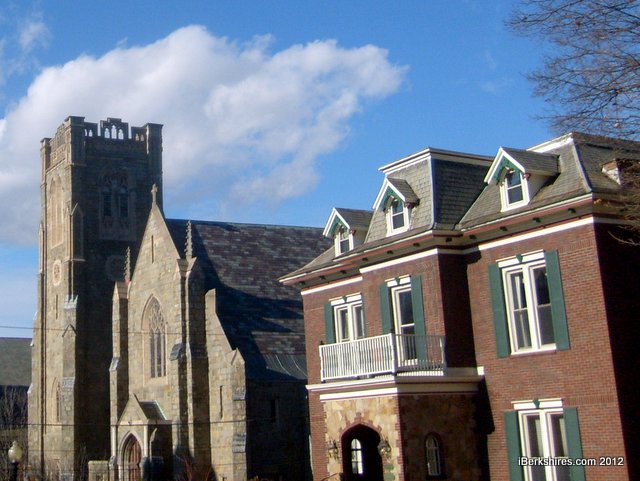 Down the block from St. Francis, the Methodist church and former funeral home (more recently dentist's office) are for sale on Monument Square. |
The ordinance, which would give the Historic Commission authority to delay demolition of buildings 50 years and older for up to one year, was introduced two weeks ago to the City Council by Mayor Richard Alcombright. The committee unanimously voted to recommend the ordinance, which would fall separately after the section on building codes, to the City Council.
On Monday, the mayor reiterated his believe that swift passage of the ordinance was critical to protection of the city's downtown area. Committee member Jennifer Breen, however, strongly pressed the mayor on whether the sudden appearance of am ordinance was predicated on a possible sale of St. Francis of Assisi Church.
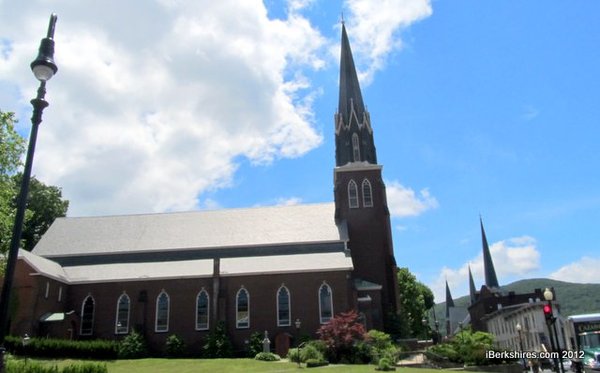
St. Francis is the oldest Catholic church in the city, built in 1863, and commands the entrance to the city along Route 2 from a perch above its busiest commercial corner. It is owned by the Roman Catholic Diocese of Springfield, which closed it as part of a widespread consolidation of parishes several years ago.
The nearly 15,000 square foot church and its connected 13,000 square foot rectory are listed online without price by Colebrook Realty Services. There have been widespread rumors for years that a national chain, possibly a drugstore, has been interested in parcels along Eagle Street.
Breen said she was in support of the goals of the ordinance but had reservations about the amount of government interference in private business and whether it was being promulgated to protect one structure.
"It's hard to know whether to support this ordinance then if I don't know what the potential is with that space," said Breen. "... My constituents have a right to know exactly why this is being pushed so quickly."
She posed it as a matter of transparency and potential for subversion of progress that could be beneficial for citizens. But Alcombright said he was not at liberty to say what was being proposed for the church property or who was involved in the discussions.
"What I can say is that what I know of could potentially bring the church down," he said. "The sale of St. Francis is imminent ... I cannot say what the terms or the any of the conditions of that are."
The potential sale of St. Francis may have prompted the ordinance, said the mayor, but there is a broader interest in protecting other downtown properties: "I'm pushing this in front of you because it's in the best interests of the city to protect historically significant buildings."
City Solicitor John DeRosa said the church property was one of nearly a dozen in the area for sale, including the Methodist church, two former funeral homes and several properties on Eagle.
Both committee member Marie Harpin and Historical Commission Chairwoman Justyna Carlson said the idea of having those buildings torn down on Monument Square was "horrifying."
DeRosa said the Partnership for North Adams, of which he is a principal, had taken out options on those properties at one time in hopes of securing developers for reuse and redevelopment. Both the mayor and local developer David Moresi, who has property abutting St. Francis, seemed confident that a developer would be found to repurpose the church rather than demolish it. DeRosa, however, also raised the spectre of possible changes to significant Main Street buildings.
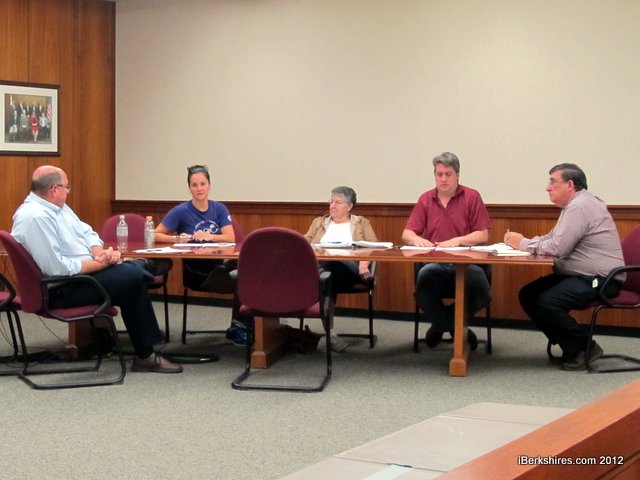 The General Government Committee was in agreement that an ordinance was necessary but member Jennifer Breen was concerned the object was to save one structure. |
Alcombright asked if the two weeks stated in the ordinance was enough time for the Historical Commission to review a demolition permit.
"Two weeks should be enough," said Carlson. "To extend it a full month and then make the declaration and tack on a year after that, people might think that was excessive."
She thought the ordinance was workable and less "anti-business" in feeling than some more rigorous bylaws.
A review by the Historical Commission would be triggered by the application of a demolition permit for a building at least 50 years old through the building inspector's office. The commission would review the permit and hold public hearings to see if demolition was warranted. It would have the authority to delay action for up to 12 months with the goal of encouraging repurposing the property. Once the delay was up, the commission would have no further ability to stop the process.
At the council meeting, Moresi and Eric Rudd spoke in favor of the ordinance. Both have salvaged a number of aged homes and buildings. In a letter to the mayor, Susan Denault, a local historical research consultant who has worked with the city of Pittsfield, strongly recommended the ordinance, noting that "once the historic structure is demolished, the architectural footprint and its unique characteristics are gone forever."
Breen, however, continued to be concerned about the condition of St. Francis, particularly its steeple as a city liability. "I don't want it to just sit there forever. It looks really bad right now," she said. "... I don't want to deter something that could be potentially less than an eyesore."
"I would want to see that church stand there probably as long as it could possibly stand there," said Alcombright. "I would have it sit there until the city could be confident nothing else can be done."
Tags: church reuse, demolition, general government committee, historic preservation, historical commission,