Historic Lenox lights named 'endangered'
By Kate AbbottPrint Story | Email Story
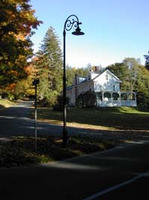
Historic Westinghouse light at the corner of Cliffwood and Greenwood St. ( Photo by David Meyer )
LENOX — With a little work, the town could light up in the style of the Roaring Twenties. Marcia Brown, Director of Ventfort Hall, has opened a campaign to preserve a dwindling set of historic streetlights and to replace the standard modern ones throughout the downtown. On Nov.6, Brown accepted an award for the lights, on behalf of the town, at Fenway Park. The award came from Preservation Mass., a nonprofit organization dedicated to preserving the commonwealth’s historic and cultural resources, which nominated the town’s Westinghouse streetlights to their 2003 list of top ten endangered historic resources in the state of Massachusetts, she said. The streetlights came from one of Lenox’s brightest cottagers, Brown explained. George Westinghouse made a name for himself as an inventor at the turn of the last century. He made major advances in fuel and natural gas, locomotive brakes and telephone switching systems among others, and he provided the electricity that lit the “white city” at the 1893 World’s Fair in Chicago. When William Stanley demonstrated the first alternating current lighting system in Great Barrington in 1886, he was in Westinghouse’s employ, Brown said. Westinghouse promptly sent the new current through his cottage, and Erskine Park became the first private residence in the country lighted exclusively by alternating current. Westinghouse built his own power station on the shores of Laurel Lake, and sold energy to the Lenox Electric Company to run the streetlights. On Dec. 31, 1913, George Westinghouse put up 105 electric lights around the town at his own expense. By 1916, the town had 149 Westinghouse lights — today it has 10, and only two have enough of their original components to shine, if a current ran through them, Brown said. Some have simply fallen down for lack of repairs, and some have been pushed — at least three have fallen victim to recent traffic accidents, she said. The Lenox Club lost the one that lit its driveway, but Cliffwood Street and Kemble Street have a few, and the Talbot’s on Walker Street shields another. Brown also acts as a consultant to the Lenox Historical Commission and has served on the commission for 27 years. She has advocated for Lenox’s streetlights for at least five years. “Every time a light goes down, I go and pick up the pieces,” she said. She has preserved a large collection of cast-iron scrolls, flanges (bowl-shaped lampshades) and other pieces. She and the historical commission also had Trimble House Traditional Lighting of Hartford, Conn. do a lighting study for the downtown and design new custom light poles to resemble the original Westinghouse lights as closely as possible. They hope to see historic lighting throughout the downtown, over time, she said. It may cost upwards of $3,000 to buy a custom-built lamppost, she said. Westinghouse installed the whole crew of them for $3,675 in 1913 currency, but after all, the town got the first 150 free. She will go before the Lenox Select Board, at its Nov. 19 meeting to discuss the lighting study and ask them to at least consider turning on the two lights that still work. The town might have to replace the wiring on these lights, since the original wiring is 90 years old. The lights all have underground wiring buried in concrete cases beneath them, she said. That wiring in fact runs under the grassy strips along the Lenox sidewalks. Though they have expressed concern about the cost of historic lighting and pointed out that Mass Electric currently supplies light poles free to the town, the selectmen have expressed some interest in Brown’s efforts. Residents and tourists have asked to see old- fashioned lampposts or light poles in the historic downtown, as many neighboring towns also have. The select board has also suggested setting up an exhibit on the lighting at town hall, Brown said.
If you would like to contribute information on this article, contact us at info@iberkshires.com.

Friends of Great Barrington Libraries Holiday Book Sale

GREAT BARRINGTON, Mass. — The Friends of Great Barrington Libraries invite the community to shop their annual Holiday Good-as-New Book Sale, happening now through the end of the year at the Mason Library, 231 Main Street. 
 
With hundreds of curated gently used books to choose from—fiction, nonfiction, children's favorites, gift-quality selections, cookbooks, and more—it's the perfect local stop for holiday gifting.
 
This year's sale is an addition to the Southern Berkshire Chamber of Commerce's Holiday Stroll on this Saturday, Dec. 13, 3–8 PM. Visitors can swing by the Mason Library for early parking, browse the sale until 3:00 PM, then meet Pete the Cat on the front lawn before heading downtown for the Stroll's shopping, music, and festive eats.
 
Can't make the Holiday Stroll? The book sale is open during regular Mason Library hours throughout December.
 
Proceeds support free library programming and events for all ages.
View Full Story

More Stories