Don’t crush that salamander
By Linda CarmanPrint Story | Email Story
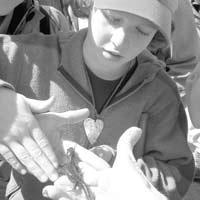
Helen Overstreet, 9, of Williamstown, holds a Jefferson's salamander, gray with blue sides and considered endangered. (Photo By Linda Carman)
WILLIAMSTOWN — Small, cool, damp and wriggly, salamanders are on the move in woods and waters, as much a sign of spring as crocuses blooming in yards throughout the region. About 60 people, including many children with their parents, turned out Saturday to tromp through Williams College’s Hopkins Forest with naturalist and herpetologist Thomas F. Tyning, on a quest to find the variously spotted or striped creatures under fallen logs or in brooks. This quest was successful: Those who clambered steeply downhill to Ford Glen Brook found at least 20 dusky salamanders, at least 10 two-lined – some in larval stage – primarily in and around the stream, and three red-backed salamanders, on land. Cries of “I’ve got something,” “I think I found one” or “What’s this?” announced each discovery. And each find brought a hearty exclamation of “excellent,” and “totally cool” from Tyning. “We’ve got to be careful not to squish things,” he warned the searchers. “Every log, stone or rock has the potential to have a salamander under it.” Holding up one find, he told the finder, “That’s another dusky salamander. You see, it’s hind legs are much larger than its front legs, and it has a white eye stripe.” “Excellent,” he exulted again, as another small creature was extracted from underneath a fallen log. “This is a red-backed salamander, and it is a boy. His upper lip has a pointy edge.” Tyning, formerly with the Massachusetts Audubon Society, is the author of “Amphibians & Reptiles” in the Stokes Nature Guide series. He teaches at Berkshire Community College and was instrumental in the construction of a tunnel in Amherst under a highway for migrating salamanders. “A lot of people are making decisions on what to bulldoze for Wal-Mart parking lots,” he said, noting that often the breeding grounds of amphibians fall before the earth-movers. “Amphibians,” he said, “are no more or less important than any other species. Losing them would make the ecosystem less healthy. You save ‘em because they’re totally cool.” In his illustrated talk before the treks, Tyning described the types of frogs now starting their breeding season. “Wood frogs overwinter in leaf litter,” he said. “Ten days ago, they started migrating down to ponds.” He stressed the crucial role of vernal pools as breeding grounds for wood frogs and salamanders. These pools, he said, have no inlets, no outlets, dry up in summer and – most importantly – have no fish to gobble up the young tadpoles. On land off Northwest Hill Road near Hopkins Forest, Tyning pointed out “at least 75 masses of wood-frog eggs” in a large vernal pool surrounded by fallen birch logs. He also pointed out evidence of the spotted salamander in the pond: a white spermatophore and a spotted salamander egg mass. Fetched by an intrepid youngster, the egg mass caused Tyning to exclaim with delight. “I can’t believe how much these have already developed,” he said. “The embryos are almost comma-shaped.” The egg mass — as well as all the critters encountered, were returned unharmed to the places where they were discovered. It was strictly a catch-and-release experience. A second vernal pool near the first contained “about 500 wood-frog egg masses” and a red spotted newt. The newt is generally more associated with a permanent pond, as it is more aquatic than most other salamanders. Its presence, Tyning said, could mean that pool is more permanent than strictly vernal. Some in the group said they feared for these pools, if, as they believe, the property adjacent to Hopkins Forest is being sold. State law protects vernal pools that are certified. One of the walkers Saturday was Douglas E. Gill, visiting professor of biology at Williams College from the University of Maryland. Gill, over the course of 12 years, studied red-spotted salamanders in George Washington National Forest in western Virginia, driving four hours each way, twice a week. “No two have the same pattern of spots,” he said. The younger stage of these salamanders is familiar to many as the red eft, a tiny creature that glows flourescent orange on the forest floor. The event was co-sponsored by the Hoosic River Watershed Association, Williamstown Rural Lands Foundation and Williams College’s Center for Environmental Studies, with the Massachusetts Environmental Trust. Andrew T. Jones, manager of Hopkins Memorial Forest, said he was very pleased with Saturday’s turnout. “I think people are very curious, and from my perspective that’s a good thing. The more we know, the more good decisions we can make.”
If you would like to contribute information on this article, contact us at info@iberkshires.com.

Friends of Great Barrington Libraries Holiday Book Sale

GREAT BARRINGTON, Mass. — The Friends of Great Barrington Libraries invite the community to shop their annual Holiday Good-as-New Book Sale, happening now through the end of the year at the Mason Library, 231 Main Street. 
 
With hundreds of curated gently used books to choose from—fiction, nonfiction, children's favorites, gift-quality selections, cookbooks, and more—it's the perfect local stop for holiday gifting.
 
This year's sale is an addition to the Southern Berkshire Chamber of Commerce's Holiday Stroll on this Saturday, Dec. 13, 3–8 PM. Visitors can swing by the Mason Library for early parking, browse the sale until 3:00 PM, then meet Pete the Cat on the front lawn before heading downtown for the Stroll's shopping, music, and festive eats.
 
Can't make the Holiday Stroll? The book sale is open during regular Mason Library hours throughout December.
 
Proceeds support free library programming and events for all ages.
View Full Story

More Stories