Discovering Rockwell, through his models
By Jeanne FederPrint Story | Email Story
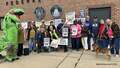
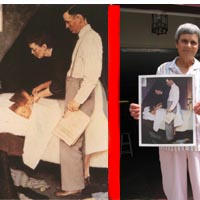
Left, Marjorie Coulter and her brother David, as they appeared with their parents in the 1943 Norman Rockwell painting “Freedom from Fear.” Right, Marjorie Coulter on the steps of the Arlington (“Vt.) Gallery during an open house on Sunday.
ARLINGTON, Vt. — What was Norman Rockwell really like? That was the question most asked of six models who had posed for the famous artist during the 14 years he lived in Arlington, at an open house at Arlington Gallery’s Norman Rockwell exhibition on Sunday. The models, who had been among more than 200 friends and neighbors whom Rockwell painted from 1939 to 1952, reminisced with visitors about Rockwell and autographed prints of the paintings for which they posed as youngsters. They posed for photographs and answered questions about Rockwell, his life in Arlington and their personal experiences. All but one grew up in Arlington or Cambridge, N.Y., and still live there today. Marjorie Coulter posed with her brother, David, as children being tucked into bed in the famous 1943 painting “Freedom from Fear.” (That’s young Marjorie’s favorite doll on the floor in the painting.) Coulter recalled her mother’s efforts to help the children keep their eyes closed and bodies still during the daytime session. So what was the famous artist like? “Rockwell was thoughtful,” Coulter said. “I remember he used to lend us his children’s bicycles. My mother and father also modeled for the “Freedom of Worship” painting, one of the famous ‘Four Freedoms’ paintings, which included, ‘Freedom of Speech,’ ‘Freedom from Want’ and ‘Freedom from Fear.’ All four became “Buy War Bonds” posters during World War II. The iconic graphics helped raise $134 million for the war effort. Robert Buck, widely accepted as the best known of Rockwell’s models, was 16 years old when he posed for the 11 “Willie Gillis” Saturday Evening Post Covers, which portrayed the average soldier during World War II. He happily pointed to himself as the leading figure in “Package from Home” and “Willie Gillis at College.” Buck remembered, “Rockwell was very down-to-earth. He used to take tickets at the local square dances, and he chose me right on the dance floor at one of those dances. He was quite a dancer and really enjoyed himself.” Models Pauline Adams Grimes and her brother Paul Adams were living in a little house on Cobble Road in Cambridge, N.Y., when they met Rockwell through Grandma Moses. “As children, we used to sing for Grandma Moses, who was friends with Norman,” Grimes said. “When he needed two African-American children to model for the ‘Golden Rule’ sketch, she introduced us. When we modeled for Rockwell, he chilled bottles of Coca-Cola in the snow-bank outside of his studio as a treat for us, and he also paid us $5 each for modeling.” Adams added, “My mother dressed me in my Sunday best clothes and, as soon as Rockwell saw me, he had me take off my shirt to portray me as a bare-chested African boy.” The siblings pointed out their mother as one of the figures in the sketch, which became, “The Golden Rule” one of the painter’s most famous works. Karl Hess Jr. proudly pointed out his father as the prominent figure in a leather bomber jacket in, “Freedom of Speech.” Shortly following his portrayal, Hess’ dad participated on radio shows for the war bond drive. In his autobiography, Rockwell (1894-1978) wrote, “Moving to Arlington had given my work a terrific boost. I’d met one or two hundred people I wanted to paint ... right here are exactly the models needed for my purpose — the sincere, honest, homespun types that I love to paint.” While the foremost daily attraction to the Arlington Gallery’s Norman Rockwell Exhibition is meeting a model, other aspects of interest include hundreds of examples of Rockwell’s printed works, including Saturday Evening Post and Boy’s Life covers, illustrations and advertisements and Boy Scout material. A continuously-shown 15-minute film (with a score by Arlo Guthrie) details the span of Rockwell’s life and his three hometowns of New Rochelle, N.Y., Arlington and Stockbridge — home of Berkshire County’s Norman Rockwell Museum. The film features interviews with models and Rockwell. Joy Hinrichsen, owner of the gallery and a painter in her own right, pointed out that all the models present during the open house volunteer on a regular basis to make Rockwell more accessible to the public, which was his goal. “He felt that art was created for the public and should be accessible to everyone,” Hinrichsen said. “He often gave models paintings as gifts and sold them for $1 to his neighbors.” Hinrichsen has run the gallery for 18 years and said she would soon be selling it to focus on her own artwork. She said she hopes the exhibit will continue to celebrate Rockwell’s contribution to Arlington and to the nation, and that those who gave their time as young models will go on to share their stories with future visitors. The exhibit is open every day from 9 to 5 and is on historic Route 7A between Bennington and Manchester in Arlington. And the models don’t get tired of answering what Rockwell was really like.
If you would like to contribute information on this article, contact us at info@iberkshires.com.

Stockbridge Grange Community Dinner

STOCKBRIDGE, Mass. — The Stockbridge Grange is holding a community dinner on Sunday, Feb. 8, 2026, featuring spaghetti and meatballs, salad, and bread with dessert choices of chocolate cream or lemon meringue pie.
 
Dinner is $17.00 per person, take out only with 12-1:30 pm pick up at the Stockbridge Grange Hall at 51 Church Street, Stockbridge.  Orders may be made by calling 413-243-1298 or 413-443-4352. 
 
Inclement weather postpones the meal for a week.
View Full Story

More Stories