Young At Heart: A Legacy Of Music
 |
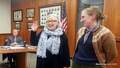
| City Music Director and Drury High School Instrumental Director Carl Jenkins, Roger W. LaRocca Jr., the elementary school instrumental and band director, attorney Bruce Grinnell, and North Adams Public Schools Superintendent James Montepare |
Former city school music instructor Pauline "Polly" Young died on Dec. 11 at the age of 92. At her behest, the city has been awarded $200,000 in funds to be managed and administered by the Berkshire Taconic Community Foundation and used exclusively to benefit the city's public school grade k-12 music program.
Announcement of the gift was made on Jan. 31 by attorney Bruce Grinnell at the office of city Mayor John Barrett III.
"Fiercely Passionate About Music"
The funds may not be used as part of the school's standard budget, said Grinnell and Barrett. Teachers, students, and citizens will be able to submit grant proposals and the first round of funding is expected to award an unspecified number of grants in amounts between $200 and $2,000. The school's Gateway Fund will oversee grant applications.
"She was a committed, honorable, ethical, human being," Grinnell said of Young. "She was fiercely independent and passionate about music."
Years Of Music
Young lived for many years at the Franklin Court apartments. She resided in the North Adams Commons long-term care facility at the time of her death. She was a Nashua, New Hampshire native and earned a master's degree in music education at Boston University in 1951.
She was a member of the New England Conservatory Orchestra and the City Symphony of Syracuse, N.Y. during her young adult years and pursued graduate studies at in music at teachers College, Columbia University, Boston University, Ithaca College and the New England Conservatory of Music.
Young taught vocal and instrumental music to pupils enrolled in public schools in Martha's Vineyard and Bristol, Conn., and first taught at the city's public schools from 1951 to 1960. Young then traveled to Nuremberg, Germany and taught at the U.S. Army's American Elementary Dependent School.
Young returned to the city during 1962 and resumed teaching music at the city's public schools. She retired in 1984 after a total of 31 years teaching city students.
"They Weren't Gonna Sing"
During her teaching career, Young encountered Barrett, Roger W. LaRocca Jr., who is the elementary school instrumental instructor, and city Director of Music and Drury High School Instrumental Director Carl Jenkins. Barrett, who was a former Johnson School teacher prior to his election as mayor, Jenkins and LaRocca met Young at Johnson School, he said.
"She was one of the sweetest, nicest people you'd ever want to meet," Barrett said. "She probably taught in our school system during our most difficult days, and music at the elementary was always one of the first things cut."
Young's love of music was shared with her students and likely benefited many of the young people she encountered, Barrett said.
"She disarmed some of the toughest kids in this city," he said. "They weren't gonna sing, and then, she had them singing. No one ever spoke an unkind word of her."
Barrett said he believes one of Young's dreams was a city-wide chorus.
"I'm hoping that can come to fruition," he said.
His own life was enriched by his friendship with Young, said Grinnell.
God Bless America
He shared anecdotes of an intelligent, capable woman who maintained her independence as long as was possible, and then decided on her own to give up driving and move to the care facility.
Young wrote her own obituary, Grinnell said.
"No one else was going to tell her story," he said.
As a person who prided herself on punctuality and expected others to be punctual as well, Young had a unique manner of niggling care facility staff when meals were served later than the appointed time, Grinnell said.
"She would stand out in the hall and, at the top of her lungs, sing 'God Bless America,'" he said.
And during Young's last hours, as a nursing assistant brought Young, who was in a wheelchair, to a television area, the question was asked if Young remembered what she used to do in that room.
Grinnell said that Young did indeed remember and stood up, and belted out "God Bless America."
Several hours later, she died, he said.
"She was sharp as a tack to the end," he said.
Jenkins recalled his first impressions of Young.
A Sweet Lady
"She was such a sweet lady," Jenkins said. "I remember thinking 'these kids are going to run her ragged,' but she outlasted everybody."
Jenkins noted that Drury High School presents a Polly Young Music Award on a yearly basis.
After her retirement, Young attended school concerts and if poor weather was predicted, she contacted LaRocca to secure transportation, he said.
"She received door to door service," LaRocca said.
City schools Superintendent James Montepare termed the gift "wonderful for North Adams."
"It really is a testament to her," he said. "This will keep on giving for a long, long time."