New Report: Extreme Downpours and Snowstorms Up 61 Percent in Massachusetts

Print Story | Email Story
BOSTON - Scientists have said for years that global warming was "loading the dice" when it comes to increasing the frequency of severe storms, and a new Environment Massachusetts report makes it clear that the New England region is already experiencing extreme downpours and heavy snowstorms much more frequently. Specifically, the new report found that storms with heavy rain- or snowfall are now 61 percent more frequent in the New England region than they were 60 years ago. "At the rate we're going, what was once the storm of the decade will soon seem like just another downpour," said Winston Vaughan, a field organizer for Environment Massachusetts. Vaughan cited the Peabody floods in May 2006 as an illustration of what more extreme storms could mean for the region. That storm, which dumped more than 8 inches of rain on the area, led to millions of dollars in damage to infrastructure and property. "More frequent downpours, fueled by global warming, will leave Massachusetts even more vulnerable to dangerous flooding in years to come," said Vaughan. The new Environment Massachusetts report, titled "When it Rains, It Pours: Global Warming and the Rising Frequency of Extreme Precipitation in the United States," examines trends in the frequency of large rain and snow events across the continental United States from 1948 to 2006. Using data from 3,000 weather stations and a methodology originally developed by scientists at the National Climatic Data Center and the Illinois State Water Survey, the report identifies storms with the greatest 24-hour precipitation totals at each weather station and analyzes when those storms occurred. Nationally, the report shows that storms with extreme precipitation have increased in frequency by 24 percent across the continental United States since 1948. At the state level, 40 states show a significant trend toward more frequent storms with extreme precipitation, while only one state (Oregon) shows a significant decline. Key findings for the New England region and Massachusetts include: - Storms with extreme precipitation increased in frequency by 61 percent in New England from 1948 to 2006. New England ranks first nationwide for the largest increase in the frequency of storms with heavy precipitation. - Massachusetts experienced a 67 percent increase in extreme rain- and snowstorms during the period studied In addition, Springfield shows a significant increase in the frequency of large storms with heavy precipitation, roughly estimated to be a 56 percent increase over the nearly 60-year period. These findings are consistent with the predicted impacts of global warming. Scientists expect some parts of the United States to receive more precipitation as a result of global warming, while other parts receive less. But regardless of the trend in total precipitation, scientists predict that the rain and snow that does fall will be more likely to come in big downpours and heavy snowstorms. Environment Massachusetts was joined by Sen. Stan Rosenberg, D-Amherst, and student activists at a press event to release today's report. "People on all sides of an issue can argue all day long about cause and effect," Sen. Rosenberg said. "But what should not be in dispute is the fact that we need to start taking better care of the planet, and we need to start taking dramatic action to address global warming now." "Global warming is the greatest challenge of our generation," said Caroline Henderson, a Smith College freshman and MASSPIRG student volunteer. "Students are taking steps on their campuses to meet this challenge but we need out leaders on Beacon Hill and in Washington DC to act too. We applaud Sen. Rosenberg's strong words today and hope he will inspire other state leaders to act quickly." Vaughan was careful to note that an increase in the frequency of extreme rainstorms does not mean more water will be available. Scientists expect that, as global warming intensifies, longer periods of relative dryness will mark the periods between extreme rainstorms, increasing the risk of drought. For example, the Intergovernmental Panel on Climate Change (IPCC) predicts that, under a scenario of intense warming, the percent of land enduring severe drought globally could be 30 times greater by the end of the century than it is today. "How serious this problem gets is largely within our control – but only if Massachusetts and the rest of the country act boldly to reduce the pollution that fuels global warming," said Vaughan. According to the most recent science, the United States must reduce its total global warming emissions by at least 20 percent by 2020 and by at least 80 percent by 2050 in order to prevent the worst effects of global warming. "Steep reductions in global warming pollution are challenging but achievable and we already have the energy efficiency and renewable energy technologies we need to get started," said Vaughan. He added "We applaud Sen. Rosenberg for his support of strong action on the state level to reduce global warming pollution. Bold state actions will be necessary to achieve the emissions reductions scientists say we need to avoid the worst effects of global warming." Environment Massachusetts is a statewide, citizen-based environmental advocacy organization. Our professional staff combines independent research, practical ideas and tough-minded advocacy to overcome the opposition of powerful special interests and win real results for Massachusetts' environment. Environment Massachusetts draws on 30 years of success in tackling our state's top environmental problems. THE FULL REPORT CAN BE DOWNLOADED AT: http://environmentmassachusetts.org/reports/global-warming-solutions/global-warming-solutions-reports/when-it-rains-it-pours
If you would like to contribute information on this article, contact us at info@iberkshires.com.

Kennedy Calls BCC Workforce Graduates Inspiring

By Breanna SteeleiBerkshires Staff
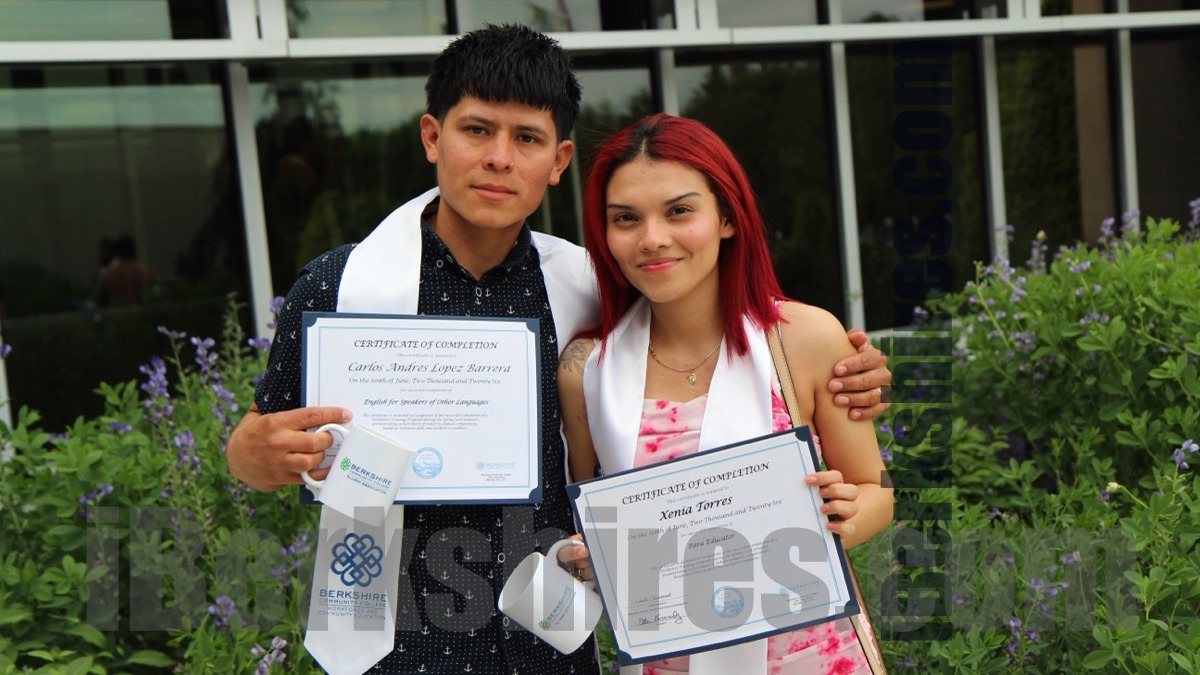
The programs ranged from emergency medical technician to computers to commercial drivers. See more photos here. 
PITTSFIELD, Mass. — Berkshire Community College Workforce and Community Education graduates were encouraged to be all they can be on Wednesday.
 
Graduates, families, friends, and staff gathered in Boland Theatre to celebrate around 100 graduates who completed a variety of courses.
 
They included community health worker, emergency medical technician, phlebotomy technician, registered behavior technician, AI fundamentals, Commercial Drivers License Class A and B, CompTIA Tech-plus, para educator, and English for Speakers of Other Languages.
 
College President Ellen Kennedy said it was amazing that this might be her last public speaking event before her tenure comes to an end.
 
She acknowledged the diverse reasons for their studies including career advancement and personal growth, commending their vulnerability and dedication. 
 
"Some of you explored AI, some of you improved your English speaking in really important ways, and the reason that each of you is here is because you decided to put your heart and soul to get vulnerable to do something that might have felt a little bit uncomfortable," she said. "And you did it, and we are so incredibly proud of you, and so happy to be here tonight, celebrating you."
 
Keynote speaker Shirley Edgerton, founder of Rites of Passage and Empowerment (ROPE) encouraged the graduates to reflect on their accomplishments and look forward to the future.

 
View Full Story

More Regional Stories