Williamstown Board Splits on Voting Hours, Blair Lot
 |
The issue of election hours provoked the most discussion in the review of the warrant at Monday night's Selectmen's meeting.
Town Clerk Mary Kennedy had requested that polling hours be set from 11 a.m. to 7 p.m. on Tuesday, May 12, rather than the normal 7 a.m. to 8 p.m. The cost to run an election was estimated at about $111 an hour, meaning the town could save $555 by shortening election hours.
Selectmen David Rempell and Thomas Costley, however, questioned the impression the town would be sending about voting and how it would affect voters. Selectman Richard Steege was concerned about disrupting voting patterns, believing if someone usually voted before going to work, and couldn't this time, they might not bother the next time.
"The reality of the situation is that it will make it more difficult for people to vote," said Rempell, who indicated he would vote yes if the consequences were understood. "I think we are making a statement that it isn't as important to vote."
Every office on the ballot has one candidate; there are no ballot questions. Town Manager Peter Fohlin said the town had had shortened hours in the 1990s, starting at about 10 or 11 in the morning.
"I hate to think we're doing this because we don't want people to vote," said Chairwoman Jane Allen, who added that if there were races on the ballot, the board would not want to do anything to affect turnout, and therefore, any contests.
"I'm not persuaded that $500 is worth saving," said Costley in voting no. "I think it's a message that we send on the importance of our democracy."
Costley was joined by Steege; Allen and Rempell voted in the affirmative. With Selectman Ronald Turbin absent. the vote was deadlocked. The motion was made to restore the original hours of 7 a.m. to 8 p.m., which was passed unanimously.
The rest of the review of the 34-article warrant went fairly smoothly since many of the issues had been previously discussed.
Pam Malumphy, regional director of the state Office of Business Development in Pittsfield, appeared before the board to discuss aspects of Article 31, which if approved would designate the town's various business districts as economic opportunity areas.
Establishing economic opportunity areas would open up incentives such as 10 percent in tax credits for businesses taking over abandoned buildings and 5 percent investment tax credits. "That automatic tax credit is really a wonderful carrot, said Malumphy.
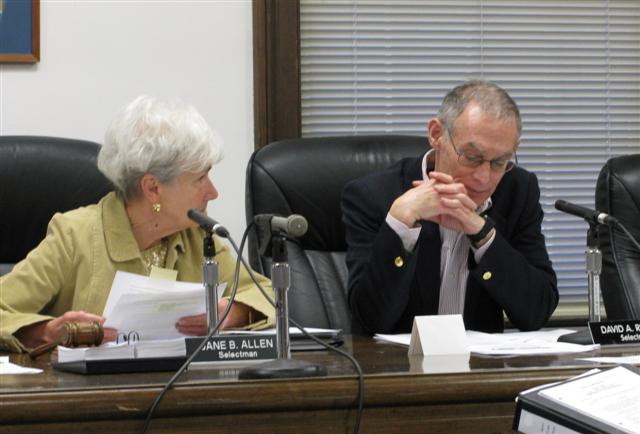 Selectmen Chairwoman Jane Allen confers with Selectman David Rempell. |
Fohlin said the town has several parcels that were designated EOAs — the 1896 House, the former Grand Union property and the Wild Oats Marketplace property. The idea of creating larger EOAs had arisen during talks between himself, Malumphy and Ariel Sutain about the defunct Taconic Restaurant, which Sutain owns.
"It dawned on me that there are other parcels along Route 7 that would benefit," said Fohlin. It would be easier to make all business districts — limited, planned, tourist and village — economic opportunity areas rather than doing each one separately as they came up. Rather, he said, the town could decide incremental tax packages on a case-by-case basis.
"It is very, very widely used," said Malumphy to the board. "Go for it."
The board voted to recommend that article, as did the Finance Committee, and all other articles without opposition with the exception of Article 28, which if approved would make the so-called Blair Lot surplus municipal property and give the Selectmen authority to sell it to the state Fish and Wildlife Department if they deem the price is right.
The possible sale has been discussed at length at both Selectmen and Finance Committee meetings; the Finance Committee has decided to make its recommendation at town meeting. Costley, pointing to that board's hesitance, said he would vote against recommending the article if only to reinforce that town officials sitll had a lot of questions about selling the property.
"It still seems like this is rushed to me," said Costley, who's hoping it will prompt discussion at town meeting. "I'm not convinced a sale is the right way to go."
The article was recommended 3-1, with Costley voting no.
Also in the warrant:
■ Transfer of $114,267 in state circuit breaker funds back to the elementary school.
■ Various sums to raise and appropriate, including $6,126,738 for the general budget (up 1.6 percent); $940,596 for the capital improvement program; $5,261,543 for the elementary school; $254,933 for McCann Technical School (down 8.4 percent) and $4,413,109 for the Mount Greylock Regional School District (up 1.9 percent).
■ Voters will decide whether to transfer land on Church Street to the School Committee for possible development as a youth center (Rempell, director of the Youth Center, abstained); to pay up to $15,000 for funeral costs for police and firefighters killed in the line of duty; to expand the board of library trustees from five to seven and to add three associate members to the Zoning Board of Appeals; to pass a series of zoning articles creating a downtown business district; and expand Community Preservation Funds for affordable housing in the former St. Raphael's Church ($400,000) for preservation purposes in the Cable Mills project ($167,539), and $892,000 to replace the town's Well No. 1.
Town meeting is scheduled for Tuesday, May 19, at 7 p.m. at Williamstown Elementary School to decide Articles 2 through 34. Article 1, election of officers, will voted on Tuesday, May 12, from 7 a.m. to 8 p.m. also at the elementary school.